


























Views
Downloads


Complete Geometric Modeling Worksheet | Grade 10 Geometry
Paste this activity's link or code into your existing LMS (Google Classroom, Canvas, Teams, Schoology, Moodle, etc.).
Students can open and work on the activity right away, with no student login required.
You'll still be able to track student progress and results from your teacher account.
This high school geometry worksheet challenges students to apply geometric modeling and optimization to physical design problems. Students solve multi-step real-world scenarios by calculating volume, surface area, and material limits for composite 3D figures, determining dimensions while evaluating trade-offs and fabrication costs.
At a Glance
- Grade: 10 · Subject: Geometry
- Standard:
HSG-MG.A.3— Apply geometric methods to solve design and optimization problems- Skill Focus: Find Dimensions Meeting Capacity and Material Limits
- Format: 4 pages · 6 problems · Answer key included · PDF
- Best For: Independent modeling practice or assessment
- Time: 45–60 minutes
What's Inside
This 4-page printable PDF features 6 rigorous geometric design tasks organized into three distinct modeling sections. Students work with cylinders, hemispheres, regular hexagonal prisms, and conical frustums. The resource includes explicit formula reference tables, realistic engineering scenarios with cost estimations, and a complete 2-page step-by-step answer key providing exact and rounded solutions.
Skill Progression
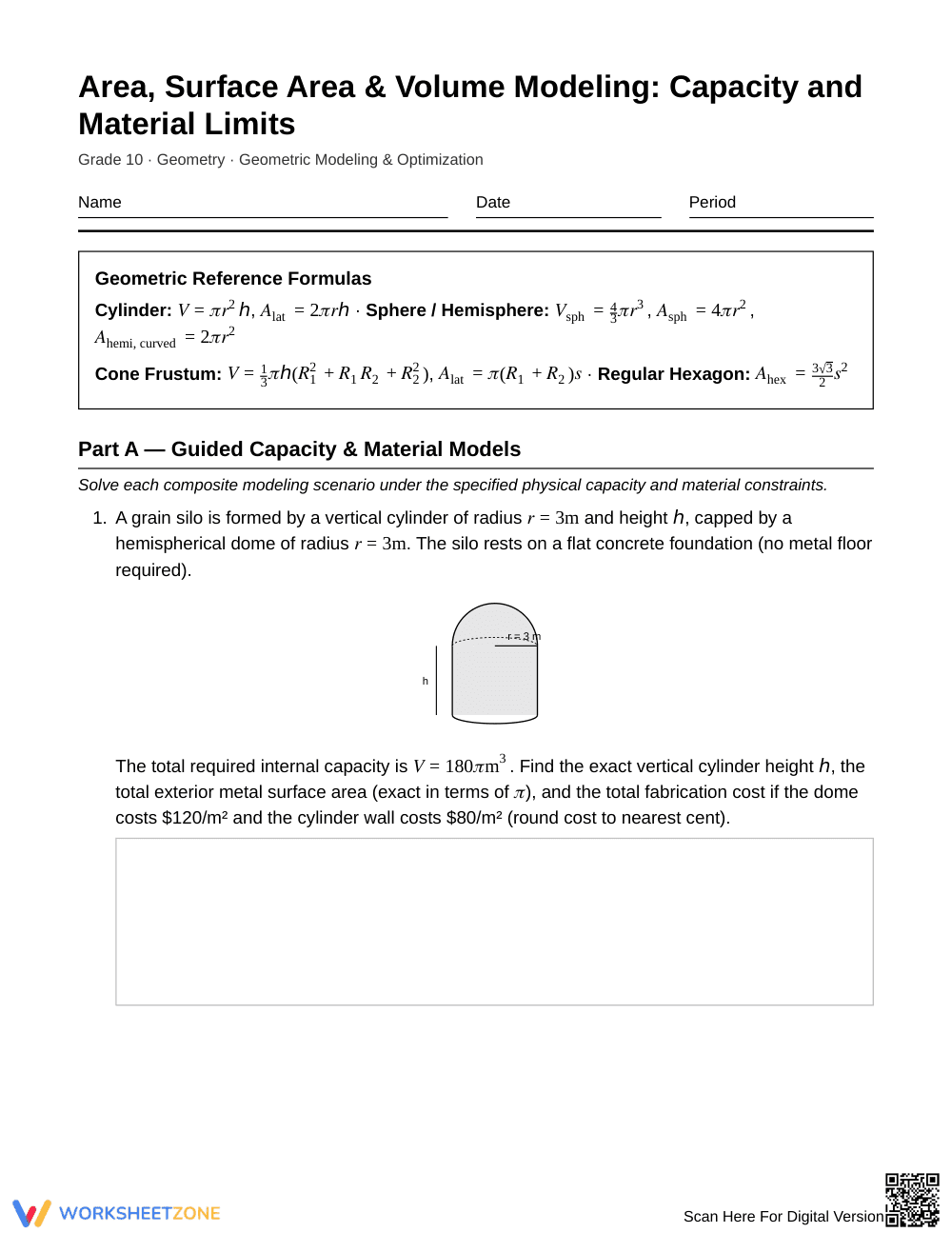
- Guided Practice (Part A): 2 structured scenarios introduce silo and sorting bin models with explicit dimension constraints and capacity thresholds.
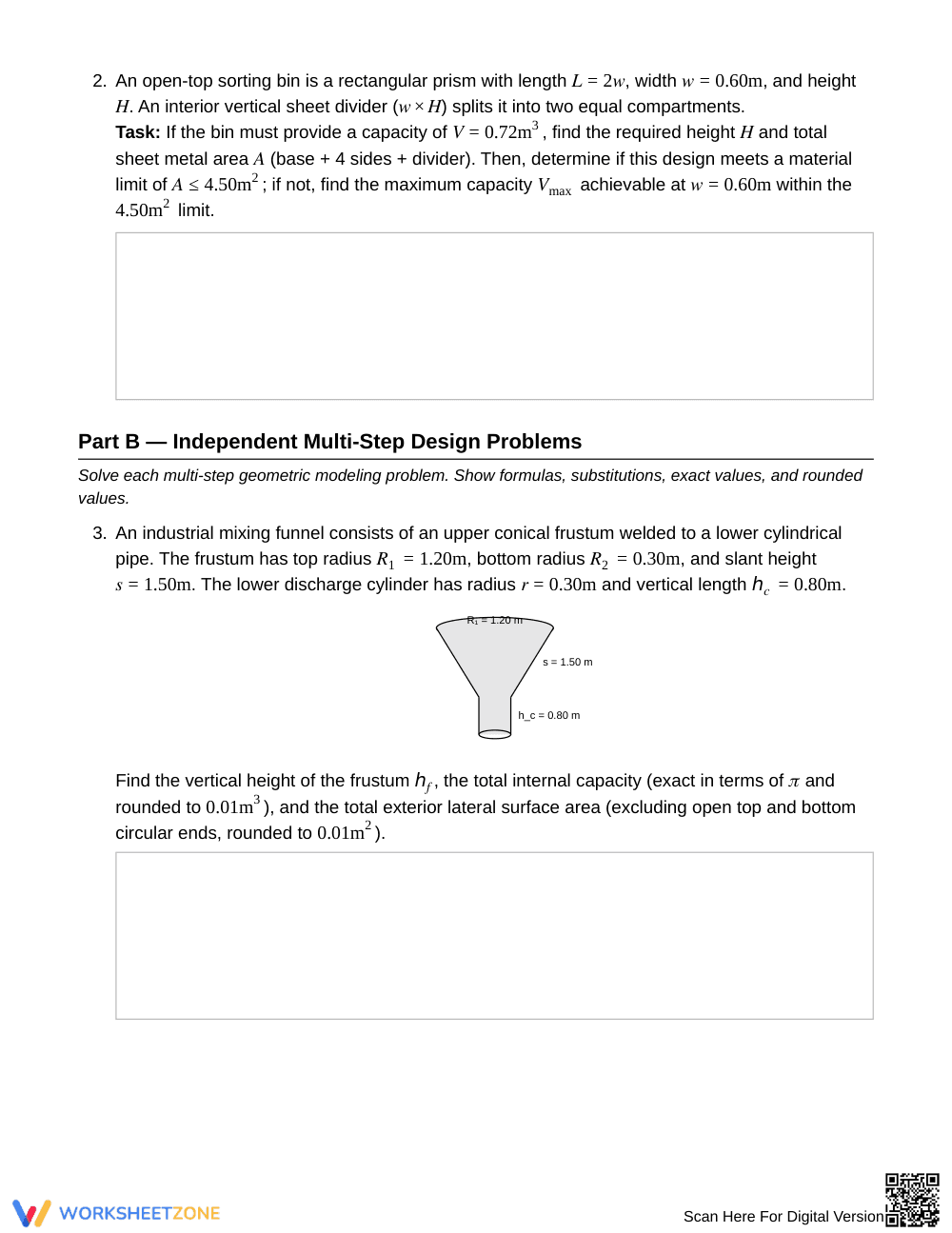
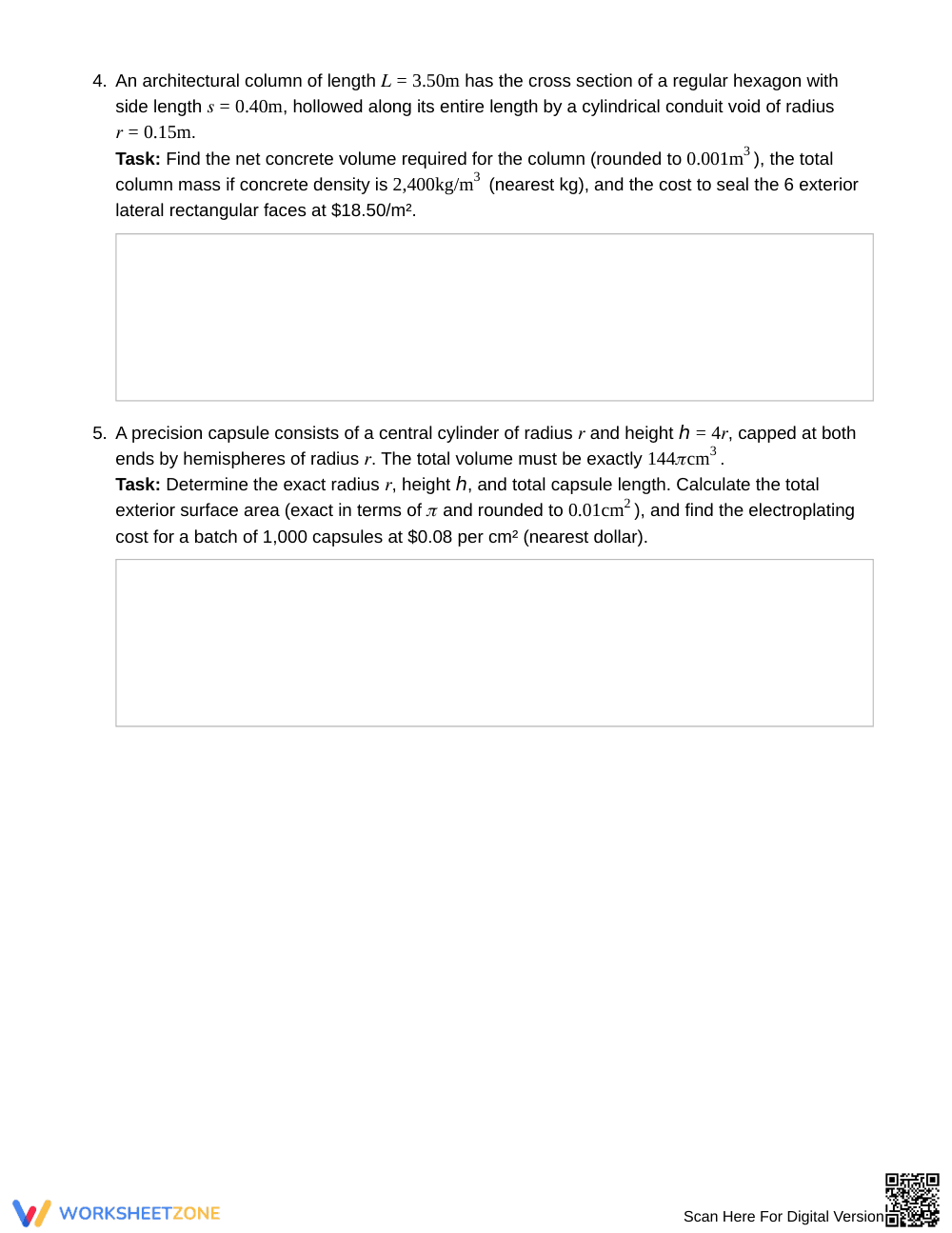
- Supported Practice (Part B): 3 multi-step design problems require students to calculate frustum funnels, hollowed hexagonal columns, and medical capsules with density and manufacturing costs.
- Independent Practice (Part C): 1 comprehensive optimization challenge where students analyze competing water tank geometries to minimize surface area and evaluate material savings.
This structured progression leverages a gradual-release framework, guiding students from foundational composite modeling toward independent optimization.
Standards Alignment
This resource aligns directly with Common Core State Standard `HSG-MG.A.3`: Apply geometric methods to solve design problems (e.g., designing an object or structure to satisfy physical constraints or minimize cost; working with typographic grid systems based on ratios). Students also reinforce supporting standard `HSG-GMD.A.3` through volume calculations of cylinders, cones, and composite solids. Both standard codes can be copied directly into lesson plans, IEP goals, or district curriculum mapping tools.
How to Use It
Administer this worksheet after direct instruction on composite 3D solids and optimization modeling. For collaborative problem-solving, have student pairs complete Parts A and B during class, checking intermediate volume expressions before computing costs. Formatively assess student work by checking whether learners keep exact radical and pi values during algebraic isolation before rounding final measurements. Students typically finish this 6-problem modeling set within 45 to 60 minutes.
Who It's For
This activity is designed for Grade 10 Geometry students, honors math cohorts, and integrated STEM classes tackling spatial optimization. Differentiate by providing formula cue cards or pre-isolated equations for learners requiring algebraic scaffolding. Pair this worksheet directly with a physical 3D solids lesson or an architectural modeling task to ground geometric concepts in practical fabrication.
Mastering standard HSG-MG.A.3 requires students to apply geometric methods to solve complex design problems under real-world physical capacity and material constraints. Research from Fisher & Frey (2014) demonstrates that structured gradual-release frameworks significantly enhance student problem-solving resilience and conceptual transfer when tackling multi-tiered mathematical modeling tasks. By systematically transitioning high school learners from guided composite capacity scenarios to independent surface area optimization analyses, this worksheet cultivates durable spatial reasoning and analytical precision. Students evaluate how dimensional modifications influence internal volume and lateral surface area across composite three-dimensional figures, effectively bridging abstract geometric formulas with authentic architectural and manufacturing decisions. Integrating algebraic variable isolation, material density calculations, and fabrication cost analyses ensures high schoolers build transferable mathematical modeling proficiency aligned to rigorous academic standards and engineering readiness expectations. Such structured practice equips students to evaluate constraints methodically and communicate mathematical justifications with clarity.


