































Complete Genetics Models Worksheet | Grades 8-12 Science

Paste this activity's link or code into your existing LMS (Google Classroom, Canvas, Teams, Schoology, Moodle, etc.).
Students can open and work on the activity right away, with no student login required.
You'll still be able to track student progress and results from your teacher account.
This 4-page science worksheet guides students through constructing, evaluating, and refining genetic inheritance models. Middle and high school biology students analyze monohybrid crosses, pinpoint modeling errors, solve 16-box dihybrid squares, interpret human pedigrees, and evaluate empirical F2 generation data to disprove blending inheritance across 39 targeted tasks.
At a Glance
- Grade: Grades 8–12 · Subject: Science
- Standard: Develop and use models to predict patterns of inheritance
- Skill Focus: Mendelian Genetics model building
- Format: 4 pages · 39 problems · Answer key included · PDF
- Best For: Genetics modeling practice and revision
- Time: 45–60 minutes
What's Inside
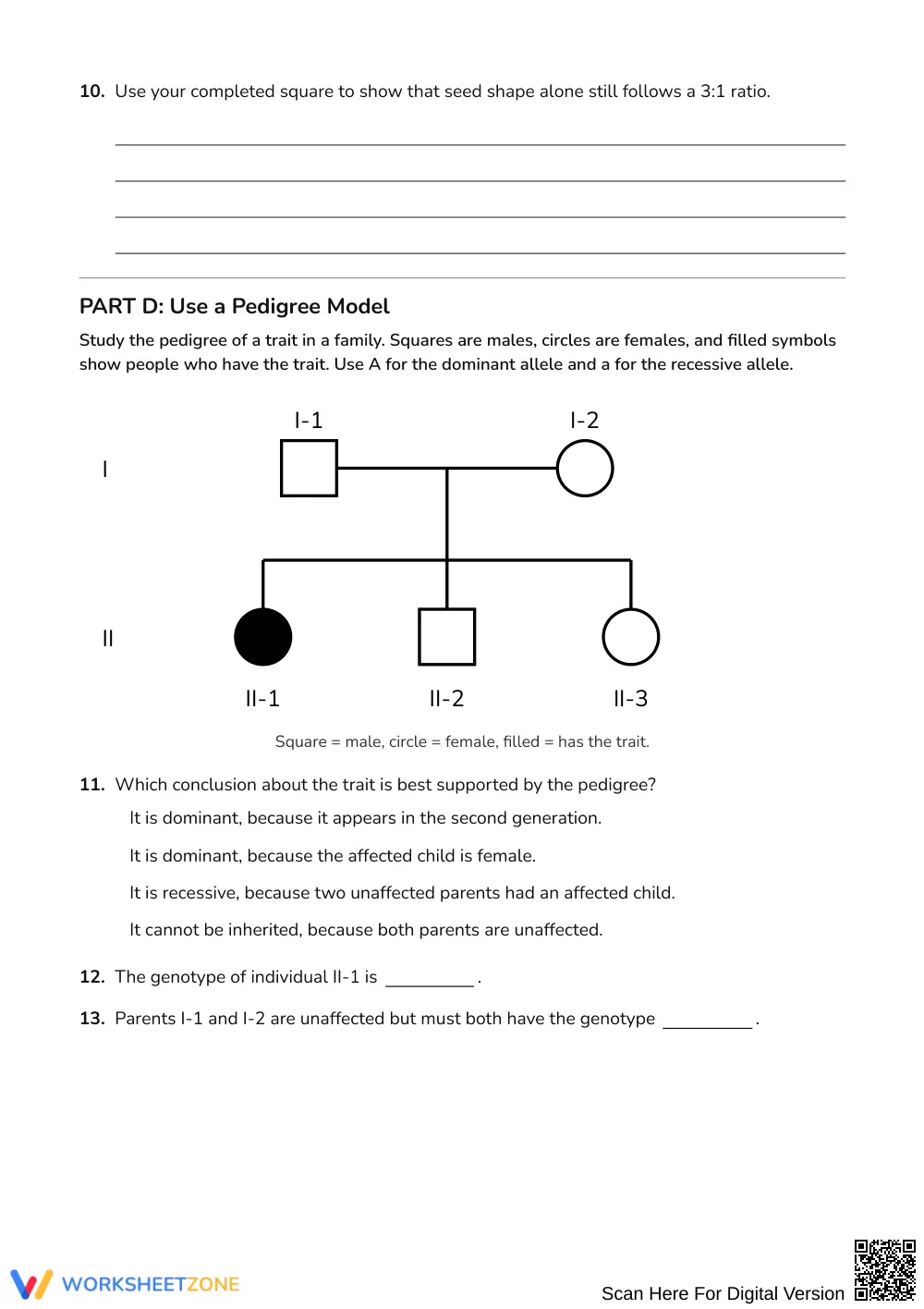
The 4-page activity contains five structured parts spanning 39 tasks. Students complete heterozygous monohybrid grids, correct gamete notation mistakes in flawed models, compute 9:3:3:1 dihybrid ratios, trace recessive traits across pedigrees, and evaluate Gregor Mendel's quantitative data to reject blending inheritance. A complete 4-page teacher answer key provides full explanations and filled grids.
Skill Progression
- Guided practice: Tasks 1–7 establish monohybrid modeling with pre-labeled axes, heterozygous parent genotypes, and scaffolded ratio calculations.
- Supported practice: Tasks 8–24 guide students to identify structural errors in peer models and solve dihybrid crosses using worked first-row scaffolds.
- Independent practice: Tasks 25–39 prompt students to deduce carrier genotypes from pedigrees and write evidence-based revisions using empirical flower data.
This gradual-release structure advances students from procedural grid completion to rigorous conceptual model critique.
Standards Alignment
This resource aligns with secondary life science standards on developing and using models to describe how meiosis and chromosomes transfer traits from parents to offspring. It emphasizes model revision based on empirical data, enabling standard integration into biology lesson plans and district curriculum maps.
How to Use It
Deploy this worksheet after direct instruction on allele segregation and independent assortment. In a formative check, have students complete Part B in pairs to verify that they recognize heterozygous parents produce two distinct gamete types. Alternatively, assign Part E after a laboratory investigation. Expected completion time is 45 to 60 minutes.
Who It's For
This resource serves general biology, introductory genetics, and high school life science classrooms. Scaffolded labels support developing learners, while multi-gene Punnett squares challenge advanced students. Pair this worksheet with an allele anchor chart or a hands-on probability lab.
Effective science instruction requires students to move beyond passive diagramming to active model evaluation. According to Fisher & Frey (2014), structured modeling progressions that require learners to detect errors, explain anomalies, and refine representations cultivate robust conceptual understanding and disciplinary literacy. This 39-task Mendelian genetics worksheet embodies that pedagogical design by prompting students to construct standard monohybrid crosses, debug flawed peer models, solve 16-cell dihybrid matrices, deduce recessive carrier lineages within pedigrees, and leverage Gregor Mendel's authentic quantitative flower ratios to disprove blending inheritance. By continually linking visual Punnett models to underlying biological mechanisms such as gametic segregation and independent assortment, this four-page resource bridges routine algorithmic calculation with evidence-based reasoning. Educators can deploy these scaffolded tasks to evaluate mastery during genetics units, supporting durable secondary life science achievement across varied classroom learning environments.


