

































Complete Genetic Variation Worksheet | Grade 10 Biology

Paste this activity's link or code into your existing LMS (Google Classroom, Canvas, Teams, Schoology, Moodle, etc.).
Students can open and work on the activity right away, with no student login required.
You'll still be able to track student progress and results from your teacher account.
Mastering genetic variation mechanisms requires students to connect cellular events to population diversity. This five-page worksheet guides Grade 10 Biology students through eight evidence-based tasks on meiosis, crossing over, independent assortment, and fertilization. Students analyze synthetic data sets, calculate genotype outcomes, and defend against flawed biological claims.
At a Glance
- Grade: 10 · Subject: Biology
- Standard: Construct explanations for how meiosis and fertilization produce genetic variation in offspring
- Skill Focus: Defend a Source-of-Variation Explanation
- Format: 5 pages · 8 problems · Answer key included · PDF
- Best For: High school meiosis and genetics units
- Time: 45–60 minutes
What's Inside
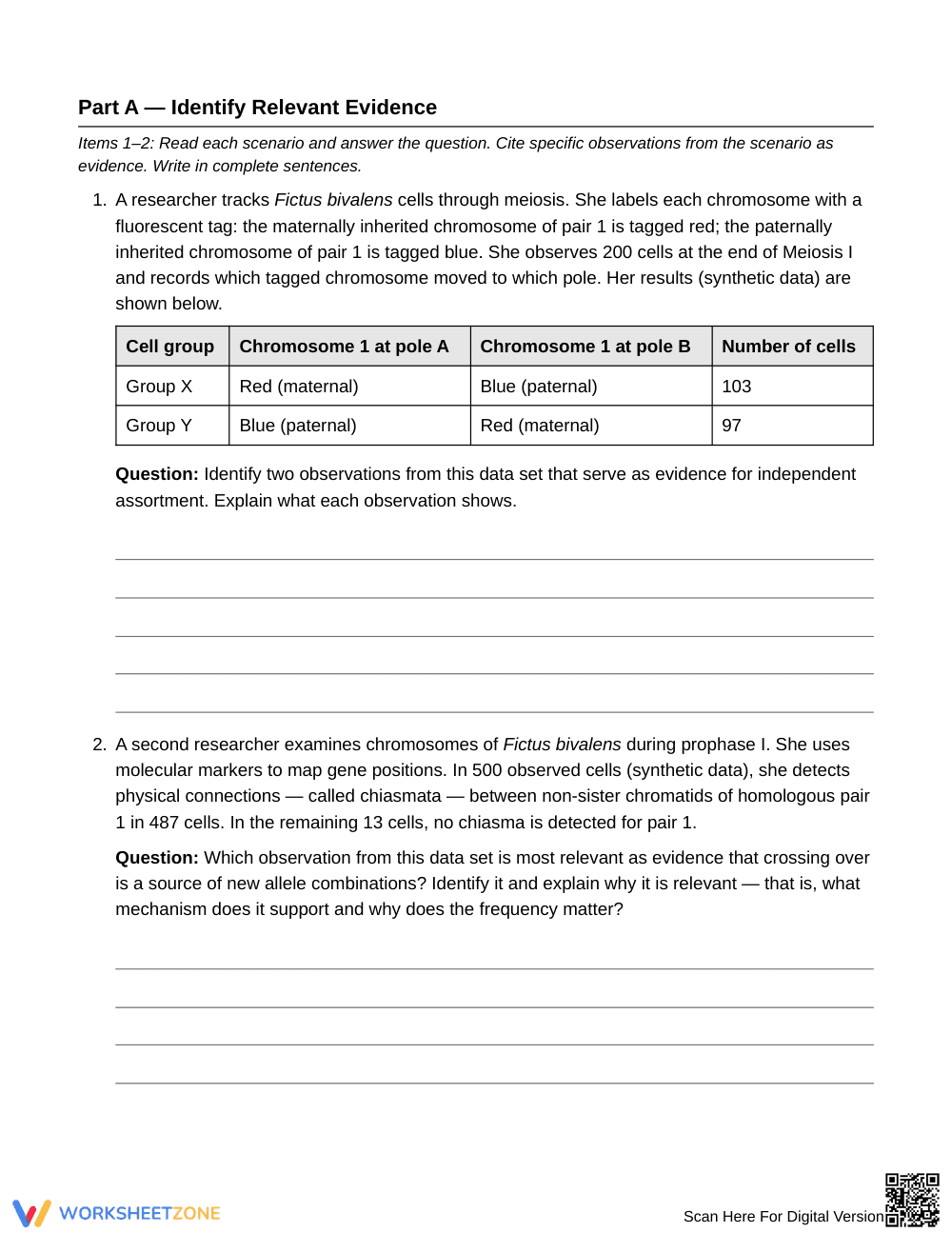
This resource includes five student pages structured around a model diploid organism. Across eight rigorous tasks, students analyze fluorescent chromosome tracking tables, calculate recombination frequencies, compute zygote combinations, and evaluate competing scientific claims. A complete six-page teacher answer key provides full mechanistic explanations and sample written arguments.
Skill Progression
- Guided Practice (Items 1–2): Students examine controlled experimental scenarios and isolate specific data points to serve as empirical evidence for independent assortment and crossing over frequency.
- Supported Practice (Items 3–6): Learners construct four multi-step mechanistic explanations connecting molecular crossover events, recombination frequencies, and random fertilization to overall gamete and zygote diversity.
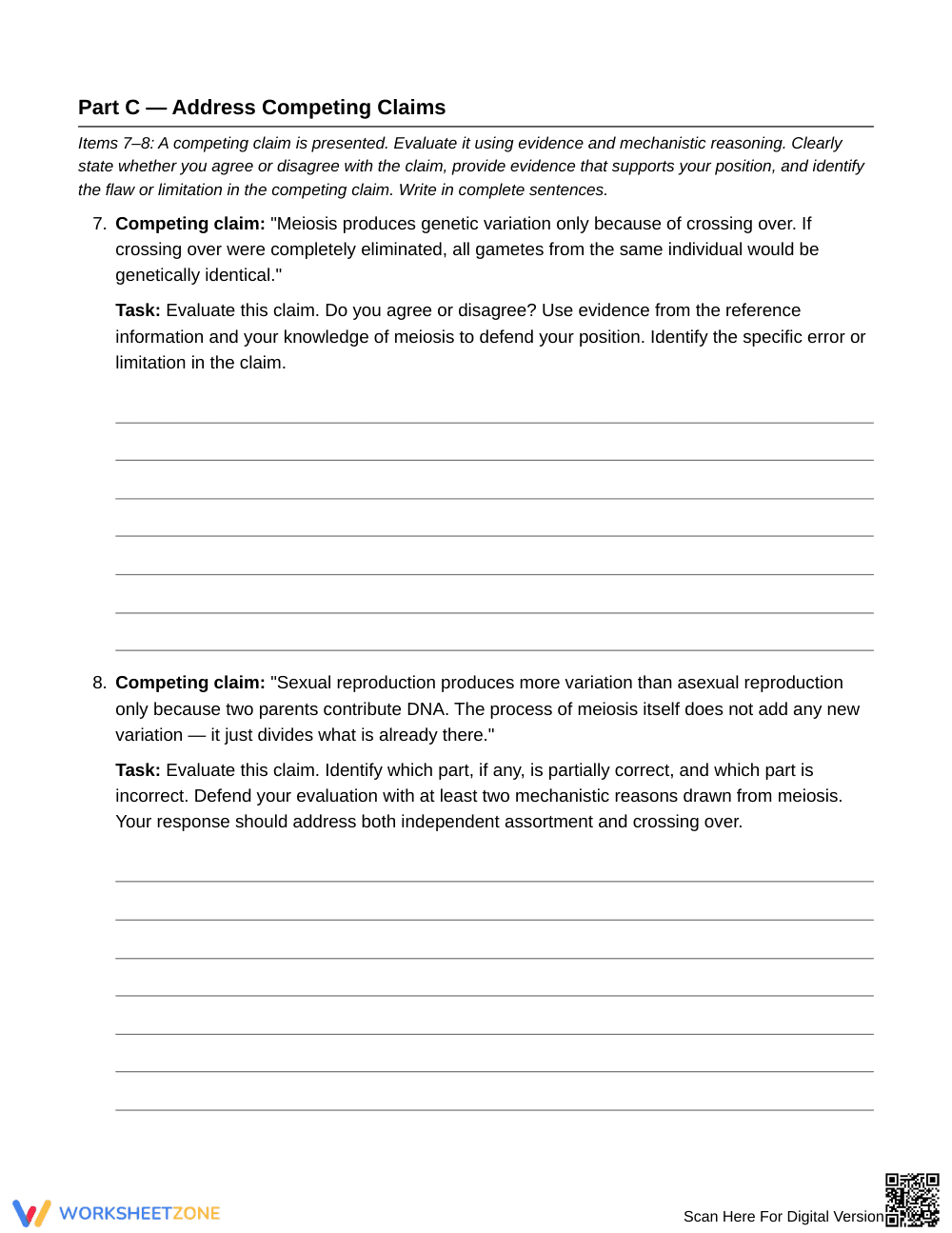
- Independent Practice (Items 7–8): Students evaluate two complex competing claims, identify conceptual fallacies regarding meiosis, and defend scientifically accurate positions using claim-evidence-reasoning structures.
This intentional sequence follows an I Do, We Do, You Do gradual-release model that builds rigorous scientific argumentation from initial data interpretation to independent counterargument evaluation.
Standards Alignment
This worksheet aligns with high school life science standards requiring students to make and defend claims that inheritable genetic variations result from meiosis and fertilization. Supporting standards focus on predicting genetic distribution. Both standard codes can be copied directly into lesson plans, IEP goals, or district curriculum mapping tools.
How to Use It
Deploy this worksheet after direct instruction on Meiosis I and II. In a mid-unit lesson, have students complete Parts A and B collaboratively before tackling Part C independently. For formative assessment, check Item 5 to see if students understand linked gene frequencies. Expected completion time is 45 to 60 minutes.
Who It's For
This activity is designed for Grade 10 General and Honors Biology students mastering scientific explanations. Scaffolds such as reference definitions support emerging bilingual learners and Tier 2 intervention. Pair this worksheet directly with a chromosome modeling lab or meiosis anchor chart to reinforce spatial understanding.
Developing written scientific arguments about unobservable cellular mechanisms presents a well-documented instructional challenge in high school biology education. According to Fisher & Frey (2014), structured writing prompts paired with disciplinary reference data enable students to transition successfully from foundational conceptual knowledge to rigorous, evidence-based reasoning. This eight-task worksheet operationalizes that pedagogical framework by providing explicit data models, targeted mathematical calculations, and competing counter-claims regarding meiosis, crossing over, and random fertilization. By requiring Grade 10 learners to isolate empirical observations and link them directly to cellular mechanisms, the resource reinforces both deep mechanistic understanding and domain-specific literacy. Research demonstrates that engaging secondary students in evaluating and refuting flawed scientific arguments solidifies long-term conceptual retention and prevents persistent misconceptions regarding inherited genetic variation across successive generations in authentic classroom settings. This approach cultivates autonomous scientific thinking.


