



























Complete Frog Dissection Worksheet | Grades 7-12 Science
Paste this activity's link or code into your existing LMS (Google Classroom, Canvas, Teams, Schoology, Moodle, etc.).
Students can open and work on the activity right away, with no student login required.
You'll still be able to track student progress and results from your teacher account.
This comprehensive frog dissection cumulative assessment evaluates secondary science students on anatomical identification, physiological adaptations, and body system interactions across 24 rigorous tasks. Students analyze ventral internal anatomy, mouth structures, comparative gas exchange data, and multi-system coordination, demonstrating mastery of vertebrate biological organization through structured diagrams, data interpretation, and extended explanatory responses.
At a Glance
- Grade: Grades 7–12 · Subject: Science
- Standard: Animal Structure and Function — Relate anatomical structures to functional systems and interactions
- Skill Focus: Frog anatomy, physiological adaptations, and organ system interactions
- Format: 4 pages · 24 problems · Answer key included · PDF
- Best For: Post-dissection lab assessment or unit review
- Time: 45–60 minutes
What's Inside
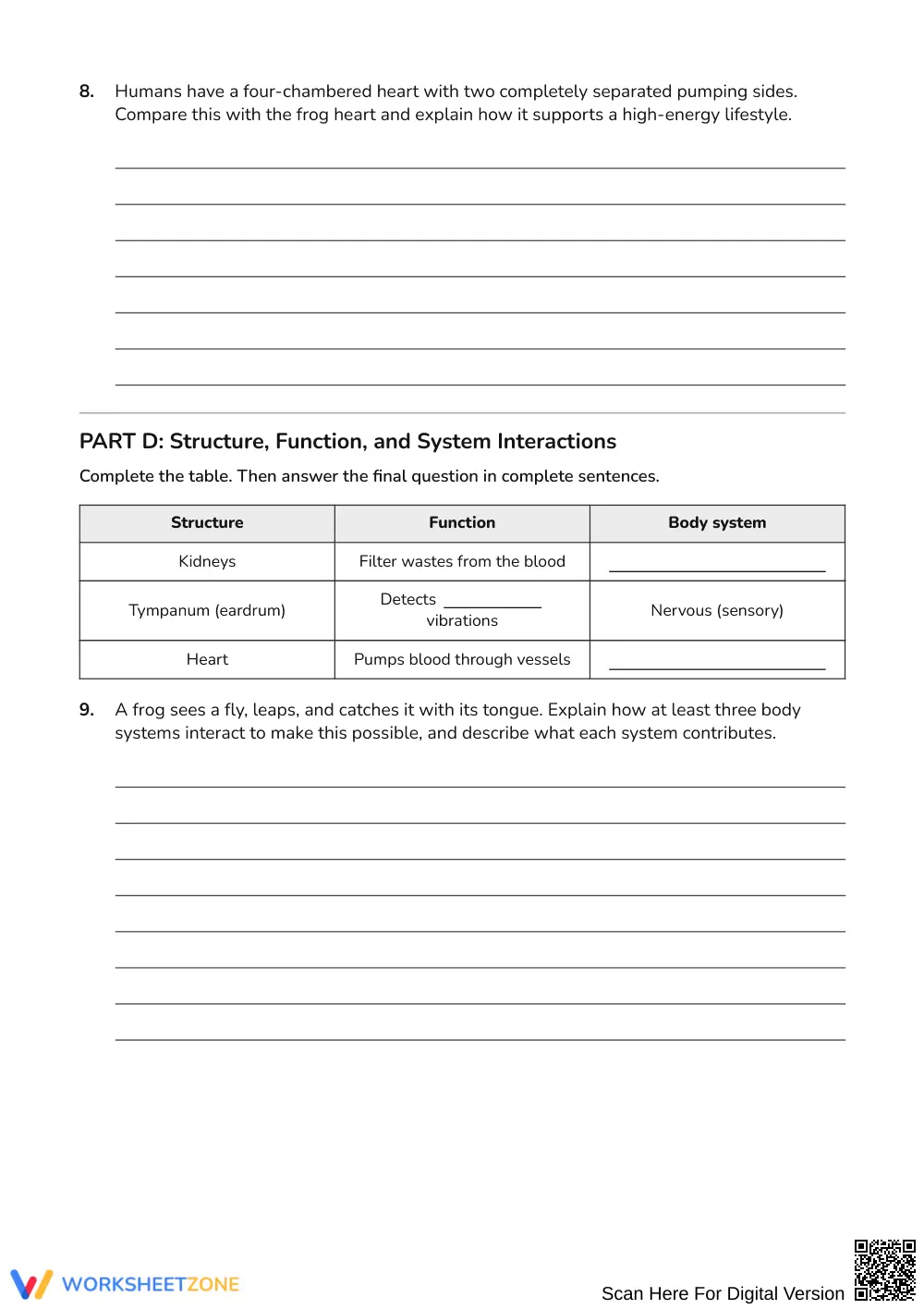
This 4-page assessment contains 24 cumulative tasks divided into four sequential parts. Students engage with anatomical labeling using provided word banks, multiple-choice conceptual checks, physiological data analysis from a gas exchange model, and an organ-function mapping table. It features a complete 4-page answer key with exemplar open-ended explanations and multi-system response criteria.
Skill Progression
- Guided practice (Part A & Part B): Twelve tasks focus on visual anatomical recognition of internal ventral organs and oral structures using targeted word banks and foundational orientation questions.
- Supported practice (Part C): Six analytical tasks guide students through respiratory data interpretation and comparative circulatory physiology, contrasting amphibian and mammalian heart structures.
- Independent practice (Part D): Six integrative tasks require students to categorize organ functions across body systems and construct an evidence-based explanation synthesizing three interacting systems.
This design mirrors a gradual-release instructional model, advancing students systematically from baseline organ identification to high-level physiological analysis.
Standards Alignment
This assessment aligns directly with secondary Life Science standards governing hierarchical organization and multicellular systems, paraphrased as: conduct an investigation to provide evidence that living things are made of systems of interacting organs. Supporting standards address comparative structure-function adaptations in animal physiology. Both standards statements can be copied directly into lesson plans, IEP goals, or district curriculum mapping tools.
How to Use It
Administer this assessment immediately after completing a wet laboratory dissection or virtual frog anatomy unit to measure cumulative understanding. Alternatively, split the sections across two class periods as structured review stations during an organ systems unit. During administration, monitor Part C to check whether students recognize cutaneous respiration trends. Expect completion within 45 to 60 minutes.
Who It's For
This resource is tailored for life science and biology students in Grades 7 through 12. Word banks provide essential visual scaffolding for emerging bilingual learners and students receiving accommodations, while open-response prompts challenge advanced learners. Pair this printable with an introductory vertebrate anatomy diagram or direct dissection lab guide.
According to research by Fisher & Frey (2014) on effective scaffolded instruction, students demonstrate significantly deeper conceptual retention when analytical assessments progress from guided perceptual prompts to unassisted synthesis tasks. This cumulative assessment embodies that framework by evaluating secondary science students on vertebrate organ identification, comparative circulatory physiology, and complex system interactions. By pairing diagrammatic identification of internal organs with quantitative data analysis of amphibian cutaneous versus pulmonary respiration, the 24 assessment tasks systematically reinforce how individual anatomical structures contribute to whole-organism survival. Students directly connect empirical observations of heart chamber morphology and oral structures to evolutionary adaptations and thermodynamic demands. Furthermore, the final synthesis prompt requires learners to coordinate at least three distinct organ systems during prey capture, validating holistic biological reasoning. This structured approach provides educators with reliable, actionable diagnostic evidence of biological literacy across middle and high school science curricula.


