




























Complete Frog Dissection Worksheet | Grade 7-12 Science
Paste this activity's link or code into your existing LMS (Google Classroom, Canvas, Teams, Schoology, Moodle, etc.).
Students can open and work on the activity right away, with no student login required.
You'll still be able to track student progress and results from your teacher account.
This four-page frog dissection worksheet guides students in Grades 7–12 through identifying, correcting, and justifying common anatomical misconceptions. By evaluating realistic lab partner claims and verifying anatomical diagrams, learners develop accurate understandings of amphibian circulatory, digestive, and respiratory structures while connecting structure to function across vertebrate body systems.
At a Glance
- Grade: Grades 7–12 · Subject: Science
- Standard: Life Science — Analyze and evaluate anatomical claims using evidence from body systems
- Skill Focus: Misconception and error analysis in frog dissection
- Format: 4 pages · 28 problems · Answer key included · PDF
- Best For: Post-lab review, error analysis, or pre-lab prep
- Time: 45–60 minutes
What's Inside
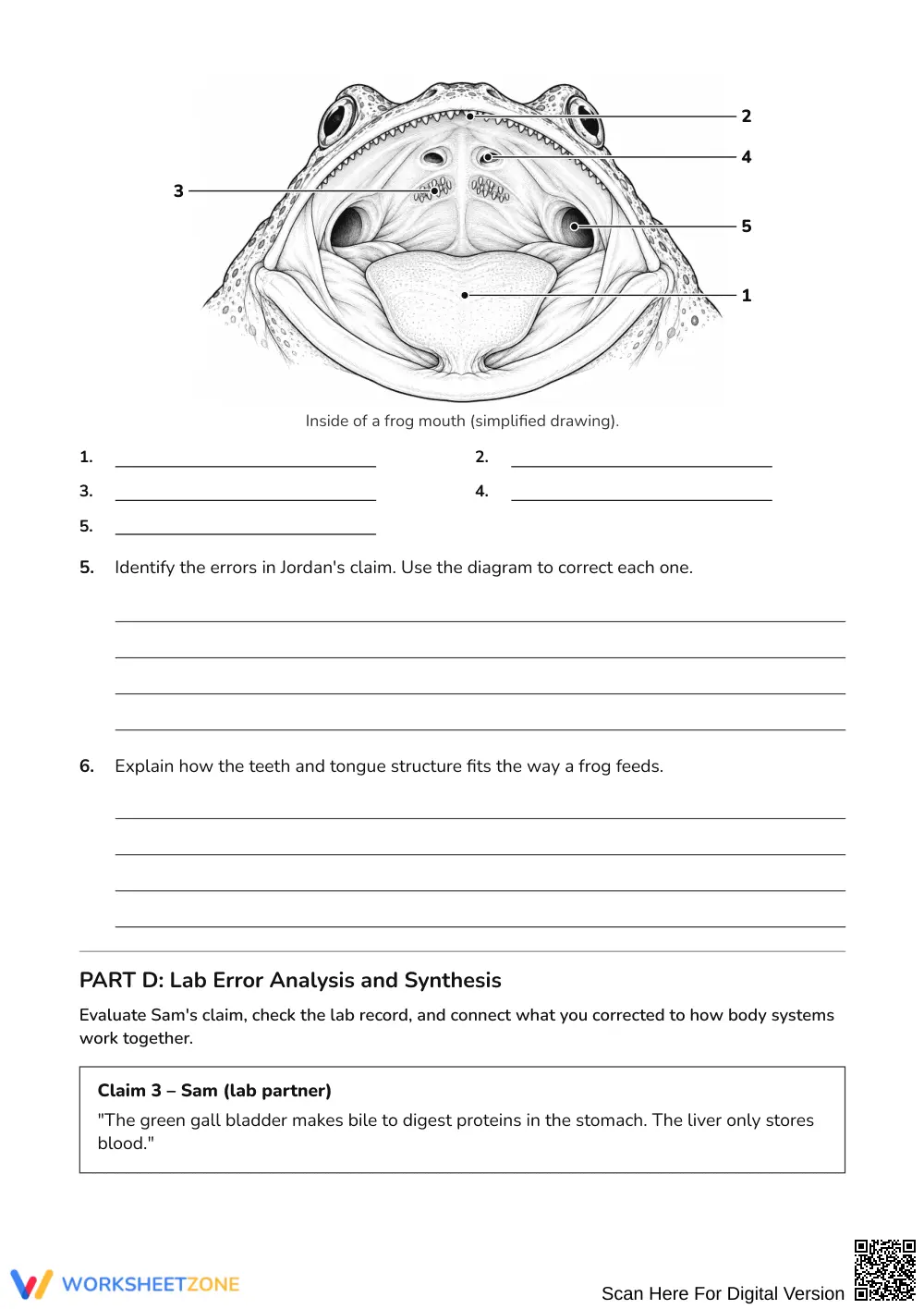
This 4-page print-ready packet features 28 targeted tasks divided into four distinct sections. Students interact with clear anatomical diagrams of ventral frog anatomy and the oral cavity, supported by targeted word banks. Across the assignment, learners analyze three realistic lab partner claims, complete a lab record evaluation table, and formulate extended written explanations, accompanied by a complete four-page teacher answer key.
Skill Progression
- Guided practice (Part A · 8 tasks): Students orient to the ventral anatomy map using a structured word bank and orientation cue before identifying relative organ sizes.
- Supported practice (Parts B & C · 10 tasks): Learners evaluate peer claims on cardiac circulation and mouth structures, identifying errors with visual models before rewriting claims with evidence.
- Independent practice (Part D · 10 tasks): Students audit lab records, correct physiological misconceptions about digestion, and independently synthesize multi-system interactions.
This sequence follows a gradual-release framework, moving students systematically from identification to critical evaluation and cross-system synthesis.
Standards Alignment
This worksheet aligns to secondary life science standards emphasizing how hierarchical body systems interact to maintain homeostasis in multicellular organisms. Students critique models, evaluate evidence, and construct explanations connecting organ structure to physiological function. Both standard codes can be copied directly into lesson plans, IEP goals, or district curriculum mapping tools.
How to Use It
Use this worksheet directly after a hands-on dissection to consolidate findings and eliminate lingering misconceptions, or assign it before lab work to teach students what structures to expect. During class, circulate during Parts B and C to check whether students recognize the three-chambered heart and skin respiration. Expected completion time is 45 to 60 minutes.
Who It's For
This activity is designed for middle and high school life science and biology students. The structured word banks and claim checklists provide accessible entry points for developing readers, while open-ended synthesis prompts challenge advanced learners. Pair this worksheet directly with a virtual frog dissection module or physical lab specimens.
Analyzing student misconceptions and correcting procedural errors in comparative anatomy reinforces deep biological comprehension across secondary life science courses. According to research on scaffolded instructional design by Fisher & Frey (2014), guiding students through deliberate error detection, peer claim evaluation, and structured justification bridges the gap between basic anatomical labeling and functional systems reasoning. Rather than merely memorizing organ locations during laboratory dissection, learners who actively critique flawed peer assertions regarding circulation, digestion, and external morphology demonstrate stronger conceptual retention and greater scientific literacy. This 28-task resource operationalizes that evidence-based pedagogy across four progressive parts, requiring students to isolate misconceptions, refer directly to anatomical diagrams, and synthesize how organ systems interact. Secondary science classrooms utilizing structured error analysis cultivate rigorous reasoning habits, evidence-based argumentation, and targeted mastery of vertebrate structure and physiological function across diverse instructional settings.


