




























Complete Frog Dissection Worksheet | Grade 7-12 Science
Paste this activity's link or code into your existing LMS (Google Classroom, Canvas, Teams, Schoology, Moodle, etc.).
Students can open and work on the activity right away, with no student login required.
You'll still be able to track student progress and results from your teacher account.
This science worksheet reinforces anatomical classification and organ relationships using a dissected frog model. Designed for grades 7–12, the resource guides students to identify key organs, trace digestive pathways, and explain functional interactions among the circulatory, digestive, and excretory systems to master vertebrate anatomy.
At a Glance
- Grade: Grades 7–12 · Subject: General Biology and Science
- Standard: Life Science — Relate anatomical structures to physiological functions across vertebrate body systems
- Skill Focus: Frog Dissection: Classification & Relationships
- Format: 4 pages · 43 problems · Answer key included · PDF
- Best For: Pre-lab orientation, post-dissection review, or makeup work
- Time: 35–45 minutes
What's Inside
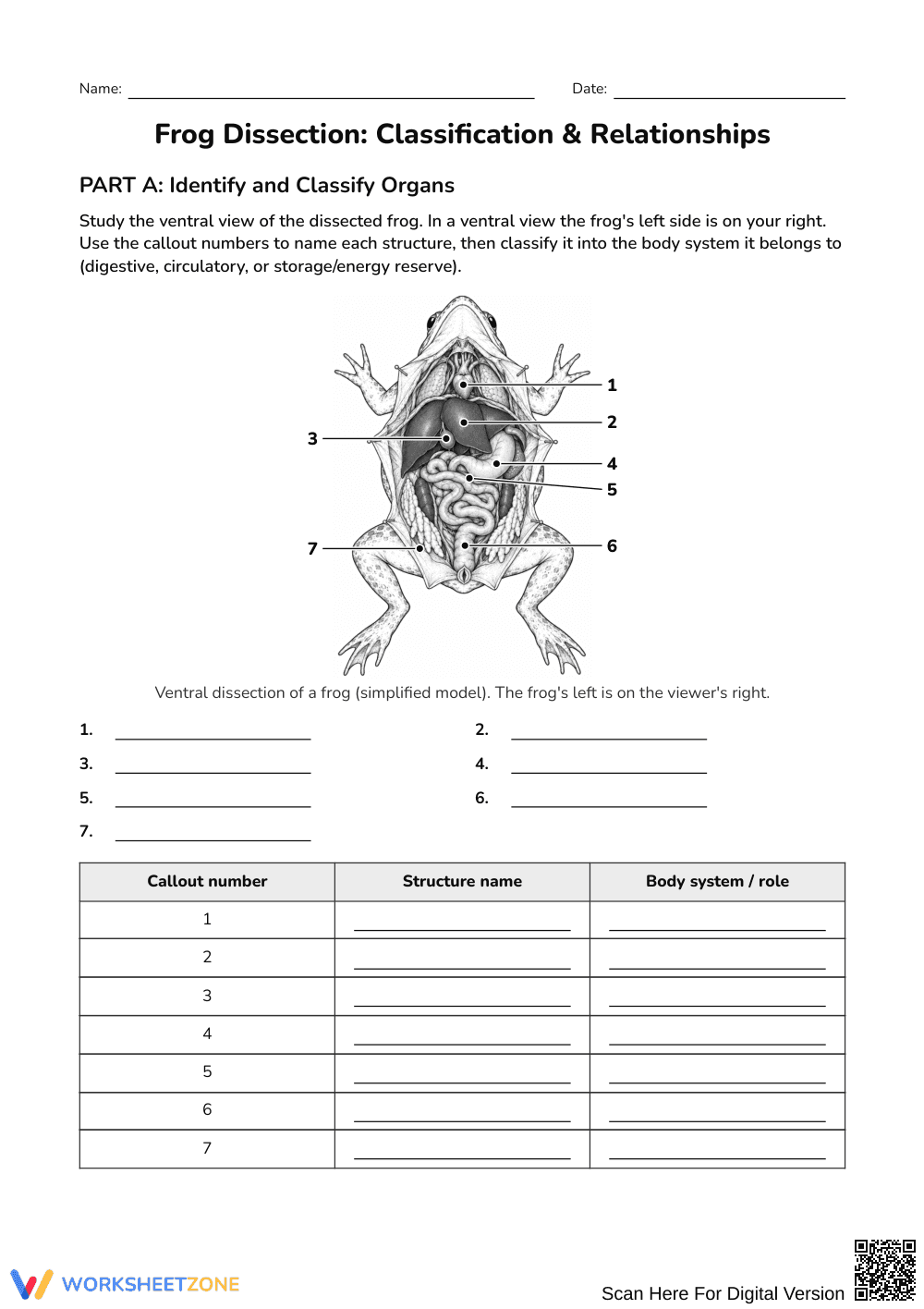
The 4-page student packet features 43 tasks across four focused parts. Part A presents a ventral dissection diagram where students identify 7 internal organs and record their primary organ system. Part B links structures like the tympanum and vomerine teeth to specific functions through matching. Part C maps the digestive tract from mouth to cloaca, while Part D provides short-answer prompts on multi-system relationships and a comparative frog-versus-human anatomy chart. A full 4-page answer key is included.
Skill Progression
- Guided practice: In Part A, students use callouts on a ventral anatomical diagram to identify 7 organs and classify them into body systems.
- Supported practice: In Parts B and C, students complete 6 matching and sequencing items to pair structures with functions and order the digestive tract.
- Independent practice: In Part D, students tackle unassisted analytical questions explaining system interactions, seasonal fat storage, and amphibian-human anatomical differences.
This sequence embodies gradual-release instruction, carrying students smoothly from visual recognition to independent physiological analysis.
Standards Alignment
This worksheet supports life science standards focused on multicellular organisms and interacting anatomical systems. Students examine how digestive, circulatory, and respiratory structures collaborate to sustain cellular respiration and maintain homeostasis. Comparative questions also reinforce vertebrate adaptations. Both standard codes can be copied directly into lesson plans, IEP goals, or district curriculum mapping tools.
How to Use It
Assign this worksheet directly after introducing organ systems or as a preparatory guide before hands-on dissection. During independent work, check Part D responses formatively to verify students recognize why the frog's single ventricle allows partial blood mixing. Expect students to finish the complete 43-task packet within 35 to 45 minutes.
Who It's For
This worksheet fits middle and high school life science and biology classes. Support developing readers with a diagram-matched organ word wall, and challenge advanced students to justify the respiratory role of amphibian skin. Pair this resource with a hands-on lab dissection or a digital frog simulation.
Grounded in the instructional architecture described by Fisher & Frey (2014), this secondary life science worksheet establishes a structured pathway for classifying anatomical organs and evaluating multi-system physiological relationships. By scaffolding student tasks from visual organ identification to complex explanations of organ system interactions, the resource activates cognitive schema necessary for biological synthesis. Educational research demonstrates that structured graphic representations paired with targeted writing prompts substantially strengthen student retention in comparative anatomy. In this 4-page instructional module, learners trace digestive pathways, evaluate gas exchange mechanisms across skin and lungs, and contrast amphibian and mammalian circulatory structures. Students progress through 43 items that transition from basic organ categorization to high-level system analysis, reinforcing how circulatory, digestive, and excretory systems coordinate physiological function. Fisher & Frey (2014) emphasize that this intentional transition from scaffolded matching to independent comparative analysis ensures durable conceptual comprehension and measurable academic mastery.


