


























Views
Downloads



Complete Frequency & Amplitude Worksheet | Grade 6 Science
Paste this activity's link or code into your existing LMS (Google Classroom, Canvas, Teams, Schoology, Moodle, etc.).
Students can open and work on the activity right away, with no student login required.
You'll still be able to track student progress and results from your teacher account.
This Grade 6 science worksheet targets a widespread sound wave misconception by guiding students to distinguish frequency from amplitude. Through structured error analysis, learners evaluate flawed peer explanations, identify conceptual mistakes regarding pitch and loudness, and formulate precise scientific repairs across diverse musical and mechanical wave scenarios.
At a Glance
- Grade: 6 · Subject: Science
- Standard: Middle School Physical Science — Differentiate between wave frequency and amplitude in mechanical sound systems
- Skill Focus: Frequency vs. Amplitude Error Analysis
- Format: 5 pages · 8 problems · Answer key included · PDF
- Best For: Conceptual misconception repair after wave lessons
- Time: 30–40 minutes
What's Inside
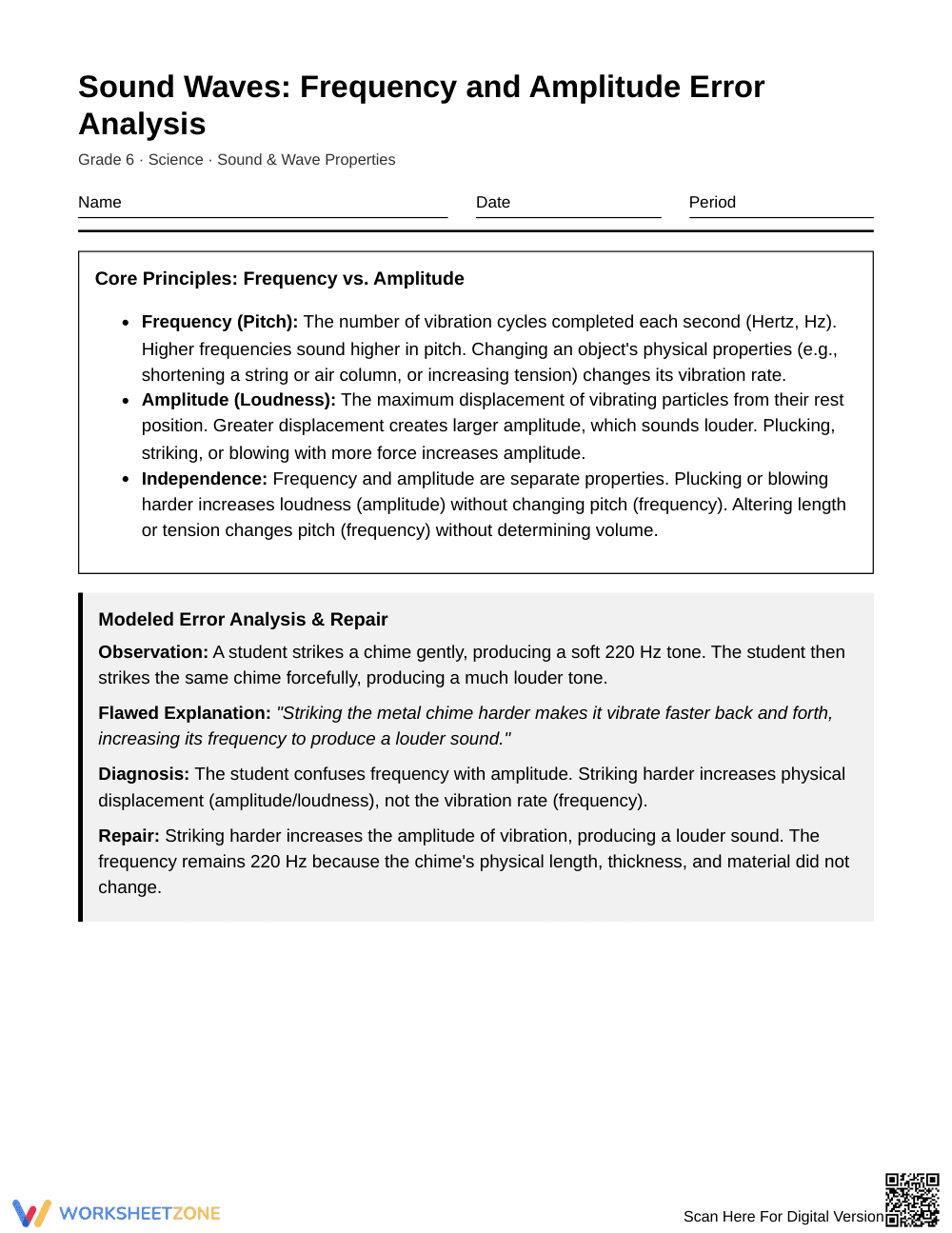
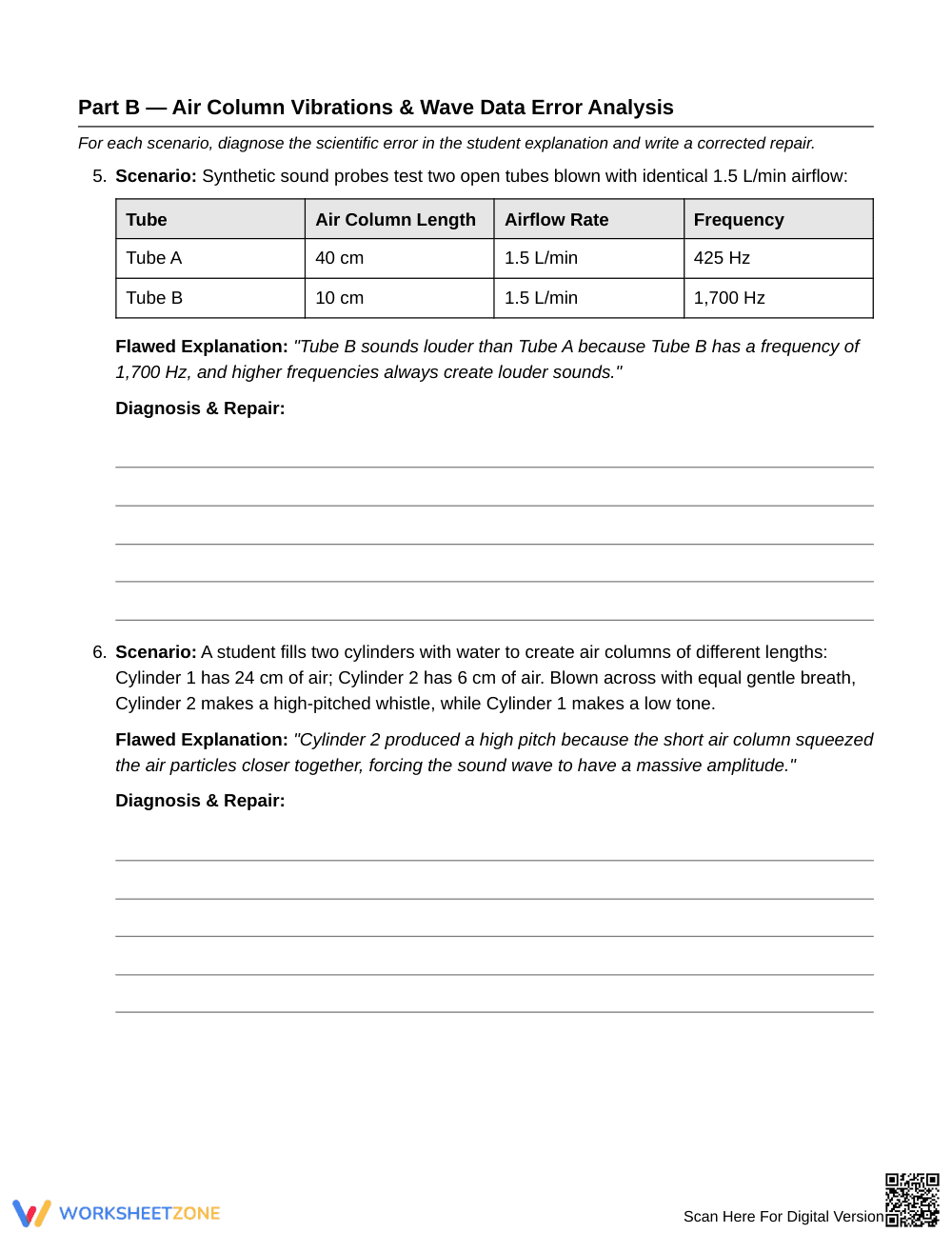
The 5-page printable resource includes a reference box of core physical principles, a modeled diagnosis and repair example, 8 scenario-based error-analysis tasks, and a comprehensive 2-page answer key. Students analyze real-world acoustic data involving string tension, monochords, vibrating rulers, air tubes, and resonant cylinders to correct flawed reasoning.
Skill Progression
- Guided practice (Modeled Example): Students examine an explicit chime scenario where a teacher-modeled diagnosis explains why striking force alters amplitude rather than frequency.
- Supported practice (Tasks 1–4): Learners evaluate 4 string and ruler vibration scenarios, applying displacement and frequency data to repair misconception statements with structured prompts.
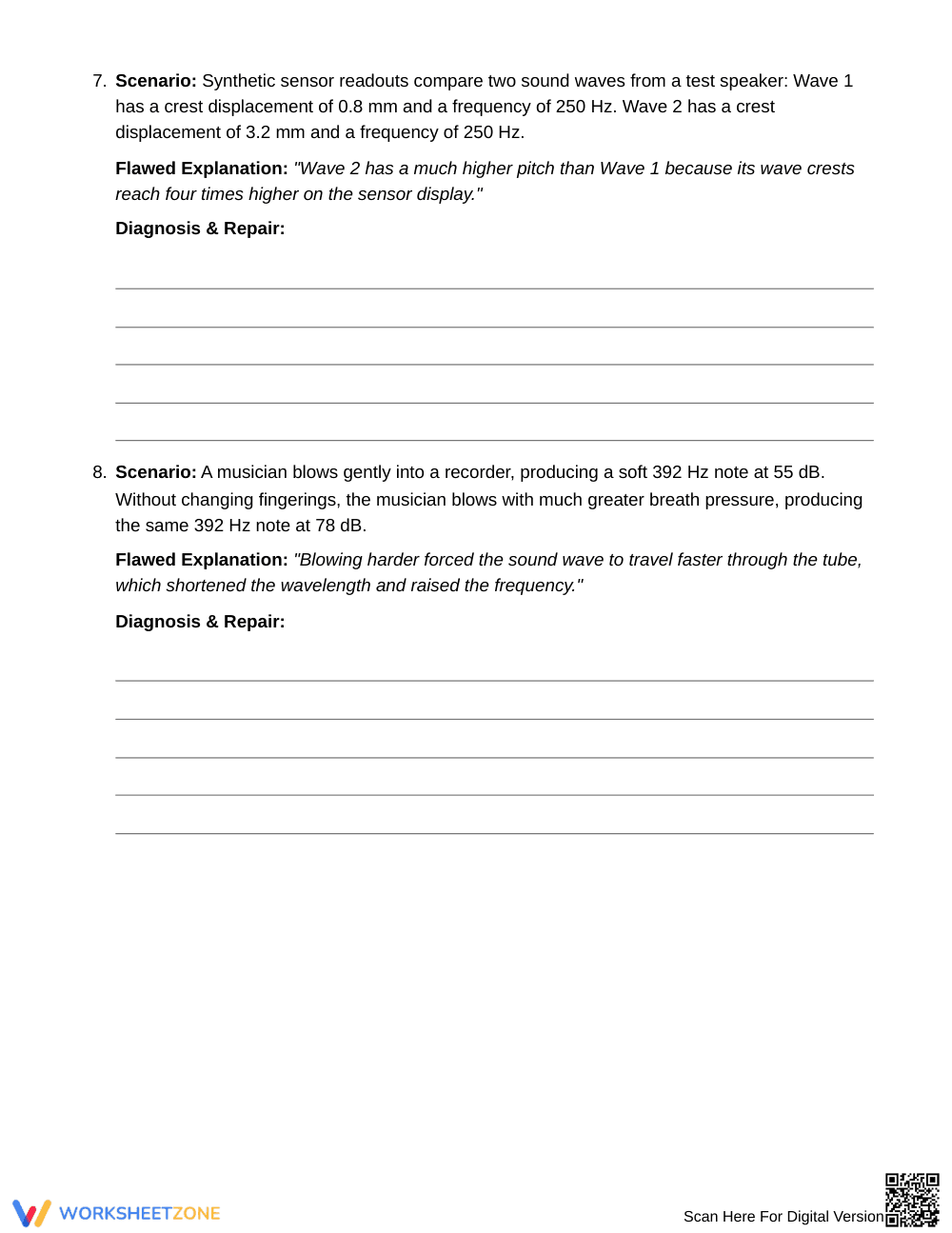
- Independent practice (Tasks 5–8): Students independently analyze 4 complex air column and decibel scenarios, articulating the physics behind pitch, airflow, and wave displacement.
This sequence follows a gradual-release model, transitioning students from teacher-guided error identification to independent scientific argumentation.
Standards Alignment
This resource aligns with middle school physical science standards requiring students to develop models showing that wave amplitude relates to energy and that wave frequency determines pitch. By evaluating quantitative frequency and displacement data, students explain why physical wave properties operate independently. Both standard codes can be copied directly into lesson plans, IEP goals, or district curriculum mapping tools.
How to Use It
Deploy this worksheet after direct instruction on wave characteristics or as a mid-unit formative check. During class, circulate while students complete Part A and check whether they mistakenly associate string pluck distance with pitch changes. Students typically complete all 8 tasks within 30 to 40 minutes during paired collaboration or independent practice.
Who It's For
Designed for Grade 6 physical science students, this activity supports general education classes, introductory physics units, and targeted intervention groups struggling with wave vocabulary. Pair this worksheet with an interactive oscilloscope simulation or a hands-on tuning fork demonstration to reinforce visual and auditory representations of amplitude and frequency.
Middle school science instruction often encounters persistent student confusion between pitch and loudness, where learners incorrectly assume that increasing sound volume alters wave frequency. According to Fisher & Frey (2014), explicit error-analysis tasks strengthen metacognitive monitoring and disciplinary reasoning by requiring students to explain why a misconception is incorrect before constructing an accurate scientific repair. This Grade 6 physical science worksheet provides 8 structured scenarios focusing on wave frequency and amplitude independence across string vibrations and resonant air columns. By analyzing quantitative acoustic measurements, including displacement values in millimeters and frequencies in Hertz, students actively decouple loudness from pitch. The resource scaffolds student thinking from a modeled chime example to independent multi-variable evaluations, helping learners internalize core wave mechanics. Fisher & Frey (2014) demonstrate that such guided cognitive scaffolds establish resilient conceptual foundations essential for subsequent studies of energy transfer and wave behavior.


