


























Views
Downloads
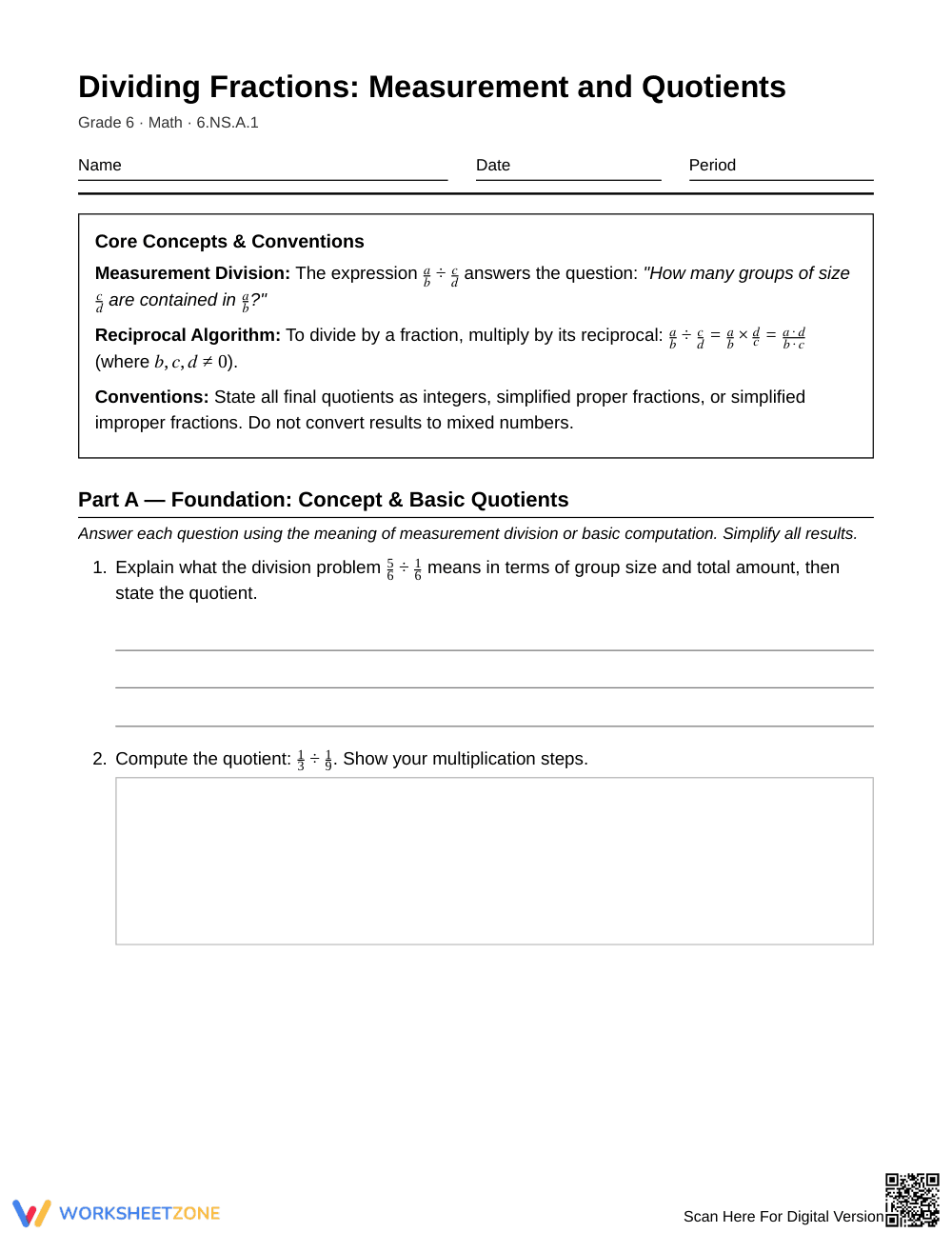
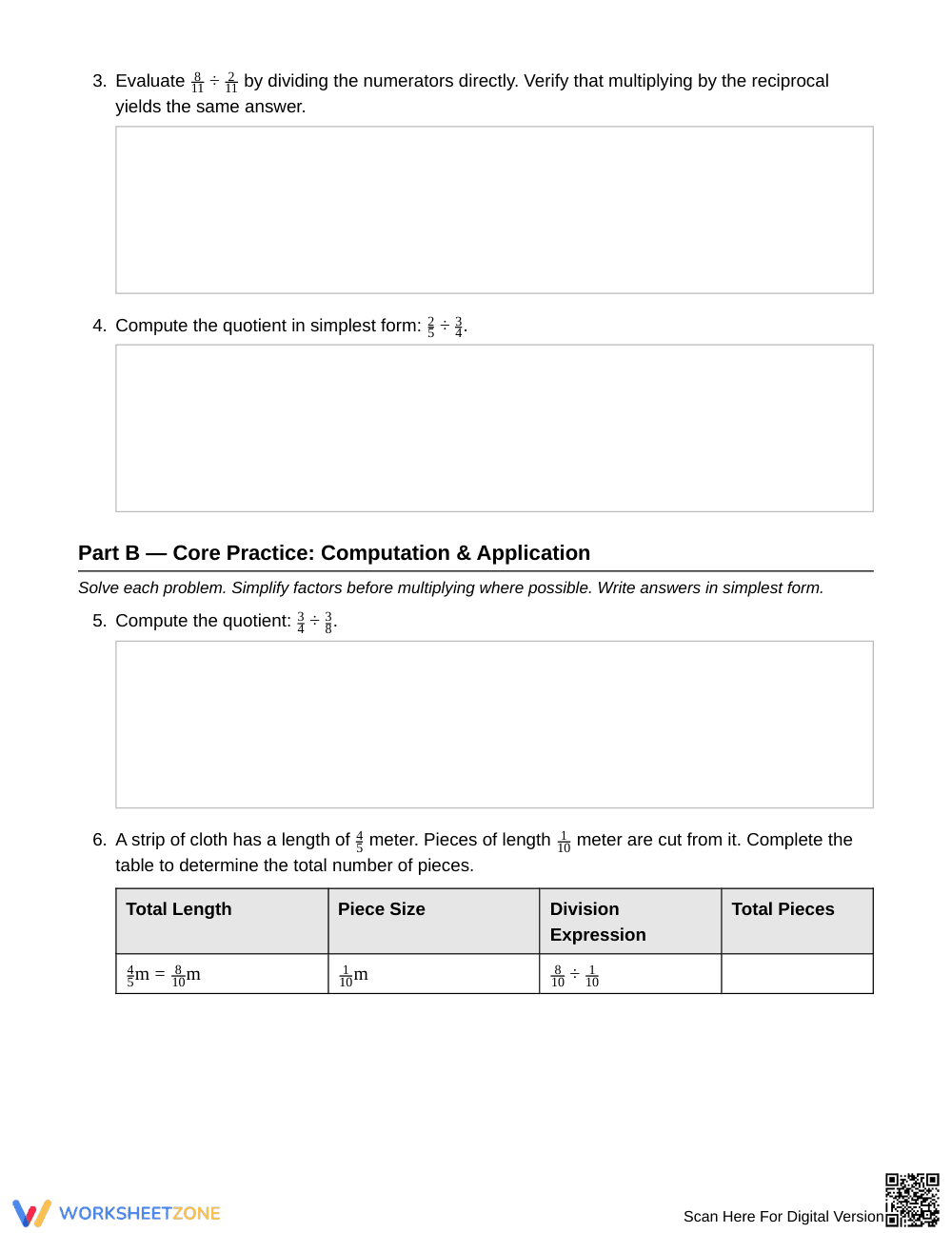
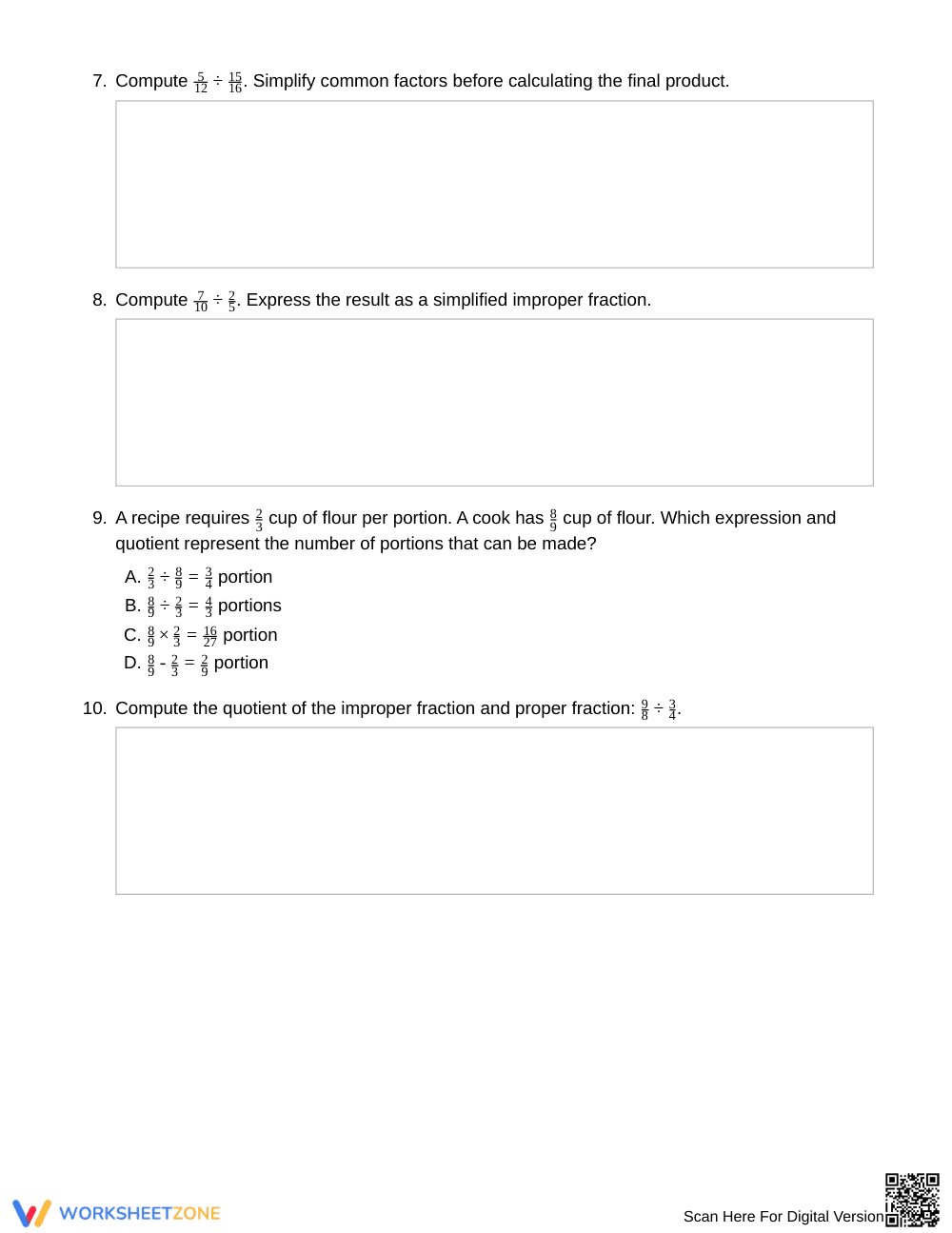
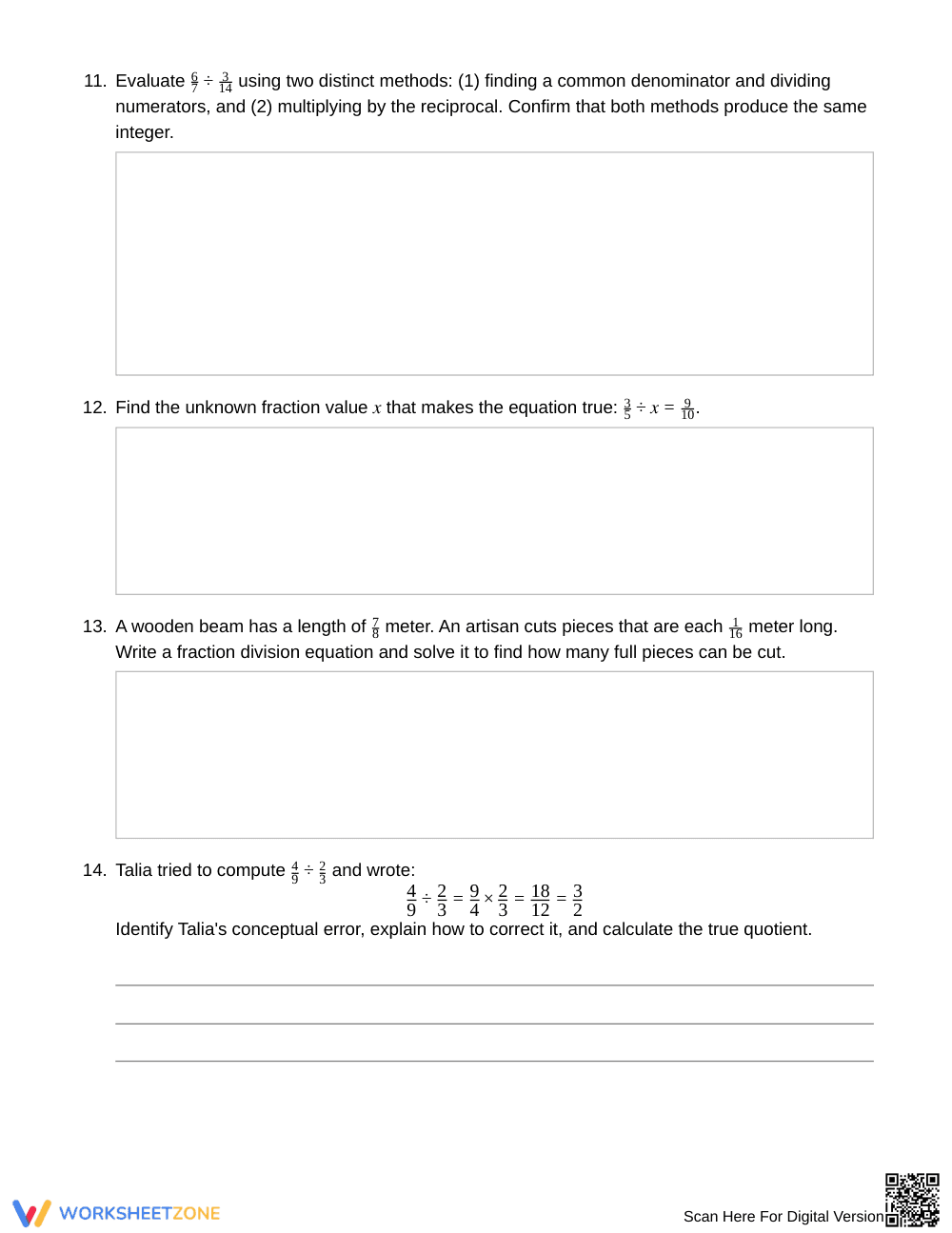


Complete Fraction Quotients Worksheet | Grade 6 Math
Paste this activity's link or code into your existing LMS (Google Classroom, Canvas, Teams, Schoology, Moodle, etc.).
Students can open and work on the activity right away, with no student login required.
You'll still be able to track student progress and results from your teacher account.
This comprehensive Grade 6 math worksheet builds student fluency with dividing fractions through structured visual modeling and algorithmic computation. Students progress from conceptual measurement division to multi-step reciprocal calculations, strengthening their procedural skills and mathematical reasoning across eighteen rigorous practice problems.
At a Glance
- Grade: 6 · Subject: Math
- Standard:
6.NS.A.1— Interpret and compute quotients of fractions to solve real-world problems- Skill Focus: Compute Fraction Quotients
- Format: 5 pages · 18 problems · Answer key included · PDF
- Best For: Core fraction division practice
- Time: 40–50 minutes
What's Inside
The 5-page printable resource contains 18 carefully constructed mathematical tasks divided into three pedagogical sections, paired with a complete 3-page answer key showing step-by-step solutions. Students engage with foundational definition prompts, table-based word problems, common denominator comparisons, error analysis tasks, and algebraic fraction challenges.
Skill Progression
- Guided practice (Part A): 4 foundational items reinforcing the measurement model of division and simple fraction reciprocals.
- Supported practice (Part B): 10 core application problems involving real-world measurement scenarios, mixed operations, and error analysis.
- Independent practice (Part C): 4 challenge problems featuring multi-step fraction operations and algebraic parameter solving.
This structured sequence reflects the gradual-release model, advancing students systematically from conceptual understanding to independent procedural mastery.
Standards Alignment
This worksheet directly targets standard 6.NS.A.1: Interpret and compute quotients of fractions, and solve word problems involving division of fractions by fractions using visual models and equations. Both standard codes can be copied directly into lesson plans, IEP goals, or district curriculum mapping tools.
How to Use It
Deploy this resource during direct instruction as guided independent practice following a mini-lesson on reciprocals, or assign it after instruction as a comprehensive review station. Formatively assess student work by checking whether students correctly invert only the divisor rather than the dividend during Part B. Expect completion within 40 to 50 minutes.
Who It's For
Designed for general education Grade 6 math classrooms, this resource supports tiered intervention groups needing reinforced fraction models and advanced learners tackling algebraic equations. Pair this worksheet directly with fraction bar manipulatives or an anchor chart highlighting division algorithms.
According to research by Fisher & Frey (2014), purposeful gradual-release instructional frameworks significantly enhance procedural fluency and conceptual transfer in middle school mathematics. This instructional worksheet operationalizes that research-backed design by targeting standard 6.NS.A.1 through a rigorous 18-task learning progression. Students begin by interpreting the concrete measurement meaning of dividing fractions before transitioning systematically into reciprocal multiplication algorithms, contextual real-world scenarios, and algebraic fraction reasoning. By combining structured computational practice with diagnostic error analysis tasks and multi-step non-routine challenges, the resource ensures learners develop durable conceptual foundations alongside reliable computational accuracy. Teachers obtain immediate, actionable diagnostic data on fraction division proficiency across diverse learner profiles, making this comprehensive 5-page resource an essential asset for standards-aligned Grade 6 arithmetic instruction, targeted small-group remediation, and independent mastery practice.


