































Complete Focused Thesis Worksheet | Grade 10 English II

Paste this activity's link or code into your existing LMS (Google Classroom, Canvas, Teams, Schoology, Moodle, etc.).
Students can open and work on the activity right away, with no student login required.
You'll still be able to track student progress and results from your teacher account.
This 6-page Grade 10 English II worksheet teaches students to transition from summary-based claims to precise, arguable thesis statements. Working with the passage "The Orchard Wall," learners evaluate claim models, analyze craft choices, and draft cohesive analytical paragraphs supported by textual evidence.
At a Glance
- Grade: 10 · Subject: English II
- Standard:
W.9-10.1— Write arguments to support claims in textual analysis- Skill Focus: Focused Versus Descriptive Thesis Statements
- Format: 6 pages · 8 problems · Answer key included · PDF
- Best For: Analytical paragraph instruction and essay preparation
- Time: 45–60 minutes
What's Inside: The worksheet includes an original literary text, a distinction guide defining descriptive versus focused claims, and 8 structured tasks across three sections. Students evaluate thesis pairs, extract competing evidence, analyze literary craft, outline a four-part argument, and write a complete analytical paragraph. A 6-page answer key provides exemplar responses.
Skill Progression
- Guided Practice (Part A, 2 tasks): Students evaluate comparative thesis pairs to distinguish plot summary from arguable claims, explaining the analytical strength of the stronger statement.
- Supported Practice (Part B, 4 tasks): Learners locate competing textual evidence, analyze subtle craft choices, draft an original thesis, and complete a four-part paragraph outline.
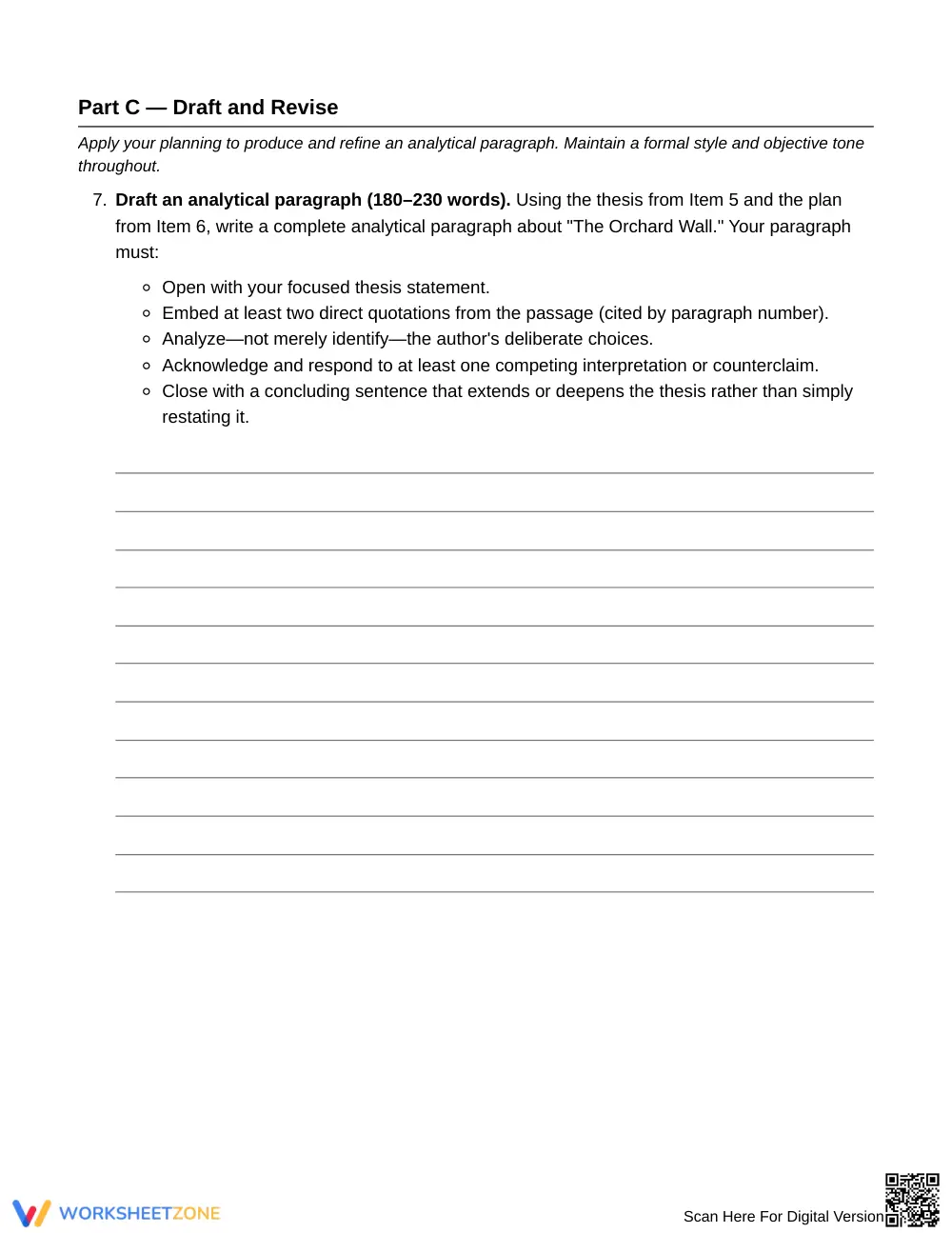
- Independent Practice (Part C, 2 tasks): Students compose an evidence-based paragraph and perform targeted revisions for transitions, cohesion, and precision.
This gradual-release structure moves writers from conceptual identification to independent paragraph composition.
Standards Alignment
This resource aligns to primary standard `W.9-10.1`: Write arguments to support claims in an analysis of substantive texts, using valid reasoning and relevant evidence. It also supports `RL.9-10.1` through rigorous text-based citations. Both standard codes can be copied directly into lesson plans, IEP goals, or district curriculum mapping tools.
How to Use It
Assign this activity during analytical writing units after introducing thesis formulas, or use it before major essays to remediate summary-heavy topic sentences. For formative assessment, check students' Part B planning tables to ensure their claims identify specific craft choices before drafting. Completion takes 45 to 60 minutes.
Who It's For
This worksheet serves Grade 10 English II students developing text-based arguments. Use the planning chart for small-group scaffolding. Pair this resource with direct instruction on literary analysis or an anchor chart on embedding quotations.
According to Fisher & Frey (2014), explicit instruction in analytical writing structures combined with deliberate modeling empowers secondary students to transition successfully from descriptive retelling to evaluative critique. Aligning with standard W.9-10.1, this instructional framework enables tenth-grade writers to master focused versus descriptive thesis statements by isolating craft choices, synthesizing nuanced textual evidence, and executing structured revisions. When students systematically distinguish between summary and interpretation, they develop the critical literacy required for college-ready argumentative writing. Research demonstrates that breaking complex composition tasks into explicit stages—evaluating sample arguments, isolating evidence, outlining reasoning, and revising for syntactic precision—substantially improves writing clarity, claim sophistication, and textual analysis among high school learners. By providing concrete mentor models and scaffolded practice, this instructional design strengthens students' capacity to construct defensible, text-based arguments across diverse academic contexts.


