




























Complete Flower Dissection Worksheet | Grades 7-12 Science
Paste this activity's link or code into your existing LMS (Google Classroom, Canvas, Teams, Schoology, Moodle, etc.).
Students can open and work on the activity right away, with no student login required.
You'll still be able to track student progress and results from your teacher account.
This flower dissection worksheet guides secondary science students through constructing, analyzing, and revising models of angiosperm reproduction. Across four structured sections, learners label anatomical whorls, correct peer misconceptions, trace fertilization pathways from pollen to seed, and test floral patterns across monocots and eudicots using authentic data sets.
At a Glance
- Grade: Grades 7–12 · Subject: Science
- Standard: Develop and use models to describe anatomical structures and reproductive systems
- Skill Focus: Construct, complete, or revise flower dissection models
- Format: 4 pages · 31 problems · Answer key included · PDF
- Best For: Post-lab synthesis or biology review
- Time: 45–60 minutes
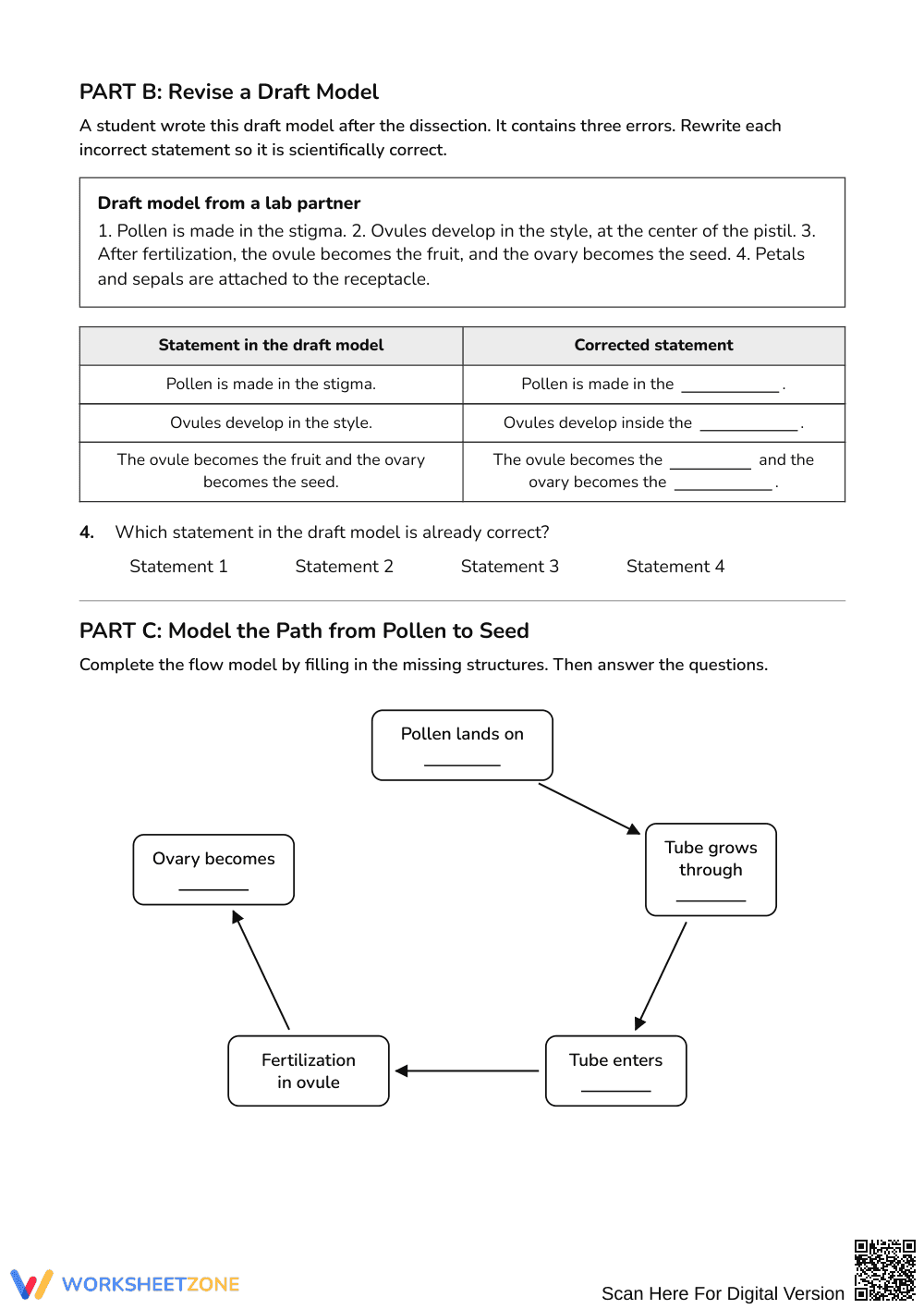
This 4-page student packet contains 31 targeted tasks divided into four parts, plus a 4-page teacher answer key. Students begin with diagram labeling supported by a word bank, advance to error correction in peer drafts, complete a fertilization flowchart, and analyze comparative data distinguishing monocot and eudicot morphology.
- Guided practice (Part A, 8 items): Students identify eight floral structures on a longitudinal section and explain how outer whorls protect developing ovules.
- Supported practice (Parts B & C, 11 items): Learners evaluate a flawed student draft to correct three anatomical errors, then map pollen tube growth through the style.
- Independent practice (Part D, 12 items): Students analyze specimen counts to classify monocots and eudicots, critique imperfect squash flowers, and refute botanical misconceptions.
This sequence follows gradual release, moving students from anatomical recall to independent scientific critique.
This resource aligns with secondary science standards for developing and using models to demonstrate how plant structures achieve reproductive success. It reinforces how anatomical adaptations support pollen transfer, pollen tube elongation, and seed development. Both standard topics can be copied directly into lesson plans, IEP goals, or district curriculum mapping tools.
Deploy this worksheet following a dissection lab to anchor physical observations into conceptual schematics, or assign it during a botany unit as an independent review packet. During classwork, formatively assess whether students distinguish between ovules and ovaries during fruit formation. Typical completion time is 45 to 60 minutes.
Designed for middle school life science and high school biology classrooms, this resource supports general, honors, and pre-AP biology students. Differentiated prompts challenge advanced learners to evaluate double fertilization and endosperm formation. Pair this worksheet with fresh flower specimens, microscope slides, or an anatomical floral anchor chart.
Developing conceptual models is foundational for secondary life science education, enabling students to organize structural evidence and articulate biological processes clearly. According to Fisher & Frey (2014), structured modeling progressions that transition from visual identification to peer-critique tasks significantly strengthen conceptual retention and academic literacy within scientific argumentation. When students actively revise flawed models, identify structural non-examples, and trace complex physiological flows like angiosperm fertilization, they move past superficial memorization into genuine explanatory competence. This 4-page worksheet aligns with national science modeling practices by requiring students to evaluate the physiological functions of floral whorls, predict reproductive outcomes across diverse plant taxa, and distinguish monocots from eudicots through authentic quantitative data. Incorporating structured error correction directly addresses prevalent student misconceptions regarding ovarian development and fruit maturation, establishing a reliable, standards-based formative assessment measure for secondary biology and life science instructors.


