




























Views
Downloads


Complete Exoplanet Orbits Worksheet | Grade 12 Science

Paste this activity's link or code into your existing LMS (Google Classroom, Canvas, Teams, Schoology, Moodle, etc.).
Students can open and work on the activity right away, with no student login required.
You'll still be able to track student progress and results from your teacher account.
This orbital motion worksheet trains Grade 12 students to evaluate astronomical inferences and test candidate exoplanet data using Kepler's laws. Learners calculate stellar masses, analyze survey baselines, and determine whether published planetary claims are physically consistent with observational constraints across multi-planet systems.
At a Glance
- Grade: 12 · Subject: Earth & Space Science
- Standard: Orbital Mechanics — Apply Kepler's laws to verify and evaluate exoplanetary orbital claims
- Skill Focus: Evaluate an Exoplanet-Orbit Inference
- Format: 5 pages · 10 problems · Answer key included · PDF
- Best For: Astrophysics and orbital mechanics review
- Time: 45–60 minutes
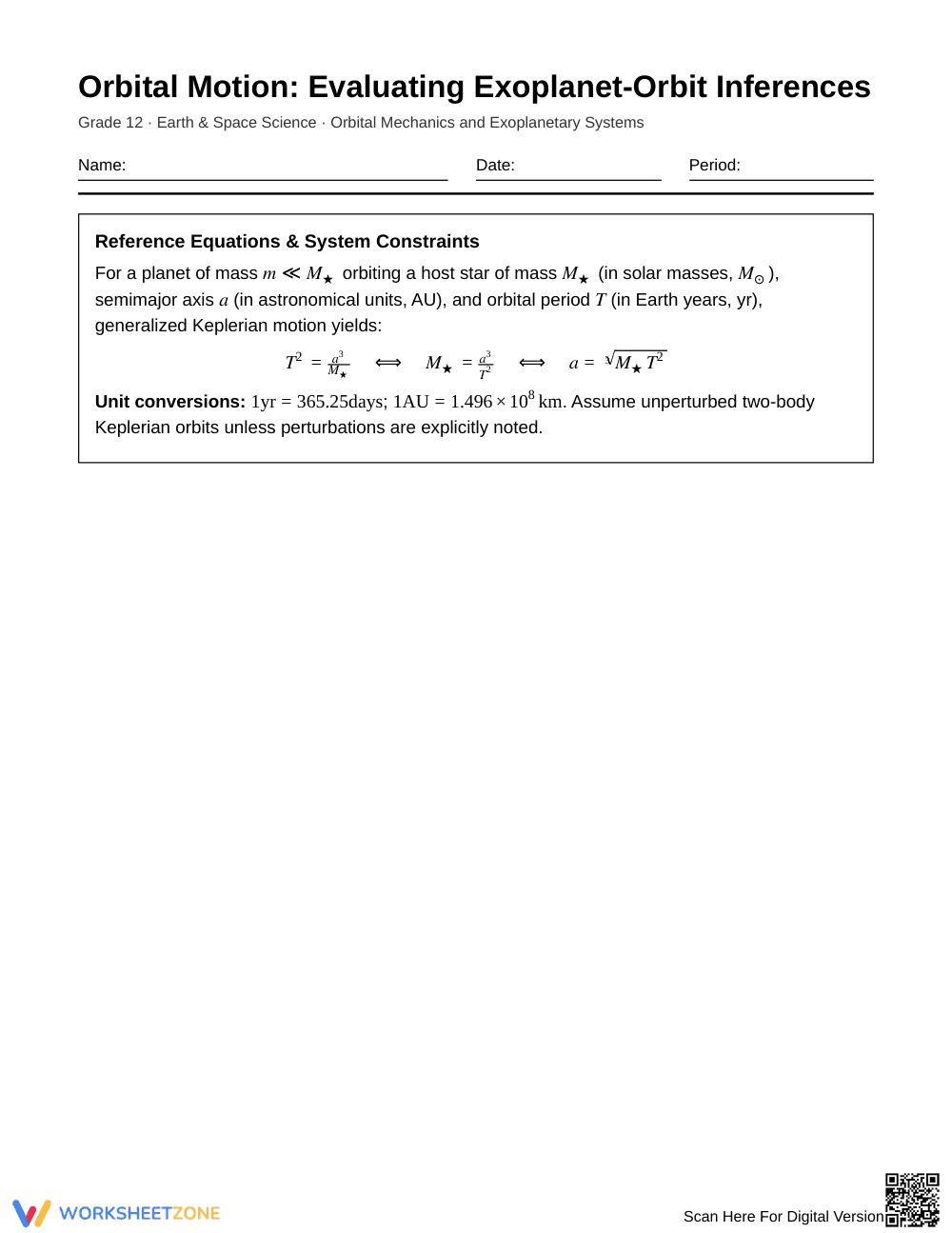
The 5-page worksheet includes reference equations for Kepler's Third Law, unit conversions, and synthetic datasets for host stars Alpha-9 and Kepler-X72. Across 10 tasks, students examine transit baselines, derive orbital periods, calculate periastron and apastron distances, and write scientific evaluations. A complete 3-page answer key provides step-by-step mathematical solutions and evaluation criteria.
Skill Progression
- Guided practice (Tasks 1–2): Students establish physical constraints, identifying two-body mass assumptions and maximum observable transits within survey baselines.
- Supported practice (Tasks 3–8): Learners apply orbital equations to calculate stellar mass, determine period ratios, compute eccentric orbital bounds, and apply Kepler's Second Law.
- Independent practice (Tasks 9–10): Students conduct unassisted evaluations of two research preprints, proving whether proposed exoplanet candidates represent genuine discoveries or flawed inferences.
This structure follows an "I Do, We Do, You Do" gradual-release framework.
Standards Alignment
This activity aligns with high school Earth and Space Science standards governing orbital mechanics and Keplerian motion. Students construct scientific arguments supported by quantitative evidence to evaluate planetary claims. Both standard concepts and analytical competencies can be copied directly into lesson plans, IEP goals, or district curriculum mapping tools.
How to Use It
Use this resource after direct instruction on Kepler's Third Law and transit detection methods. It works well as an intensive paired investigation or summative assessment. While circulating, verify that students adjust for non-solar host stellar masses when calculating theoretical orbital periods. Completion takes approximately 45 to 60 minutes.
Who It's For
Designed for Grade 12 Earth and Space Science and Advanced Placement Physics students. Advanced learners evaluate multi-parameter datasets, while students needing support benefit from the provided reference equations and structured data tables. Pair this worksheet with a photometric transit simulation or astronomy lecture.
Evaluating scientific inferences through quantitative modeling represents a core competency in Grade 12 Earth and Space Science. According to Fisher & Frey (2014), structured gradual-release frameworks enable secondary science students to transition successfully from conceptual formulas to complex data evaluation. This worksheet reinforces the plain-English skill of applying Kepler's laws to verify exoplanetary orbital claims by challenging students to analyze observational constraints, compute orbital parameters, and detect erroneous claims in published research. By embedding authentic spectroscopic and photometric parameters across 10 structured tasks, the activity deepens conceptual mastery of two-body gravitational mechanics, orbital eccentricity, and transit survey limitations. Students gain the analytical proficiency required to critique astronomical claims and substantiate scientific conclusions using mathematical evidence. This rigorous practice prepares high school learners for college-level astrophysics coursework and inquiry-based STEM investigations in higher education.


