




























Complete Evidentiary Gaps Worksheet | Grade 10 English II
Paste this activity's link or code into your existing LMS (Google Classroom, Canvas, Teams, Schoology, Moodle, etc.).
Students can open and work on the activity right away, with no student login required.
You'll still be able to track student progress and results from your teacher account.
Teach tenth-grade students to evaluate how authors manipulate informational text structure to obscure missing or contradictory evidence. Students analyze a paired municipal transit report, tracing how executive summaries aggregate data to mask demographic disparities and high peripheral subsidies. This 8-task worksheet develops critical rhetoric analysis and prepares learners for advanced non-fiction textual critique.
At a Glance
- Grade: 10 · Subject: English II
- Standard:
RI.9-10.5— Analyze how structure shapes and clarifies claims in complex texts- Skill Focus: Structural Framing & Evidentiary Gaps
- Format: 6 pages · 8 problems · Answer key included · PDF
- Best For: Close reading and rhetorical analysis
- Time: 45–60 minutes
This 6-page printable activity features a two-part informational text, an analytical comparison table, and eight rigorous tasks. Students engage with multiple-choice constraint identification, fiscal metric contrasting, table-based structural evaluation, and extended policy synthesis prompts. A 5-page teacher answer key provides complete model responses and detailed explanations.
Skill Progression
- Guided Practice (Part A, Tasks 1–2): Students identify how initial paragraph placement establishes baseline interpretive constraints and contrast high-level cost recovery with disaggregated operational realities.
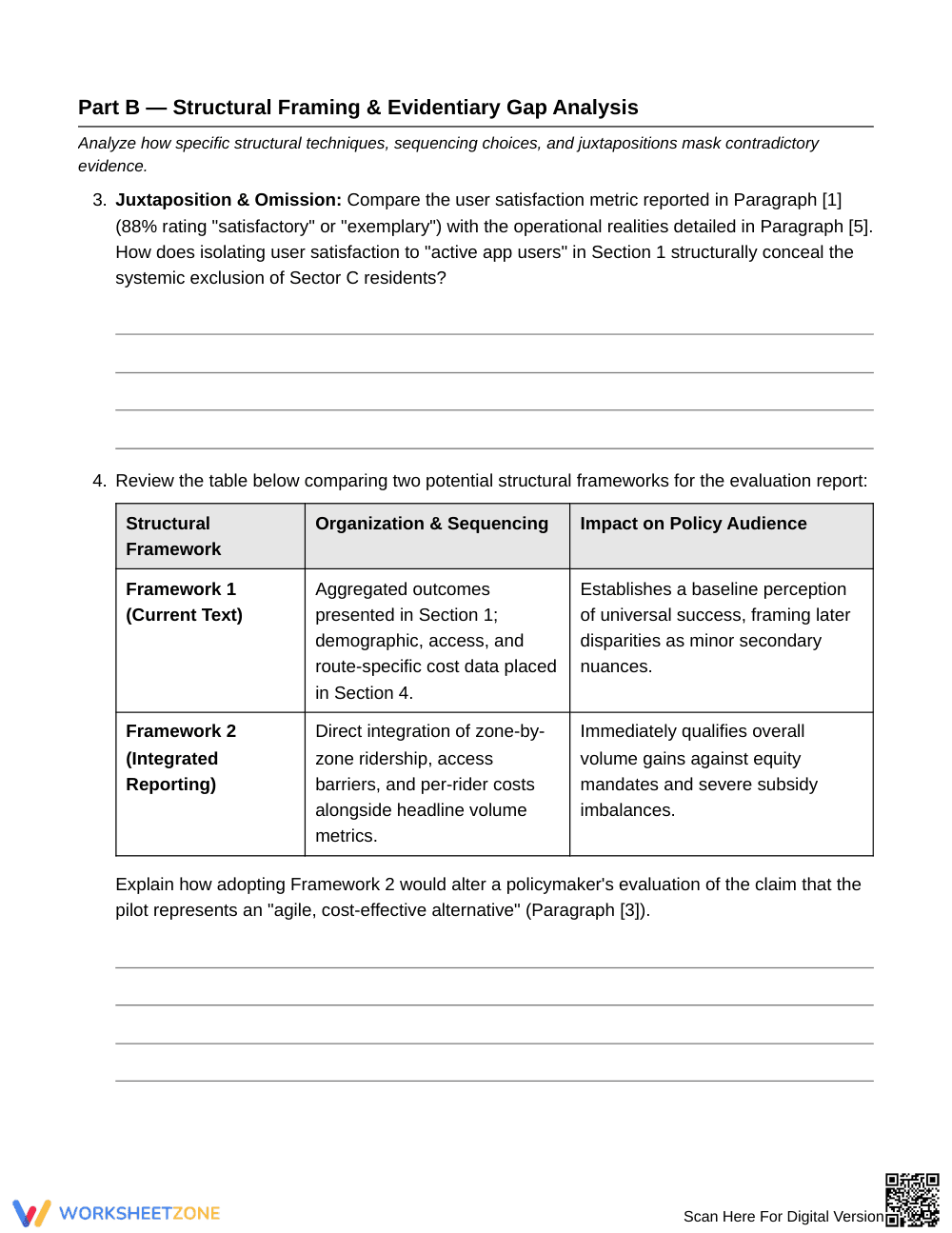
- Supported Practice (Part B, Tasks 3–6): Learners examine juxtaposition, comparative reporting frameworks, and sentence transitions using structured prompts.
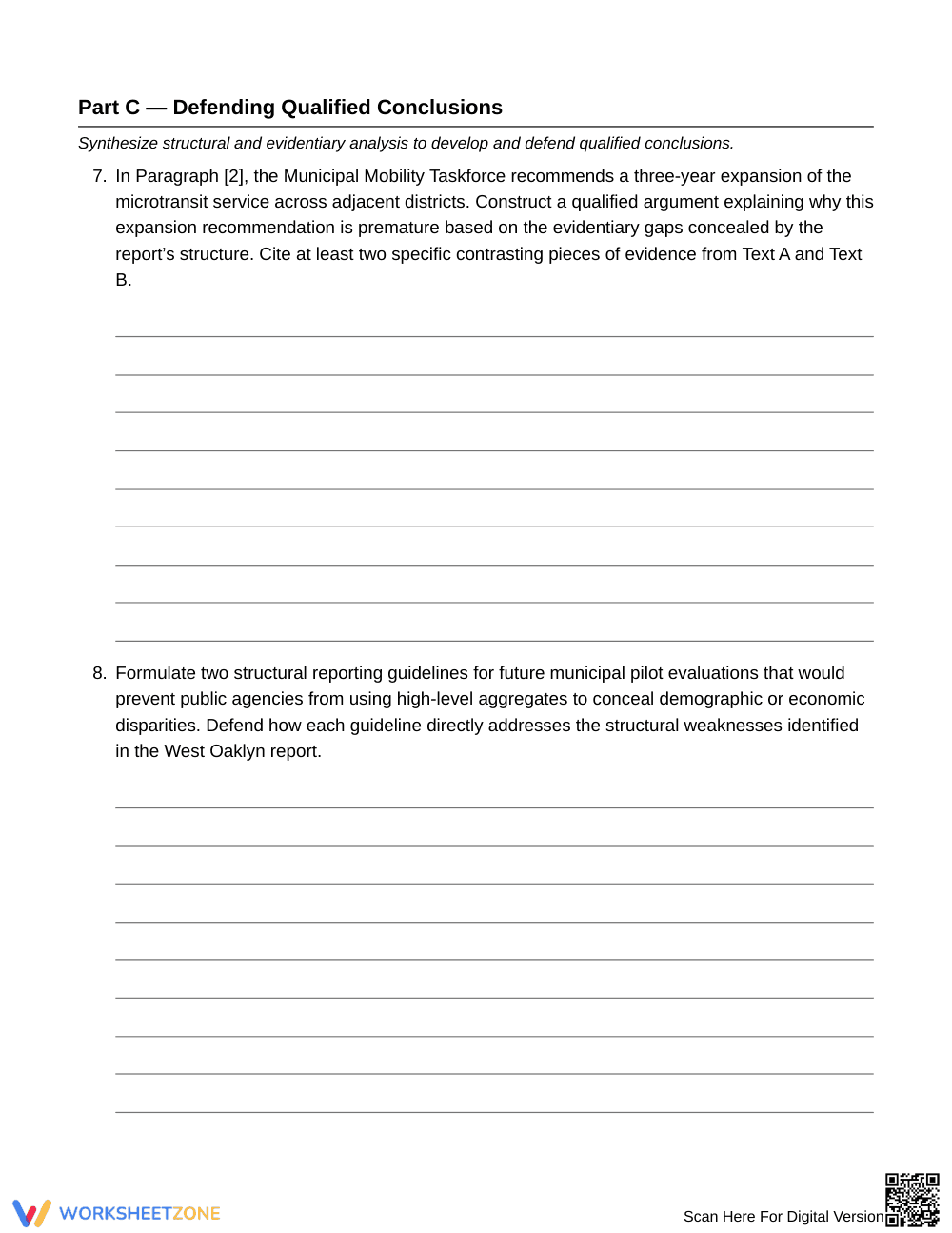
- Independent Practice (Part C, Tasks 7–8): High schoolers independently synthesize findings to construct qualified policy arguments and formulate robust structural reporting guidelines.
This gradual-release architecture moves students systematically from identifying isolated structural techniques to critiquing systemic informational bias.
Standards Alignment
This resource aligns directly with primary standard RI.9-10.5: Analyze in detail how an author’s ideas or claims are developed and refined by particular sentences, paragraphs, or larger portions of a text. Supporting standard RI.9-10.8 is reinforced as students evaluate argument validity and evidence relevance. Both standard codes can be copied directly into lesson plans, IEP goals, or district curriculum mapping tools.
How to Use It
Deploy this worksheet after direct instruction on text structures and informational bias. In a whole-class setting, guide students through Text A and Text B before assigning Parts A and B for partner analysis. For formative assessment, examine student responses to Task 4; if learners struggle to explain how separated reporting alters perception, conduct a brief re-teaching check on juxtaposition. Expected completion time is 45 to 60 minutes.
Who It's For
This activity is designed for Grade 10 English II students mastering non-fiction text complexity, honors ELA cohorts, and AP Seminar preparation classes. Pair this worksheet with an anchor chart on informational text structures to maximize comprehension.
Tenth-grade mastery of standard RI.9-10.5 requires students to recognize how paragraph sequencing and metric aggregation function as rhetorical mechanisms. As highlighted by Fisher & Frey (2014), close reading of complex non-fiction demands that secondary readers evaluate not only what an author explicitly states, but also what structural choices omit or downplay. This worksheet operationalizes evidentiary gap analysis across eight structured tasks, directing learners to contrast high-visibility executive summaries against disaggregated data in technical subsections. By investigating how municipal reports aggregate rider satisfaction and cost efficiency to conceal suburban access disparities, students develop transferable analytical tools for college-level reading. The scaffolded progression from multiple-choice constraint identification to independent policy formulation ensures that high schoolers cultivate deep critical literacy. Integrating direct textual critique with structured synthesis empowers learners to interrogate institutional claims and evaluate data-driven argumentation effectively.


