

































Complete Event List to Narrative Worksheet | Grade 6 ELA

Paste this activity's link or code into your existing LMS (Google Classroom, Canvas, Teams, Schoology, Moodle, etc.).
Students can open and work on the activity right away, with no student login required.
You'll still be able to track student progress and results from your teacher account.
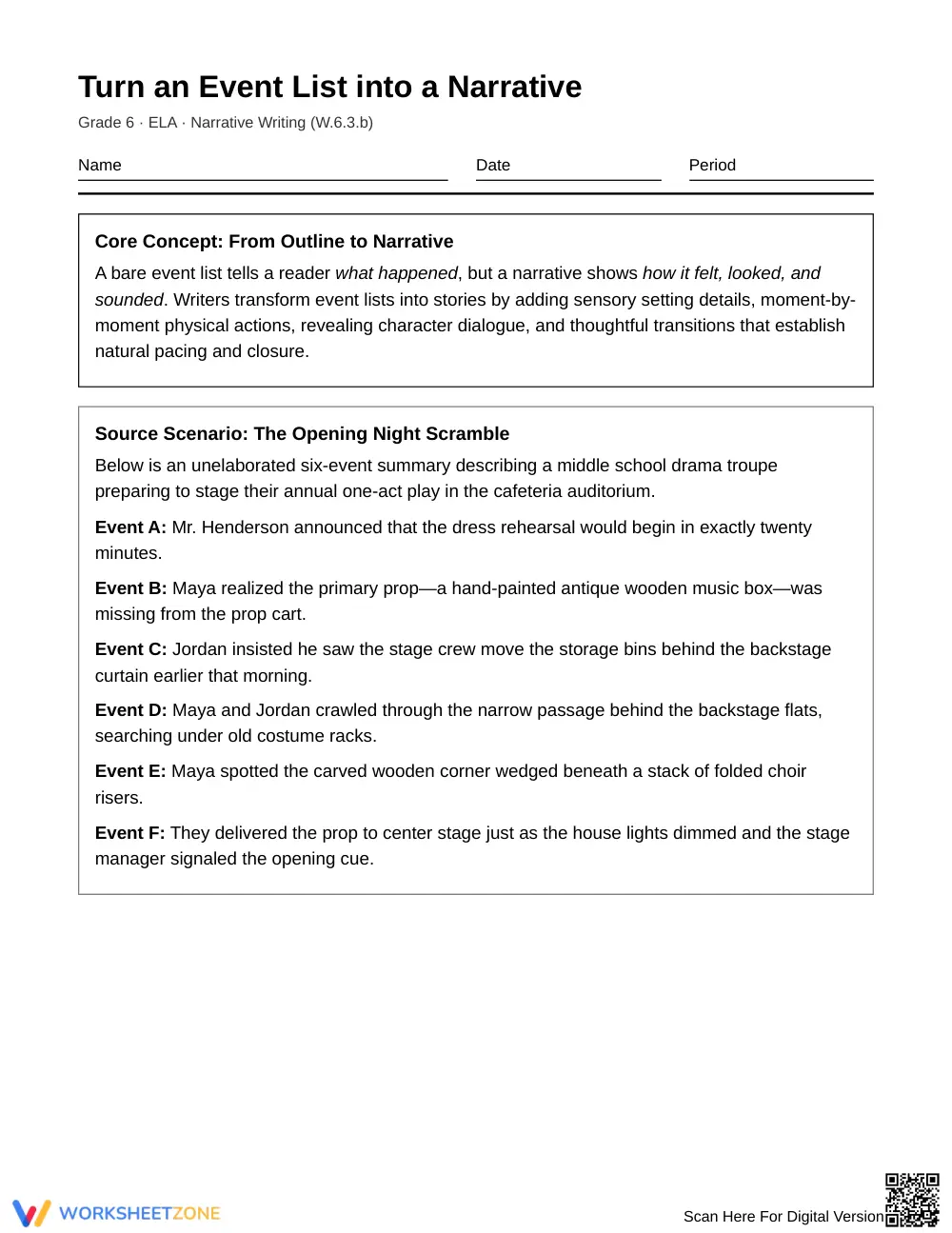
This Grade 6 ELA narrative writing worksheet trains middle school writers to transform chronological summary outlines into fully realized, descriptive scenes. Students analyze plot structure, draft descriptive elements with sensory dialogue and pacing, and synthesize a cohesive scene, moving beyond flat summary to purposeful narrative storytelling.
At a Glance
- Grade: 6 · Subject: ELA
- Standard: Narrative Writing — Develop narrative scenes using sensory details, pacing, dialogue, and transitions
- Skill Focus: Turn an Event List into a Narrative
- Format: 5 pages · 8 problems · Answer key included · PDF
- Best For: Writing workshop scene expansion practice
- Time: 45–60 minutes
What's Inside: This 5-page printable packet includes 8 focused tasks arranged around a backstage drama scenario. Students evaluate narrative pacing, complete targeted line-by-line expansions with sensory details and dialogue, and draft a 140-word narrative scene. A comprehensive 4-page answer key provides complete model responses, analytical explanations, and revision exemplars.
Skill Progression
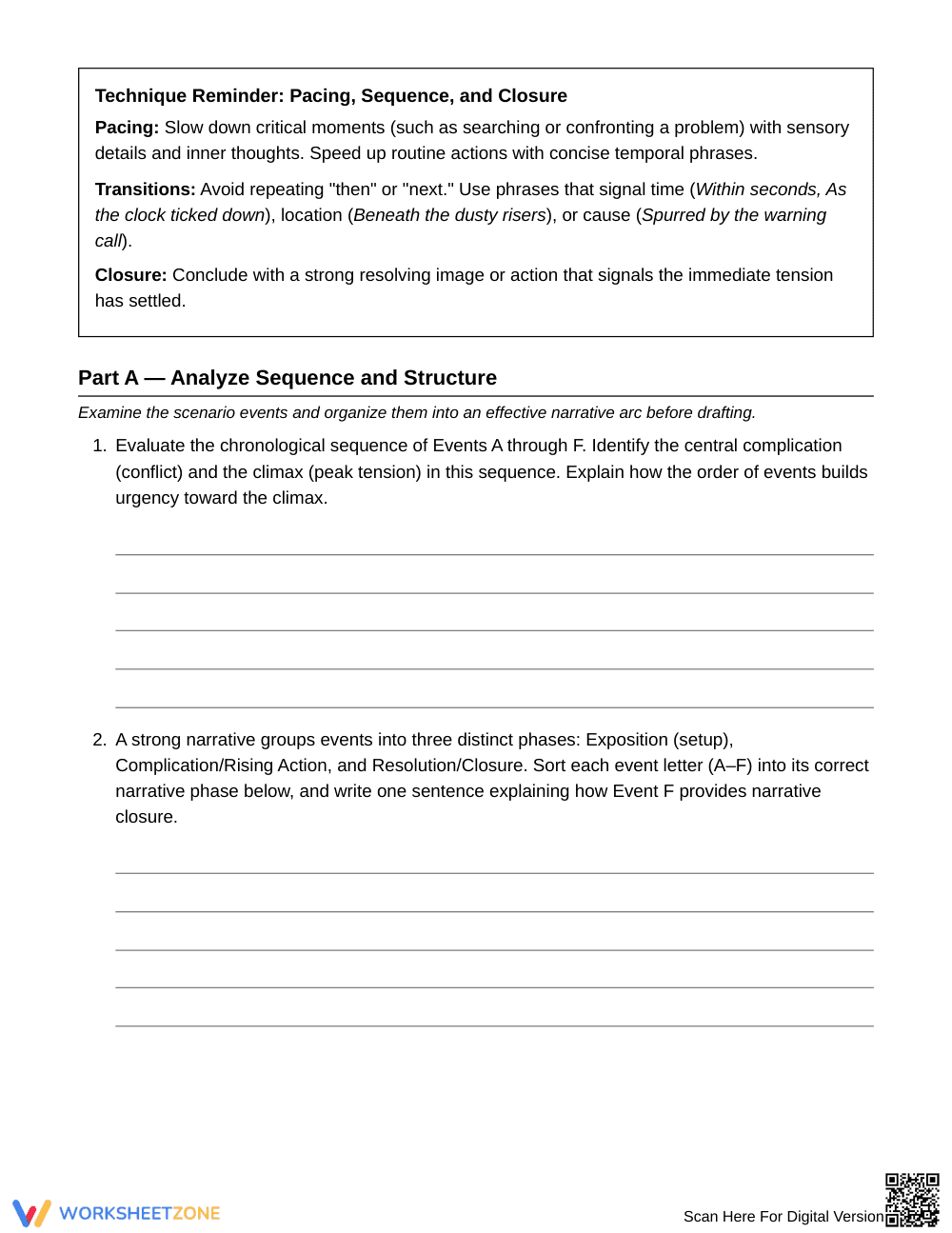
- Guided Practice: Tasks 1 and 2 guide students through plot analysis, categorizing 6 chronological events into exposition, complication, and resolution phases while evaluating narrative pacing.
- Supported Practice: Tasks 3 through 6 provide focused sentence-level exercises where students draft backstage atmosphere, physical character reactions, dialogue exchanges, and varied transitions.
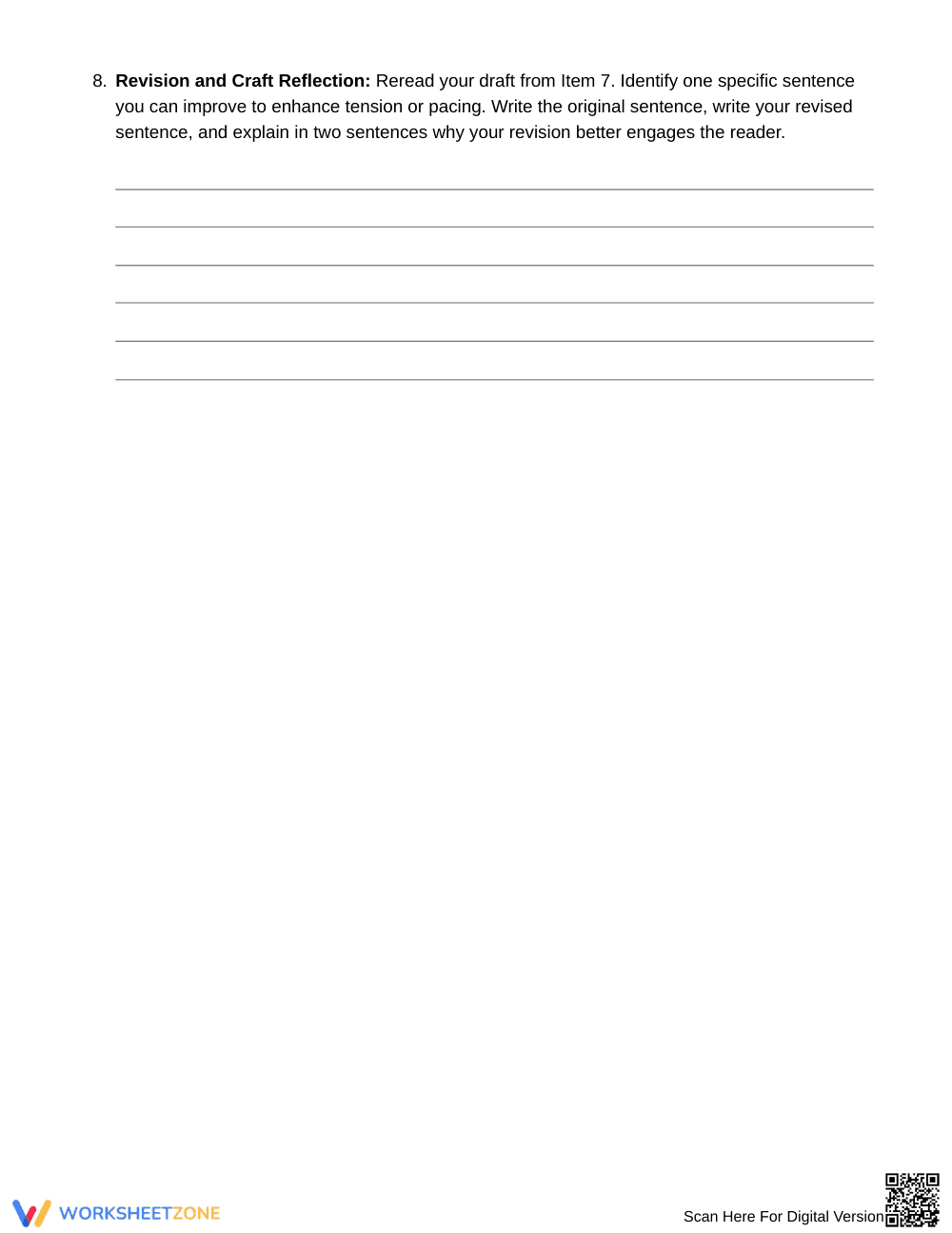
- Independent Practice: Tasks 7 and 8 challenge students to draft a continuous scene independently and perform self-reflection by revising a single sentence to sharpen tension.
This structure reflects the gradual-release model, moving writers smoothly from analytical deconstruction to supported elaboration and fully autonomous drafting.
Standards Alignment
This resource focuses on middle school narrative writing benchmarks by requiring students to employ narrative techniques, descriptive details, and clear event sequences. Learners practice establishing context, incorporating natural dialogue, pacing events deliberately, and crafting meaningful narrative closure. Both standard codes can be copied directly into lesson plans, IEP goals, or district curriculum mapping tools.
How to Use It
Use this resource during the mid-unit drafting stage of narrative writing. Introduce the packet after direct instruction on sensory language and dialogue formatting to reinforce scene expansion. Alternatively, assign Part B during small-group intervention while reviewing student drafts. As a formative assessment tip, check Task 4 to verify whether students replace emotion labels with observable physical actions. Expect completion in 45 to 60 minutes.
Who It's For
This packet serves sixth-grade general education students, developing writers who struggle with plot summarization, and English learners needing structured writing frames. Pair this worksheet directly with a teacher-led mentor text study or an anchor chart highlighting temporal transitional phrases to maximize student success.
According to Fisher & Frey (2014), the gradual release of responsibility framework accelerates adolescent writing growth by transitioning students from collaborative analysis to autonomous composition. This Grade 6 narrative writing resource operationalizes that research through an 8-task progression that teaches students to turn an event list into a narrative. Middle school writers frequently default to chronological plot summaries, listing events rather than rendering them through sensory atmosphere, character action, and authentic dialogue. By structuring the writing process into distinct analytical, elaborative, and synthetic phases across 5 pages, this instructional design supports working memory and cognitive stamina. Students first evaluate narrative pacing, subsequently expand isolated scene components, and ultimately produce an original 140-word dramatic narrative accompanied by targeted revision reflection. The included 4-page answer key equips teachers with explicit exemplars to support robust formative feedback and scaffolded writing instruction.


