




























Views
Downloads




Complete Evaluating Proposals Worksheet | Grade 7 ELA

Paste this activity's link or code into your existing LMS (Google Classroom, Canvas, Teams, Schoology, Moodle, etc.).
Students can open and work on the activity right away, with no student login required.
You'll still be able to track student progress and results from your teacher account.
This targeted reading comprehension worksheet trains middle school readers to evaluate an informational proposal by testing claims and evidence against real-world constraints. Students analyze an authentic operational scenario involving youth center renovation budgets, staffing, sightlines, and timelines, developing the critical literacy skills needed to assess whether an author's reasoning is truly sound.
At a Glance
- Grade: 7 · Subject: ELA
- Standard:
RI.7.8— Trace and evaluate arguments, distinguishing sound claims from unsupported assertions- Skill Focus: Evaluate a Proposal Against Constraints
- Format: 5 pages · 10 problems · Answer key included · PDF
- Best For: Argument evaluation and evidence analysis
- Time: 40–50 minutes
What's Inside
The 5-page printable resource includes a rich informational case study followed by 10 analytical tasks divided across three scaffolded sections. Students encounter multiple-choice identification items, short-answer evidence evaluations, a structured comparison matrix, and open-ended policy recommendations. A complete 2-page answer key provides clear model responses and text-grounded explanations for rapid grading.
Skill Progression
- Guided practice (Part A — Tasks 1–2): Identifies baseline parameters and explicit operational limits through structured multiple-choice questions with low cognitive load.
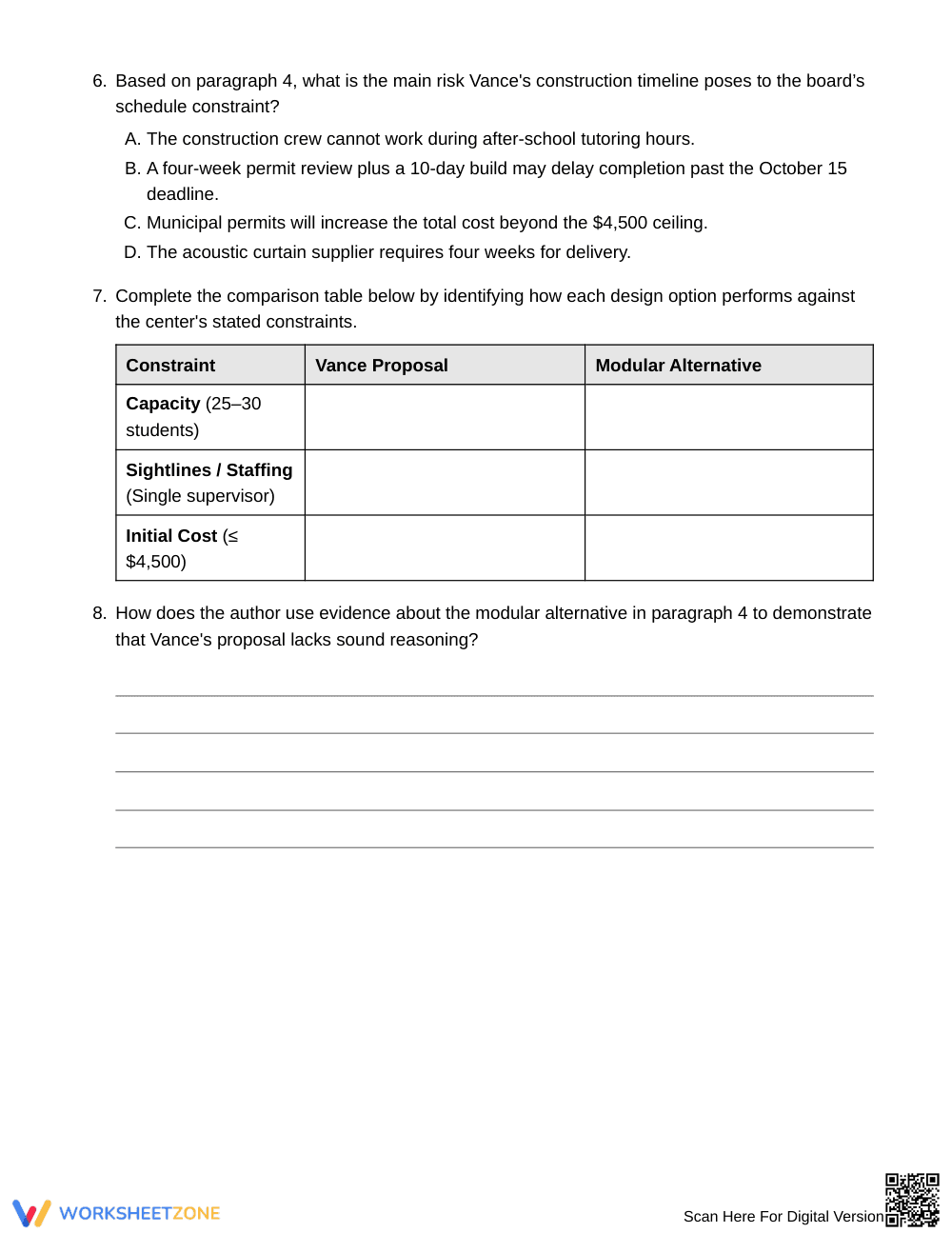
- Supported practice (Part B — Tasks 3–8): Directs students to evaluate conflicting claims, calculate long-term staffing costs, assess timeline feasibility, and complete an evidence comparison matrix.
- Independent practice (Part C — Tasks 9–10): Requires students to synthesize findings into an evidence-based recommendation memo and author a viable compromise proposal balancing all constraints.
This sequence embodies the gradual release of responsibility model, guiding learners from concrete constraint identification toward independent, multi-variable argumentative evaluation.
Standards Alignment
Primary Standard: `RI.7.8` — Trace and evaluate the argument and specific claims in a text, assessing whether the reasoning is sound and the evidence is relevant and sufficient to support the claims. This resource challenges students to look beyond persuasive rhetoric to verify whether structural data, timelines, and budgets actually support an author's assertions. Both standard codes can be copied directly into lesson plans, IEP goals, or district curriculum mapping tools.
How to Use It
Deploy this activity during the guided application phase of an argumentative reading unit or as a mid-unit formative assessment. For whole-class instruction, read the youth center scenario together, pause to underline the four core constraints in paragraph 1, and allow students to complete Parts B and C in collaborative pairs. Formative observation tip: Monitor student responses to Task 5 to ensure they recognize how recurring monthly staffing costs compromise an initially compliant construction budget. The complete activity takes approximately 40 to 50 minutes.
Who It's For
This worksheet is designed for Grade 7 general education English language arts students, advanced Grade 6 critical reading groups, and Grade 8 intervention classes addressing text analysis gaps. Pair this practice set with an anchor chart on logical fallacies or a direct instruction lesson on evaluating sound versus unsound reasoning.
According to Fisher & Frey (2014), teaching students to evaluate text claims against external criteria and physical constraints strengthens high-level comprehension and disciplinary literacy. When middle school learners engage with realistic data sets, operational trade-offs, and competing proposals under RI.7.8, they build authentic analytical habits that transfer directly into persuasive writing and real-world decision-making. This resource bridges abstract argumentation concepts and concrete evidence analysis by embedding explicit financial, spatial, and scheduling parameters directly into the reading passage. Rather than accepting an author's claims at face value, students systematically check assertions against verifiable facts, strengthening their ability to distinguish valid logic from unsupported assertions across complex informational texts.


