































Complete Endocrine System Word Search | Grades 8–10 Science

Paste this activity's link or code into your existing LMS (Google Classroom, Canvas, Teams, Schoology, Moodle, etc.).
Students can open and work on the activity right away, with no student login required.
You'll still be able to track student progress and results from your teacher account.
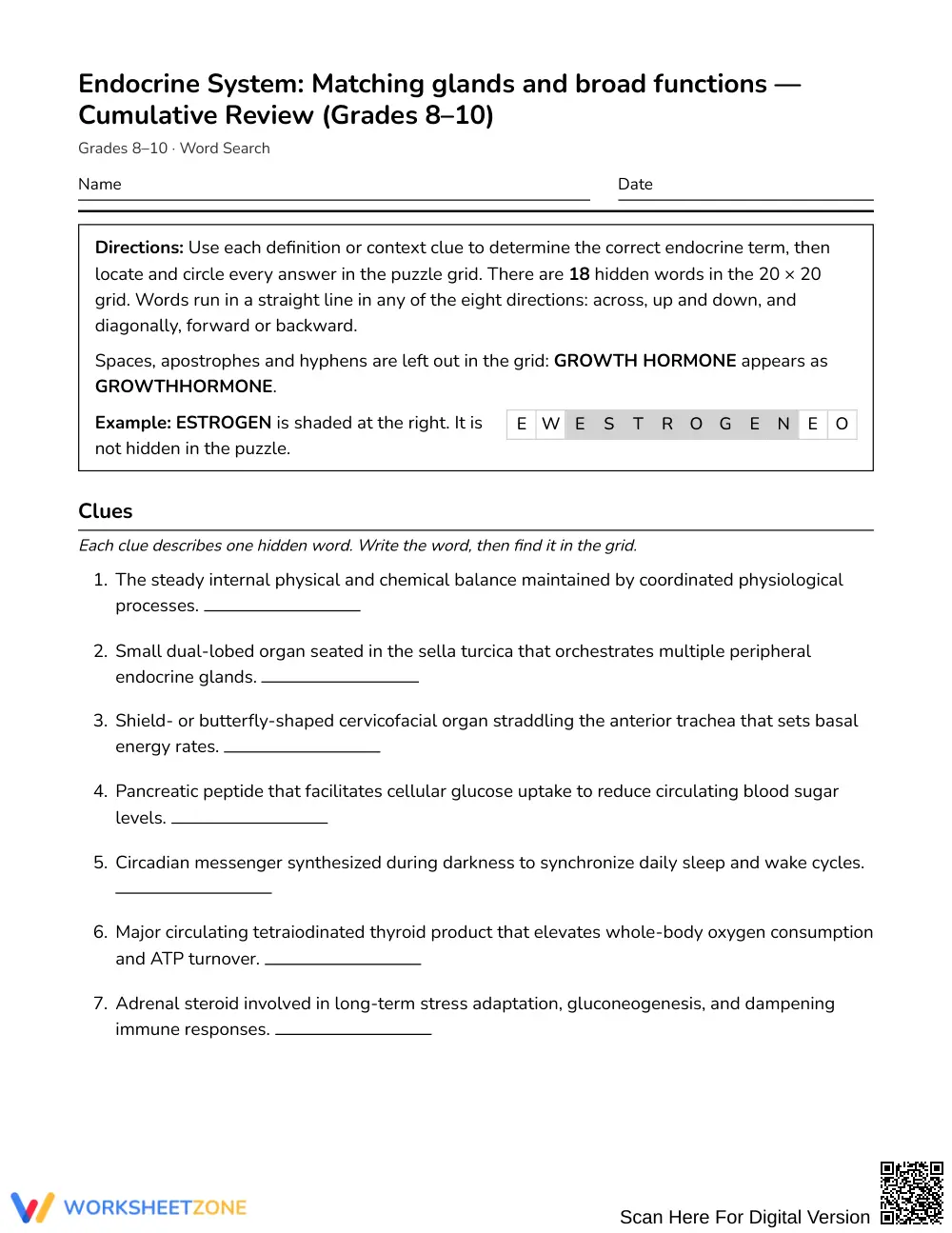
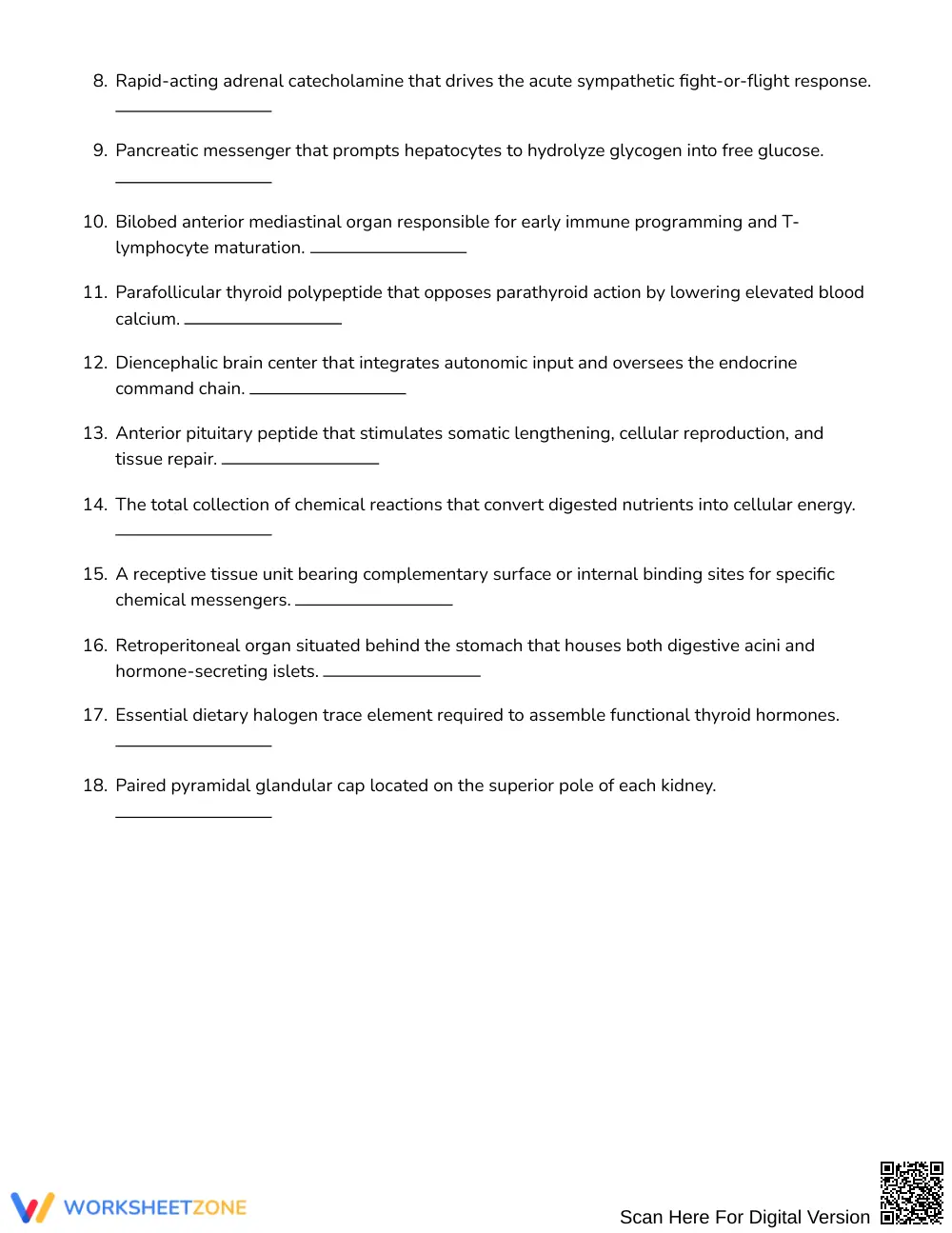
This human body system word search reinforces endocrine system anatomy and physiology by challenging students to connect eighteen critical glands, hormones, and physiological processes to their core functions. Students solve biological clues to identify key endocrine terms and locate them in the puzzle, consolidating vocabulary across secondary science units.
At a Glance
- Grade: Grades 8–10 · Subject: Science (Life Science / Biology)
- Standard: Not standards-assessed — vocabulary enrichment and anatomical term recall
- Skill Focus: Matching endocrine glands, hormones, and broad physiological functions
- Format: 3 student pages · 18 words · Full answer key included · PDF
- Best For: Cumulative unit review, post-instruction reinforcement, and sub plans
- Time: 25–35 minutes of focused practice
What's Inside
This 3-page science resource presents an 18-word puzzle driven by text-based clues rather than a simple term list. Students read eighteen biological definitions—spanning regulatory glands like the pituitary to chemical messengers like glucagon—to determine each term before searching. A shuffled word bank supports learners while maintaining rigor, and a 4-page answer key provides clear grid solutions.
Puzzle Structure and Mechanics
The puzzle features a 20 x 20 letter grid designed to reinforce vocabulary recognition. Hidden terms run in eight directions: north, northeast, east, southeast, south, southwest, west, and northwest. Students solve eighteen content clues defining structures like the adrenal gland and hormones like cortisol, then locate each term using the shuffled word bank for verification.
Standards Alignment
This resource provides targeted vocabulary enrichment rather than alignment to a specific content standard. By reinforcing critical terminology—including endocrine structures, hormonal feedback, and homeostasis—the word search supports broader high school biology coursework and human body systems curricula.
How to Use It
Use this word search immediately following direct instruction on the endocrine system for formative reinforcement. Alternatively, assign it as a collaborative review where student pairs decode definitions together before searching the grid. While circulating during this 25- to 35-minute activity, check whether students deduce terms from clues or rely heavily on the word bank, identifying concepts that need reteaching.
Who It's For
This activity is designed for Grades 8–10 science students learning human body systems and regulatory physiology. For students needing support, provide an anatomical diagram showing endocrine gland locations. Pair this word search naturally with an instructional lesson on negative feedback loops or a case study on hormonal regulation.
Focused anatomical vocabulary acquisition strengthens foundational comprehension in secondary life science. When secondary science students practice matching glands and broad functions through contextual clues and retrieval puzzles, they internalize complex physiological systems more effectively. According to Fisher & Frey (2014), purposeful vocabulary consolidation and intentional word exposure bridge the gap between initial direct instruction and independent domain-specific fluency. This Grades 8–10 endocrine system activity provides non-standardized vocabulary enrichment across 18 specialized terms, prompting learners to analyze biological definitions for regulatory structures including the hypothalamus, thyroid, and adrenal glands. By integrating active recall with spatial pattern recognition, students construct durable mental models of metabolic signaling and hormonal regulation. High school biology teachers can utilize this 3-page learning tool during formative review cycles to assess student familiarity with human body systems, ensuring learners retain precise biological terminology for subsequent physiological units.


