




























Complete Earthworm Data Worksheet | Grades 7–12 Science
Paste this activity's link or code into your existing LMS (Google Classroom, Canvas, Teams, Schoology, Moodle, etc.).
Students can open and work on the activity right away, with no student login required.
You'll still be able to track student progress and results from your teacher account.
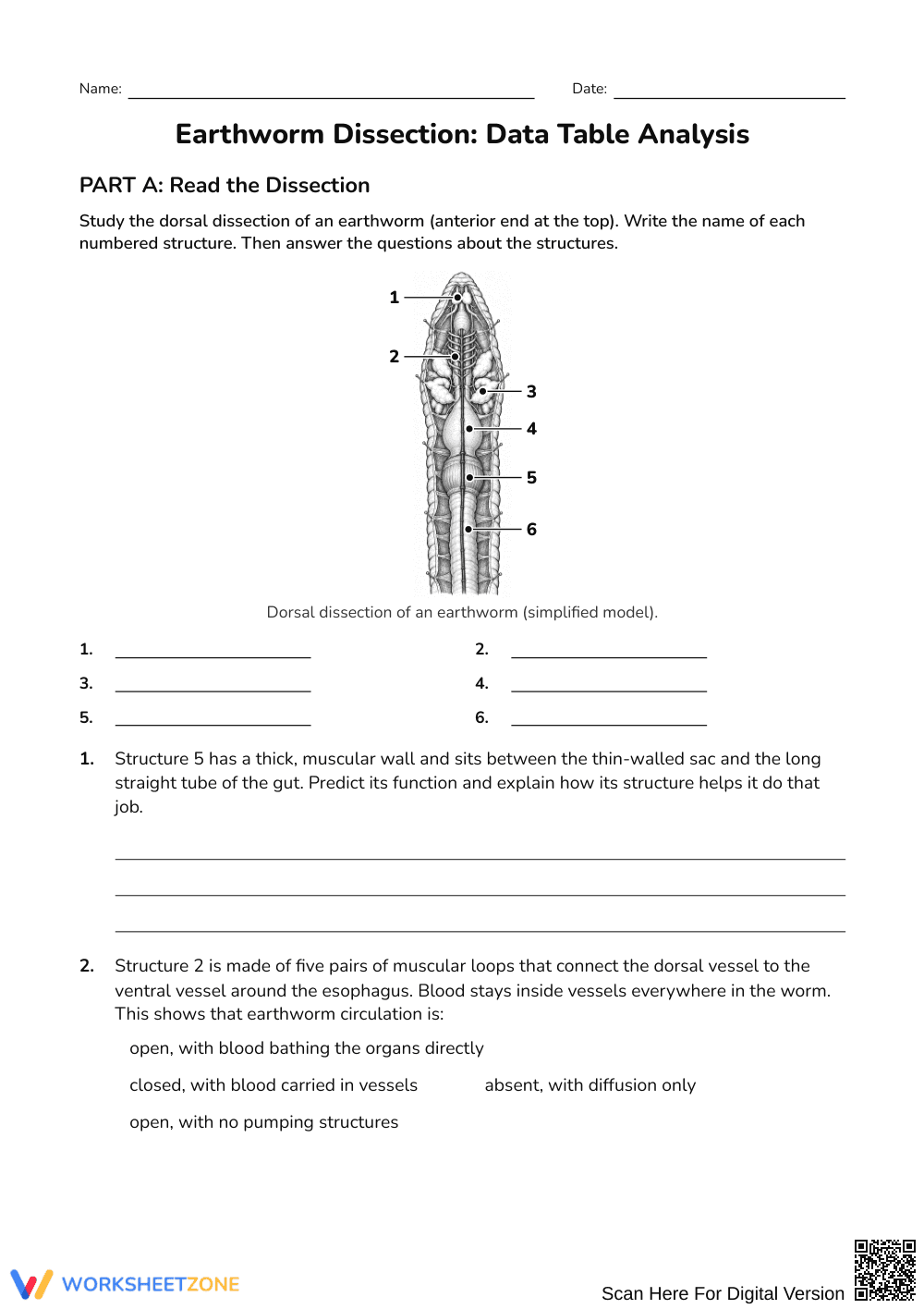
This comprehensive science worksheet trains students to analyze anatomical diagrams, calculate segment ratios, and interpret body-plan data tables from an earthworm dissection. Students connect physical structures such as aortic arches and the typhlosole directly to circulatory and digestive functions, building quantitative reasoning skills across authentic biological datasets.
At a Glance
- Grade: 7–12 · Subject: Science
- Standard: Structure, Function, and Information Processing — Model how organ systems interact and support survival
- Skill Focus: Earthworm anatomy and dissection data table analysis
- Format: 4 pages · 34 problems · Answer key included · PDF
- Best For: Lab prep, post-lab analysis, or absent-student replacement
- Time: 45–60 minutes
What's Inside
This four-page resource features four progressive sections containing 34 targeted questions. Students examine dorsal and cross-sectional anatomical diagrams, complete mathematical calculations for segment lengths, map organ locations across numbered segments, and write an evidence-based claim. A complete four-page answer key provides full model responses, formulas, and structural functions.
Skill Progression
- Guided practice (Part A, 8 items): Students identify anterior structures using a word bank and evaluate structure-function relationships with guided prompts.
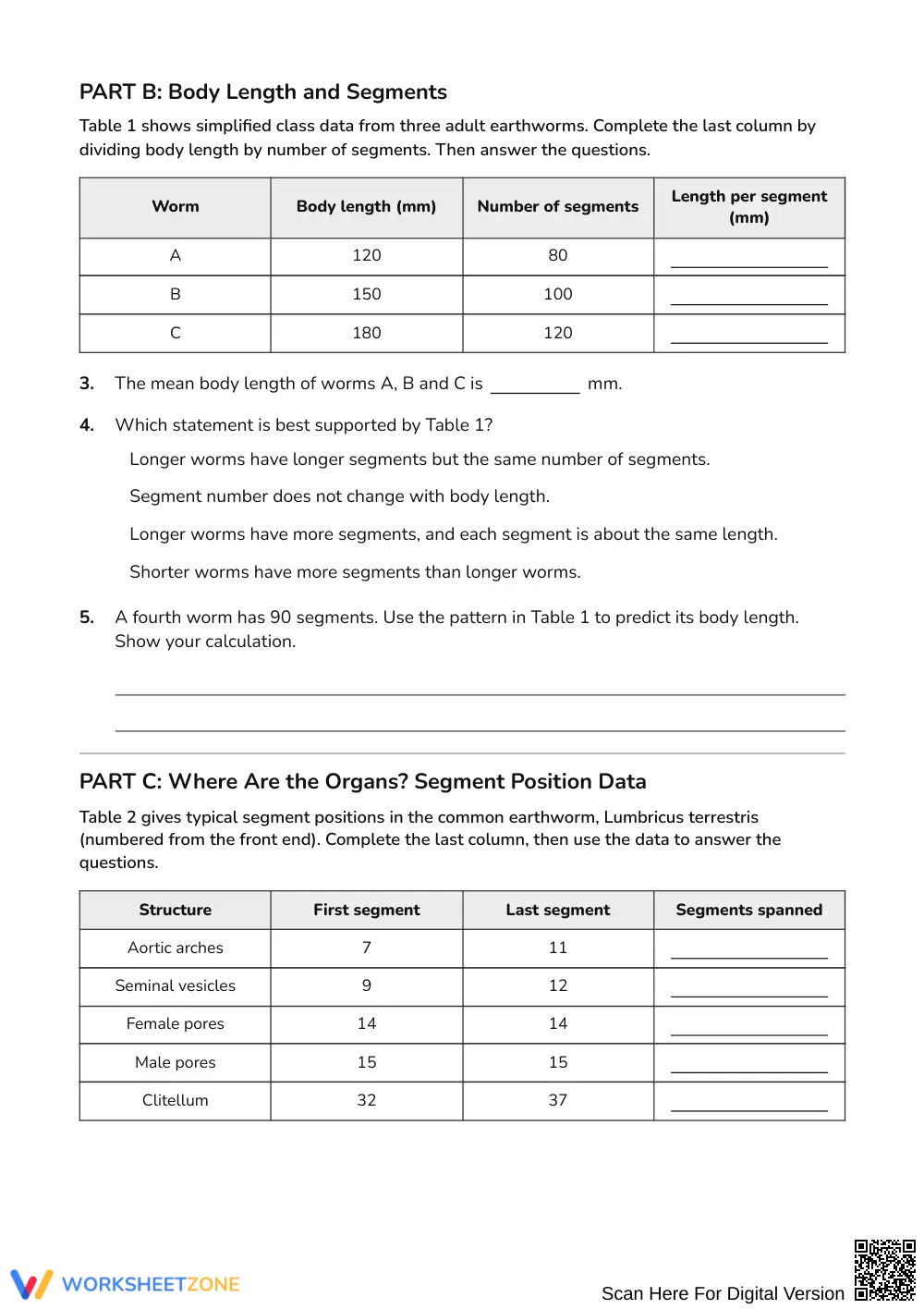
- Supported practice (Parts B & C, 14 items): Learners complete ratio calculations in data tables, predict lengths using segment patterns, and track organ distribution across anatomical segments.
- Independent practice (Part D, 12 items): Students analyze cross-sectional tissues, calculate total setae counts, and construct a full Claim-Evidence-Reasoning explanation connecting segmentation to organ placement.
This structured sequence reflects the gradual-release model, moving students from observational identification to independent quantitative and analytical synthesis.
Standards Alignment
This worksheet aligns with middle and high school life science standards focusing on multicellular body systems, organization, and evidence-based scientific argumentation. Students analyze how specialized circulatory, digestive, and muscular systems interact within segmented organisms to support survival. These standard topics can be copied directly into lesson plans, IEP goals, or district curriculum mapping tools.
How to Use It
Use this worksheet immediately after introducing invertebrate anatomy or as a structured wet-lab alternative for students needing non-dissection options. During independent work, conduct formative check-ins at Table 1 to ensure students correctly divide body length by segment count before moving to spatial mapping. The resource requires 45 to 60 minutes for complete completion.
Who It's For
Designed for middle and high school biology or life science classrooms, this activity supports general education students, remedial learners needing data literacy scaffolds, and advanced middle schoolers. Pair this packet with a preserved specimen demonstration or a digital 3D dissection tool to reinforce tactile and visual connections.
Educational research from Fisher & Frey (2014) demonstrates that structured gradual-release frameworks significantly increase student independence when interpreting unfamiliar scientific models and diagrams. By combining labeled anatomical diagrams with quantitative data tables, this resource engages students in 34 scaffolded tasks that bridge concrete biological observations and abstract systems thinking. Learners evaluate segment spans, calculate mean lengths, and connect internal structural adaptations like the typhlosole to metabolic efficiencies. The rigorous multi-step progression guides students from foundational identification to formal claim-evidence-reasoning arguments, establishing measurable mastery of structural biology principles without requiring animal specimen preparation.


