


























Views
Downloads

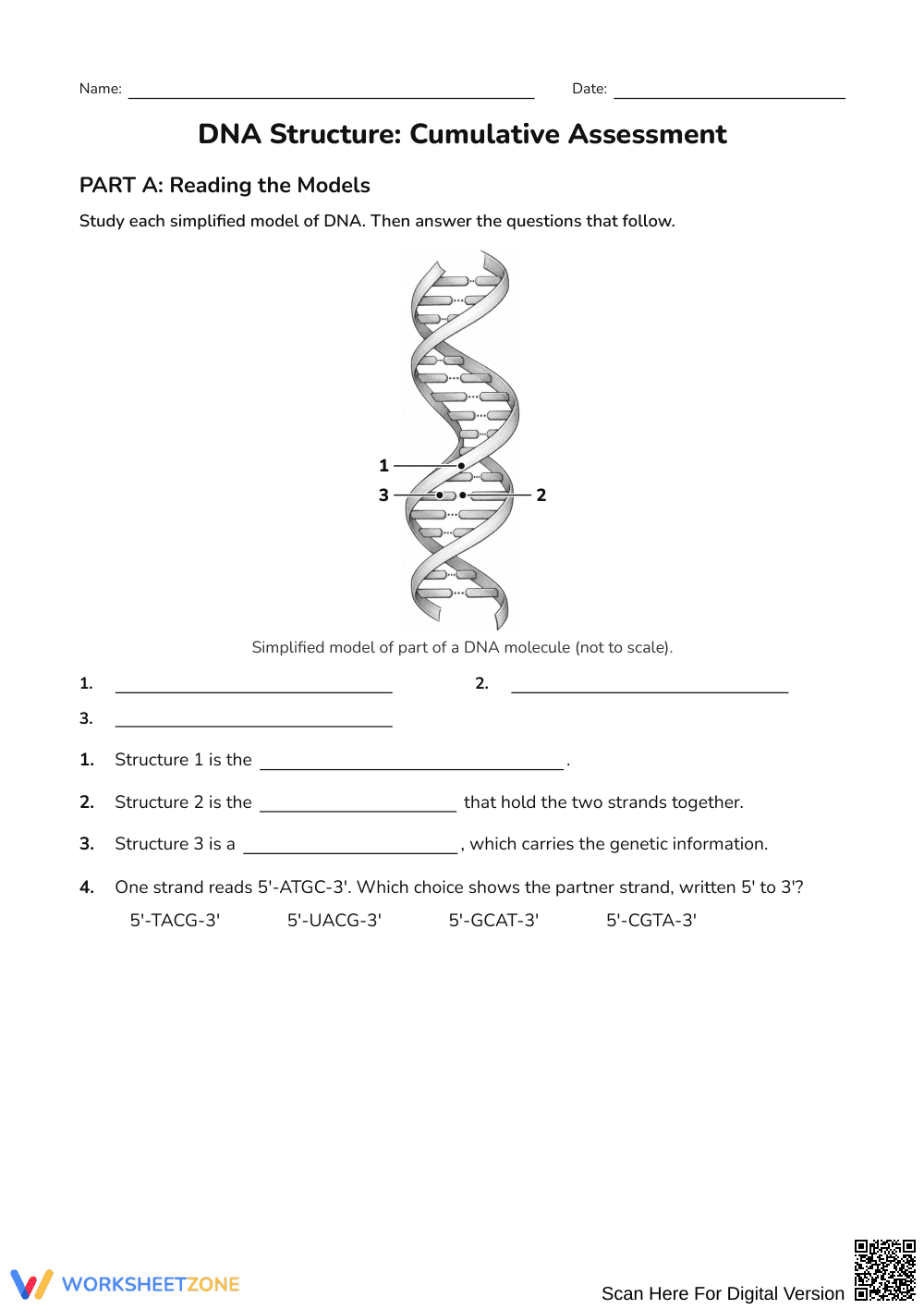
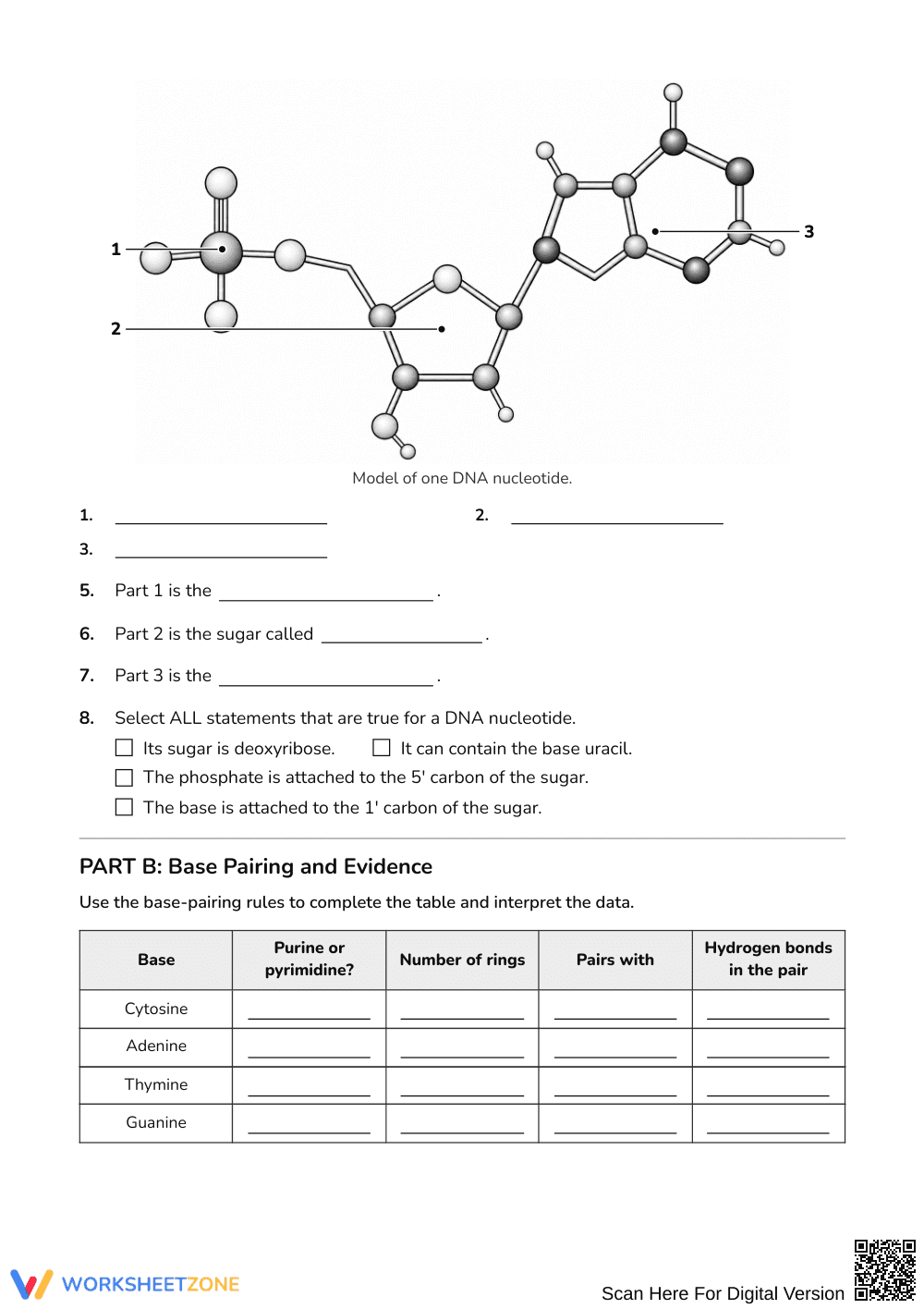
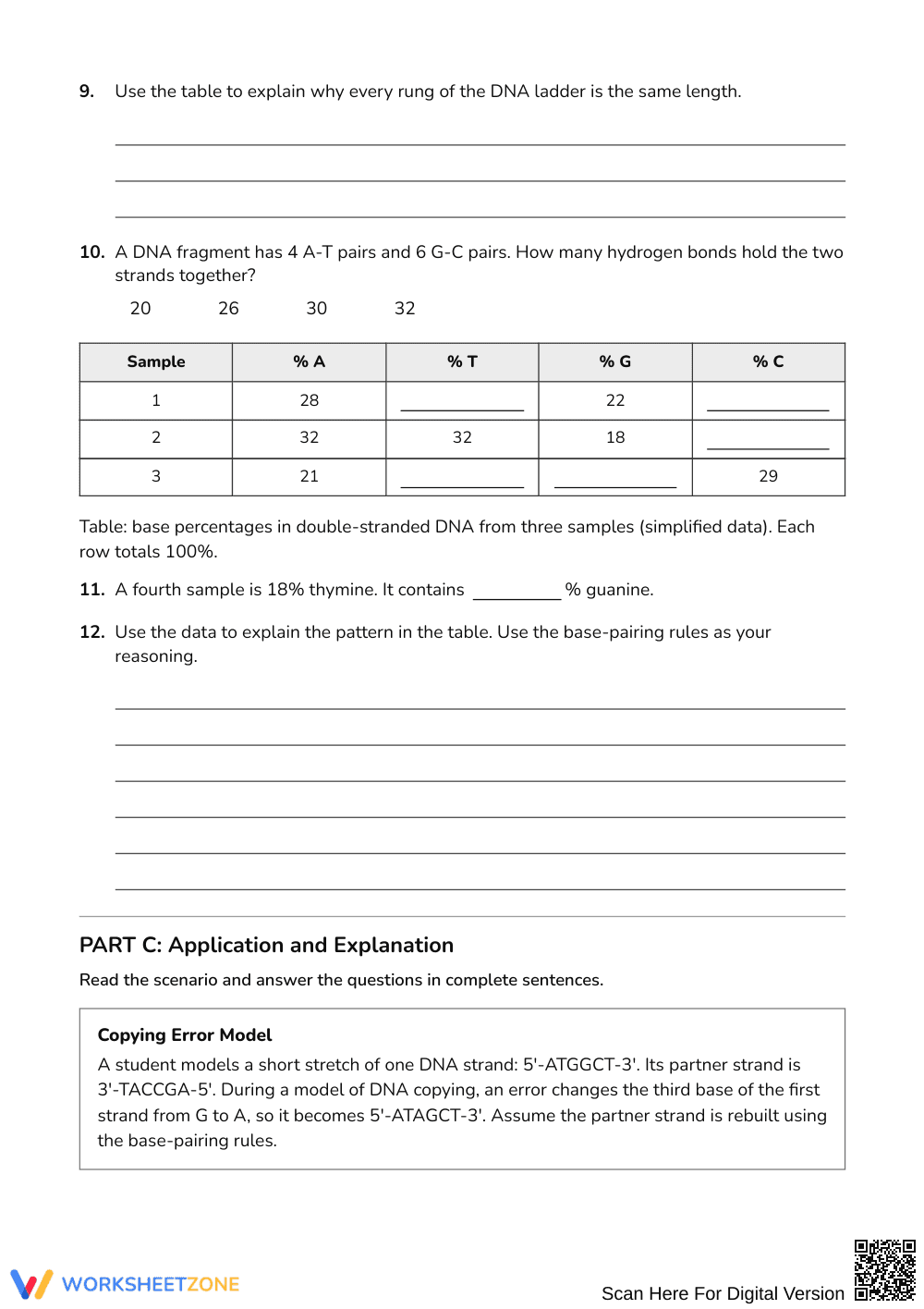
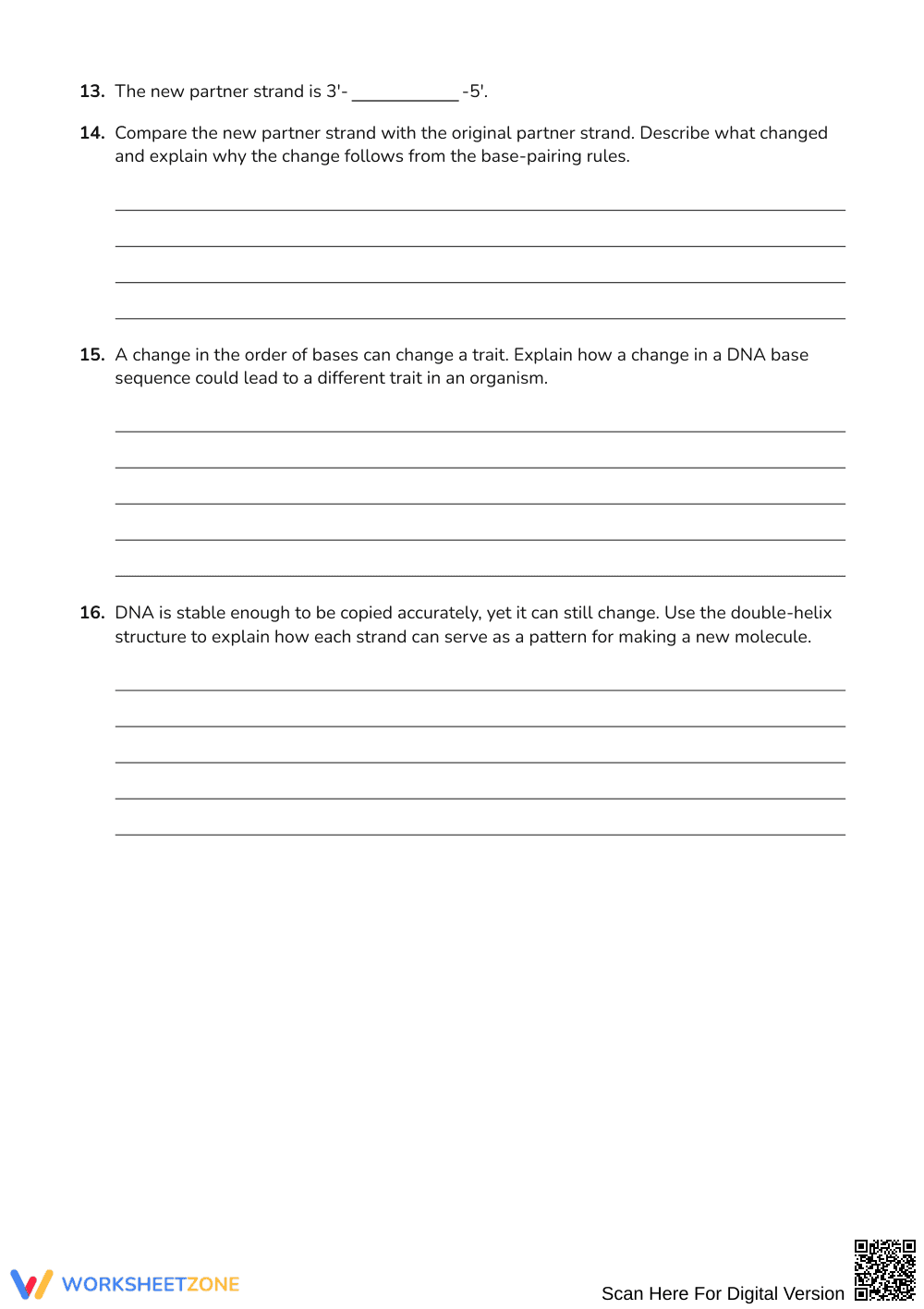

Complete DNA Structure Worksheet | Grades 8-12 Science
Paste this activity's link or code into your existing LMS (Google Classroom, Canvas, Teams, Schoology, Moodle, etc.).
Students can open and work on the activity right away, with no student login required.
You'll still be able to track student progress and results from your teacher account.
This comprehensive DNA structure assessment provides rigorous practice evaluating molecular models, calculating complementary base percentages, and explaining genetic mechanisms. Students demonstrate mastery of nucleotide components, antiparallel strand orientation, Chargaff's rules, and copying fidelity across 43 carefully scaffolded items designed for high school biology and advanced middle school physical science classrooms.
At a Glance
- Grade: Grades 8–12 · Subject: Science
- Standard: Construct an explanation based on evidence for how DNA structure determines proteins
- Skill Focus: DNA structure, base-pairing rules, and nucleotide modeling
- Format: 4 pages · 43 problems · Answer key included · PDF
- Best For: Unit review, benchmark testing, or exam prep
- Time: 45–60 minutes
What's Inside
The 4-page worksheet contains visual diagrams, comparative data tables, and structured short-response prompts. Students analyze labeled double-helix backbones, determine 5'-to-3' complementary sequences, complete nitrogenous base ring comparisons, calculate hydrogen bond totals, and evaluate hypothetical mutation scenarios. A full 4-page teacher answer key provides complete rationales for every quantitative calculation and written explanation.
Skill Progression
- Guided Practice (Part A, 14 tasks): Students identify sugar-phosphate backbones, deoxyribose sugars, and nitrogenous bases on labeled visual models while answering foundational true-false and multiple-choice questions.
- Supported Practice (Part B, 18 tasks): Learners fill out structural comparison charts contrasting purines and pyrimidines, calculate hydrogen bonding frequencies, and apply Chargaff's rules to analyze base percentages across biological samples.
- Independent Practice (Part C, 11 tasks): Students synthesize concepts independently to predict strand alterations during replication errors and write mechanistic explanations connecting DNA sequence changes to altered cellular traits.
This sequence mirrors the gradual-release framework, moving students methodically from structural identification to complex evidentiary reasoning.
Standards Alignment
This worksheet directly supports national standards requiring students to construct explanations based on evidence for how the structure of DNA determines the structure of proteins carrying essential life functions. Both foundational structure-function relationships and heredity mechanisms are thoroughly integrated so teachers can copy standard learning goals directly into lesson plans, IEP goals, or district curriculum mapping tools.
How to Use It
Administer this resource as a summative end-of-unit assessment following direct instruction on nucleic acids, or deploy it across two class periods as a collaborative review activity before standardized testing. During work time, circulate to verify whether students correctly count hydrogen bonds between adenine-thymine pairs versus guanine-cytosine pairs. Completion requires approximately 45 to 60 minutes.
Who It's For
This activity serves general biology students, honors biology cohorts, and middle school life science classes tackling molecular genetics. For English learners or students requiring accommodations, provide an annotated nucleotide diagram as an instructional reference. The resource pairs naturally with physical molecular model kits or introductory protein synthesis lectures.
According to Fisher & Frey (2014), systematic learning progressions that bridge concrete visual representations with abstract conceptual application produce substantial gains in secondary science comprehension. This 4-page worksheet operationalizes that research by leading students through 43 items that transition from diagrammatic inspection of double-helix antiparallel backbones to empirical base-ratio analysis and mutation modeling. By grounding structural identification in quantitative reasoning and functional consequences, the assessment ensures learners do not merely memorize nitrogenous base pairings in isolation. Instead, students synthesize how biochemical stability and complementary hydrogen bonding govern fidelity in replication and transcription. Biology educators can use these diagnostic prompts to pinpoint specific student misconceptions regarding nucleotide anatomy, 5'-to-3' polarity, and genetic coding mechanisms prior to summative state testing.


