

































Complete DNA Structure Worksheet | Grades 8–12 Science

Paste this activity's link or code into your existing LMS (Google Classroom, Canvas, Teams, Schoology, Moodle, etc.).
Students can open and work on the activity right away, with no student login required.
You'll still be able to track student progress and results from your teacher account.
This comprehensive DNA structure worksheet guides secondary science students through molecular modeling, Chargaff base-pairing calculations, and real-world biotechnology applications. Students investigate how nucleotide arrangement, antiparallel strands, and complementary hydrogen bonding create chemical stability, enabling reliable genetic transmission and forensic identification across diverse biological contexts.
At a Glance
- Grade: Grades 8–12 · Subject: Science
- Standard: Relate the molecular structure of DNA to its stability and functional properties
- Skill Focus: DNA Structure
- Format: 4 pages · 35 problems · Answer key included · PDF
- Best For: Biology unit practice or review
- Time: 45–60 minutes
What's Inside
Across 4 rigorous pages, this packet includes 35 targeted items organized into diagram labeling, data analysis tables, scenario-based multiple-choice questions, short-answer evaluations, and a culminating Claim-Evidence-Reasoning (CER) task. Structural supports include annotated diagrams of the sugar-phosphate backbone and base pairs, purine-pyrimidine classification charts, and comparative forensic case tables alongside a complete 4-page teacher answer key.
Skill Progression
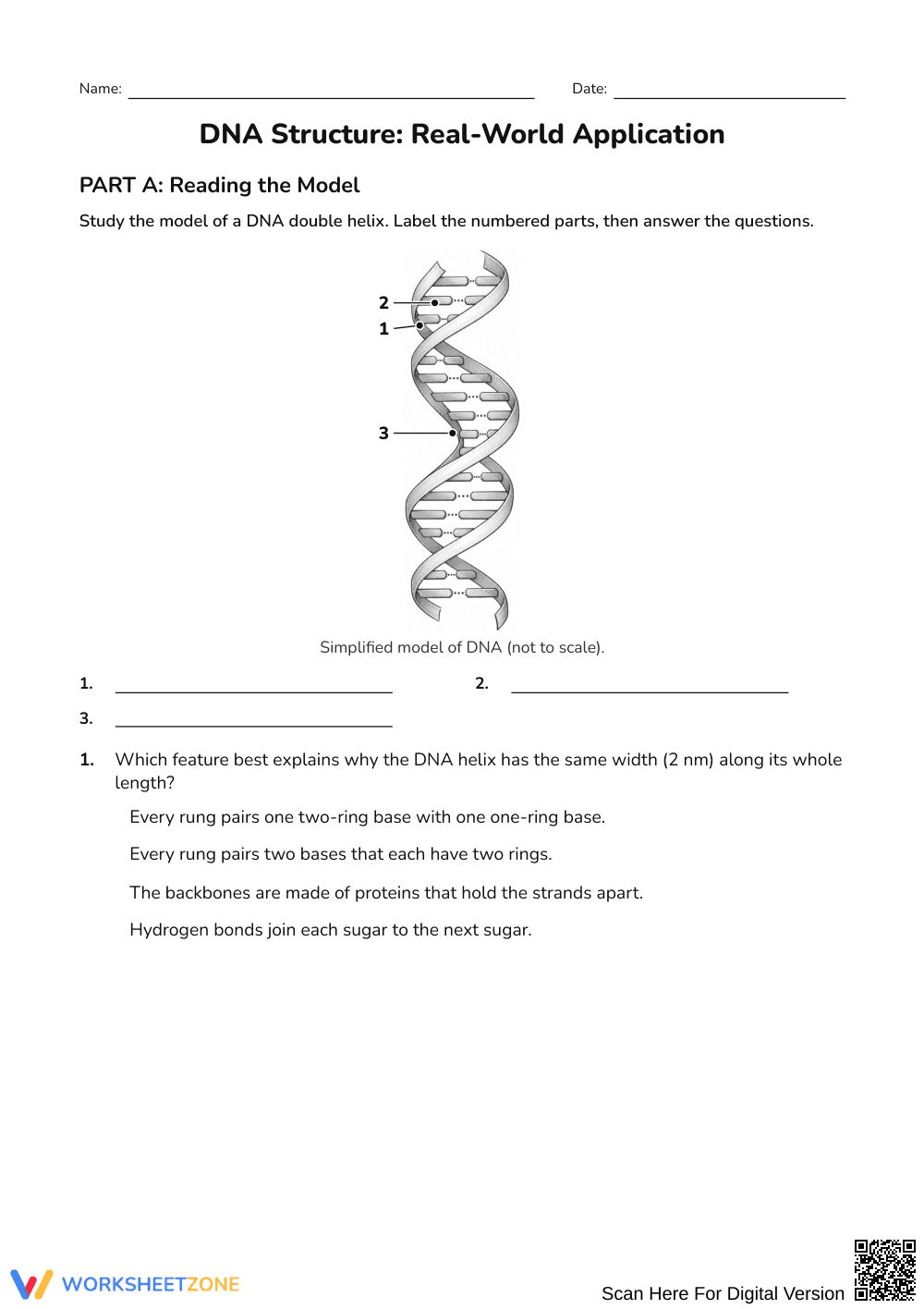
- Guided Practice (Part A, Tasks 1–10): Students identify double-helix components, evaluate uniform strand width, and examine hydrophobic bases protected inside charged phosphate backbones.
- Supported Practice (Part B, Tasks 11–22): Learners compute base percentages across multiple samples, contrast double versus triple hydrogen bonds, and evaluate thermal denaturation thresholds.
- Independent Application (Part C, Tasks 23–35): Students synthesize concepts independently to analyze thermophilic bacterial adaptations, evaluate crime-scene STR loci, and complete an evidence-based CER argument.
This sequence reinforces the gradual-release framework, transitioning students from foundational diagram literacy to rigorous, unassisted data synthesis.
Standards Alignment
This worksheet aligns directly with high school life science standards that require students to construct explanations of DNA structure and model how nucleotide sequences determine biological characteristics. The real-world application sections connect structural biochemistry to genetic variation and cellular protein synthesis. These learning objectives can be copied directly into lesson plans, IEP goals, or district curriculum mapping tools.
How to Use It
Deploy this resource during the mid-unit phase following direct instruction on nucleic acids, or as an anchor activity preceding DNA replication labs. Formative assessment tip: Check student responses on Part B table justifications to verify whether students attribute thermal stability to hydrogen bond quantities rather than bond strength alone. Most students complete all 35 tasks within 45 to 60 minutes.
Who It's For
Designed for general biology, honors life science, and introductory genetics courses in Grades 8–12. Built-in data tables and visual guides support striving readers, while forensic loci analysis provides natural depth for advanced learners. Pair this assignment with a tactile 3D DNA model building lab or an interactive nucleotide simulation.
According to Fisher & Frey (2014), structured cognitive progressions that scaffold from explicit visual models to authentic analytical problem-solving produce measurable gains in scientific concept retention. This 4-page, 35-problem DNA structure worksheet systematically develops student mastery of nucleic acid architecture by coupling structural analysis with real-world biochemical data. Students practice identifying molecular subcomponents, applying Chargaff's base-pairing rules, evaluating thermal denaturation based on hydrogen bond quantities, and interpreting forensic DNA fingerprint profiles across three distinct analytical phases. By concluding with a formal Claim-Evidence-Reasoning prompt, the worksheet solidifies conceptual connections between molecular geometry, genetic information storage, and biological function, providing teachers with actionable formative data on student mastery in secondary life science.


