




























Views
Downloads



Complete DNA Structure Worksheet | Grades 8–12 Science

Paste this activity's link or code into your existing LMS (Google Classroom, Canvas, Teams, Schoology, Moodle, etc.).
Students can open and work on the activity right away, with no student login required.
You'll still be able to track student progress and results from your teacher account.
Build solid conceptual understanding of nucleic acid biochemistry with this comprehensive DNA structure worksheet. Designed for introductory biology students, this resource guides learners through nucleotide components, complementary base-pairing rules, and double-helix geometry so they can confidently explain how molecular structure supports genetic function across all living organisms.
At a Glance
- Grade: Grades 8–12 · Subject: Science
- Standard: High School Life Science — Model DNA structure and explain complementary base pairing
- Skill Focus: DNA structure, nucleotide components, and complementary base pairing
- Format: 4 pages · 43 problems · Answer key included · PDF
- Best For: Biology unit introduction or guided review
- Time: 45–60 minutes
What's Inside
This 4-page student packet contains 43 scaffolded tasks organized into three distinct segments. Students encounter matching terms, an example and non-example classification table, fill-in-the-blank nucleotide sentences, structural diagram labeling, base-pairing calculations using real lab data, and an analytical misconception check. A complete 4-page teacher answer key provides full explanations and sample responses.
Skill Progression
- Guided practice (Part A, 15 items): Defines foundational terms, distinguishes ribonucleic components from deoxyribonucleic components, and establishes hydrogen-bonding rules with immediate word bank support.
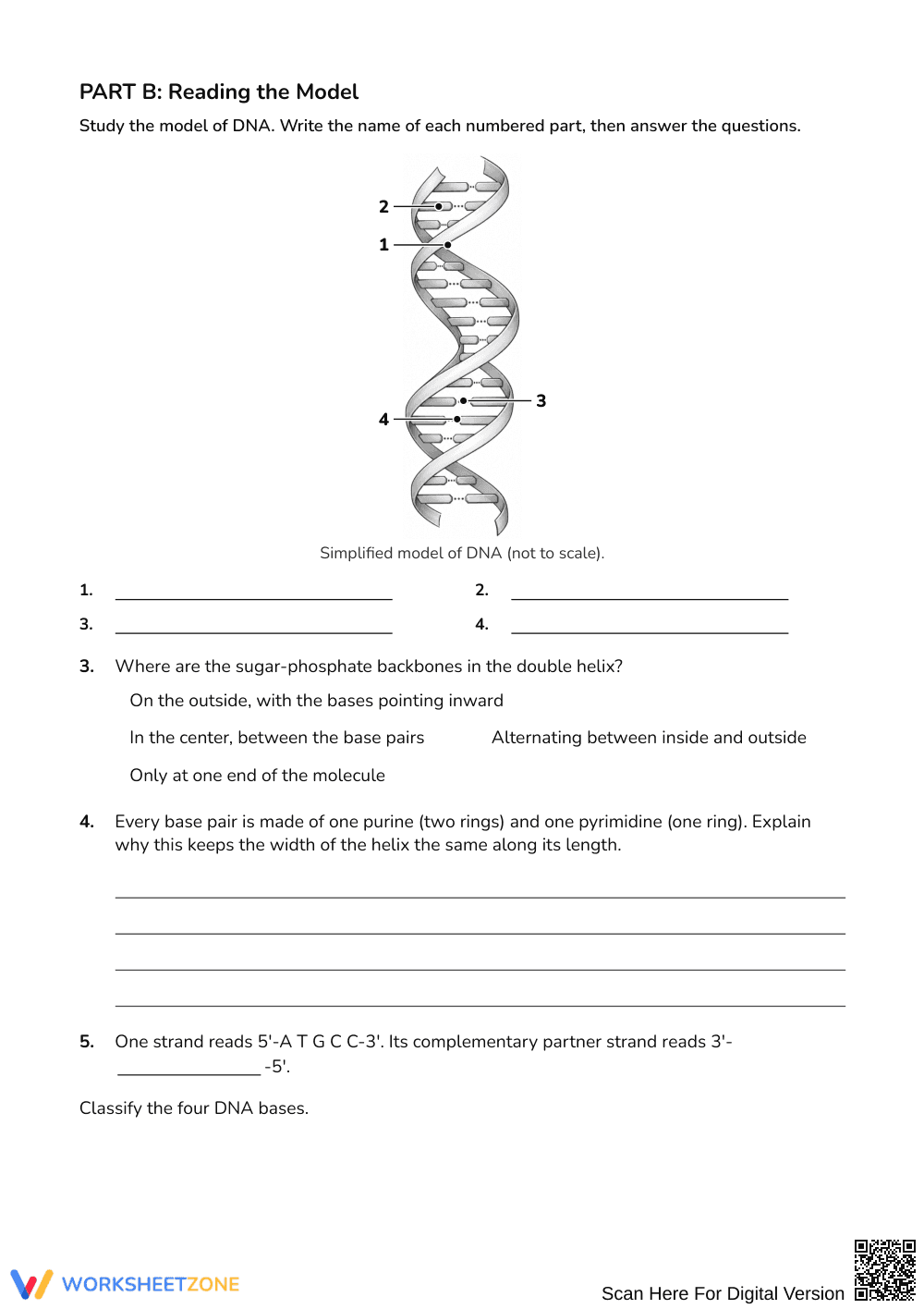
- Supported practice (Part B, 16 items): Guides students to label structural diagrams, analyze purine-pyrimidine spacing, and transcribe complementary 5'-to-3' strands.
- Independent practice (Part C, 12 items): Challenges learners to calculate Chargaff's rule ratios from laboratory samples, evaluate common scientific misconceptions, and justify molecular constancy.
This sequence mirrors the gradual-release model, shifting students systematically from teacher-supported terminology acquisition to self-directed data analysis.
Standards Alignment
This worksheet aligns with secondary life science standards requiring students to construct models of DNA molecules and explain how chemical structures encode hereditary information. Both standard expectations can be copied directly into lesson plans, IEP goals, or district curriculum mapping tools for instructional documentation.
How to Use It
Use this worksheet directly after introducing molecular genetics to reinforce core concepts. Alternatively, assign it before an extraction lab to ensure students understand nucleotide anatomy. During completion, monitor how students resolve the purine-pyrimidine diameter question to catch spatial misconceptions early. Most secondary students will complete all 43 tasks within 45 to 60 minutes.
Who It's For
This resource supports general biology, honors life science, and introductory genetics classrooms across grades 8 through 12. Teachers can differentiate by providing highlighters for the sugar-phosphate backbone or pairing struggling readers during Part B. Pair this worksheet directly with a physical molecular modeling kit or an introductory double-helix lecture.
Structured vocabulary acquisition and visual modeling form the cornerstone of conceptual mastery in secondary science classrooms. According to Fisher & Frey (2014), gradual release frameworks that combine targeted vocabulary checks, diagrammatic models, and explicit misconception analysis yield significant gains in student retention and analytical reasoning. This 4-page worksheet operationalizes these evidence-based principles through 43 carefully sequenced tasks. Students progress from foundational nucleotide identification and example classification to quantitative Chargaff data interpretation and spatial justification of uniform helix width. By directly addressing common misunderstandings regarding covalent versus hydrogen bonding between complementary base pairs, this practice set prevents the fossilization of scientific errors before summative assessment. Secondary educators can deploy this zero-prep activity during initial unit instruction, intervention periods, or review sessions to ensure measurable student mastery of nucleic acid architecture across diverse secondary science learning environments.


