




























Views
Downloads



Complete DNA Replication Worksheet | Grades 8-12 Science

Paste this activity's link or code into your existing LMS (Google Classroom, Canvas, Teams, Schoology, Moodle, etc.).
Students can open and work on the activity right away, with no student login required.
You'll still be able to track student progress and results from your teacher account.
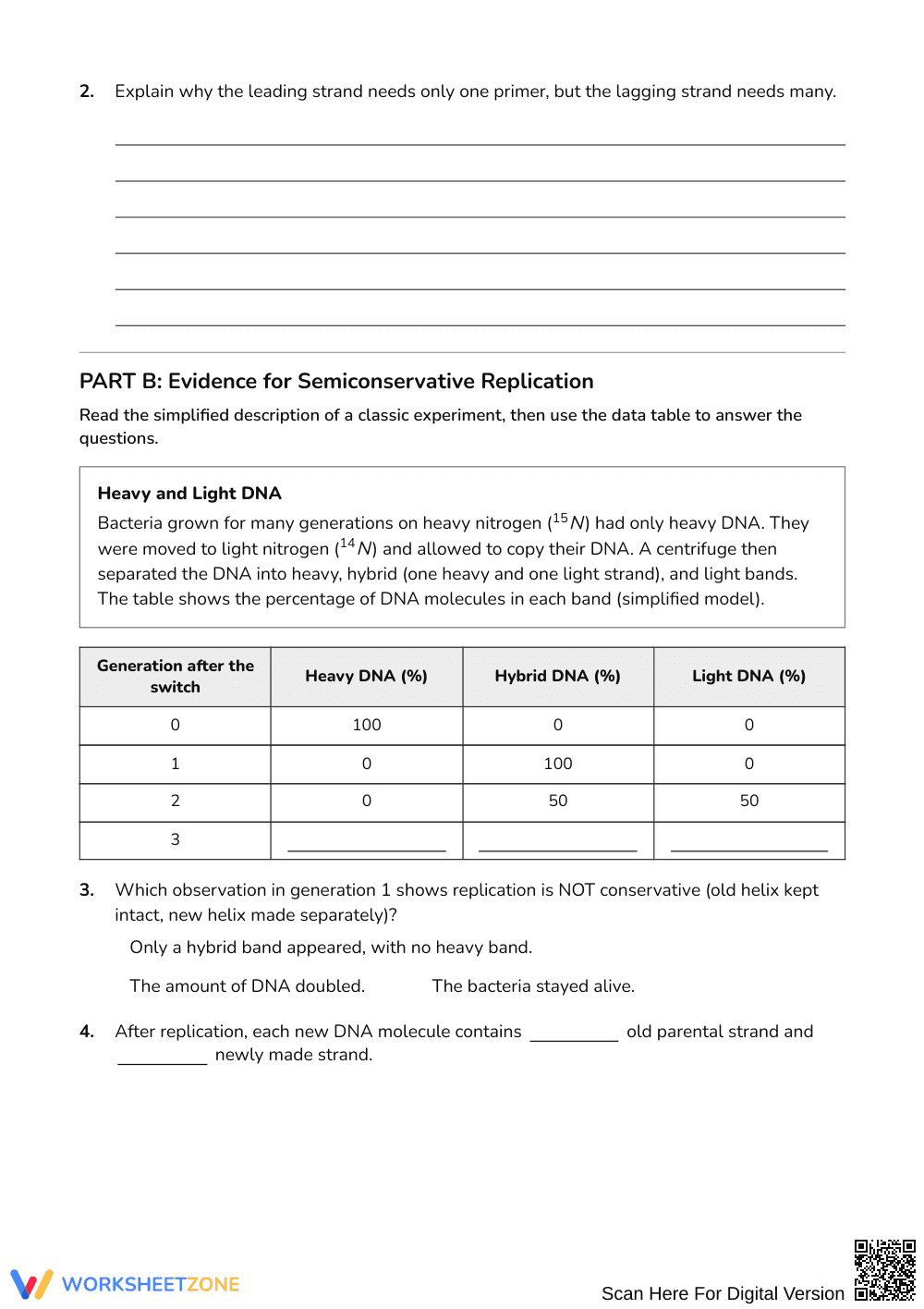
This DNA replication cumulative assessment evaluates student understanding of molecular genetics, replication fork enzymes, and semiconservative strand synthesis. High school biology learners demonstrate mastery by labeling cellular machinery, interpreting experimental density data, calculating replication error rates, and explaining directional synthesis across 23 rigorous items.
At a Glance
- Grade: Grades 8–12 · Subject: Science
- Standard: Molecular Genetics — Model DNA replication mechanisms and explain semiconservative strand inheritance accurately
- Skill Focus: DNA replication fork, enzymes, and semiconservative models
- Format: 4 pages · 23 problems · Answer key included · PDF
- Best For: Cumulative unit assessment and exam review
- Time: 45–60 minutes
What's Inside
Across four structured assessment pages, students tackle diagram labeling, multiple-choice prompts, quantitative calculations, and constructed explanations. Structural scaffolds include a targeted enzyme word bank for replication fork anatomy, a simplified Meselson-Stahl experimental data table spanning multiple bacterial generations, a template strand synthesis challenge, and a comprehensive four-page teacher answer key providing detailed scoring criteria.
Skill Progression
- Guided practice (Part A): Students examine a simplified replication fork diagram to match seven key enzymes and structures using a dedicated word bank before evaluating leading versus lagging strand mechanics across 3 conceptual items.
- Supported practice (Part B): Learners interpret nitrogen isotope density percentages across 4 generations in a data table to validate the semiconservative model and refute conservative and dispersive hypotheses across 4 analytical prompts.
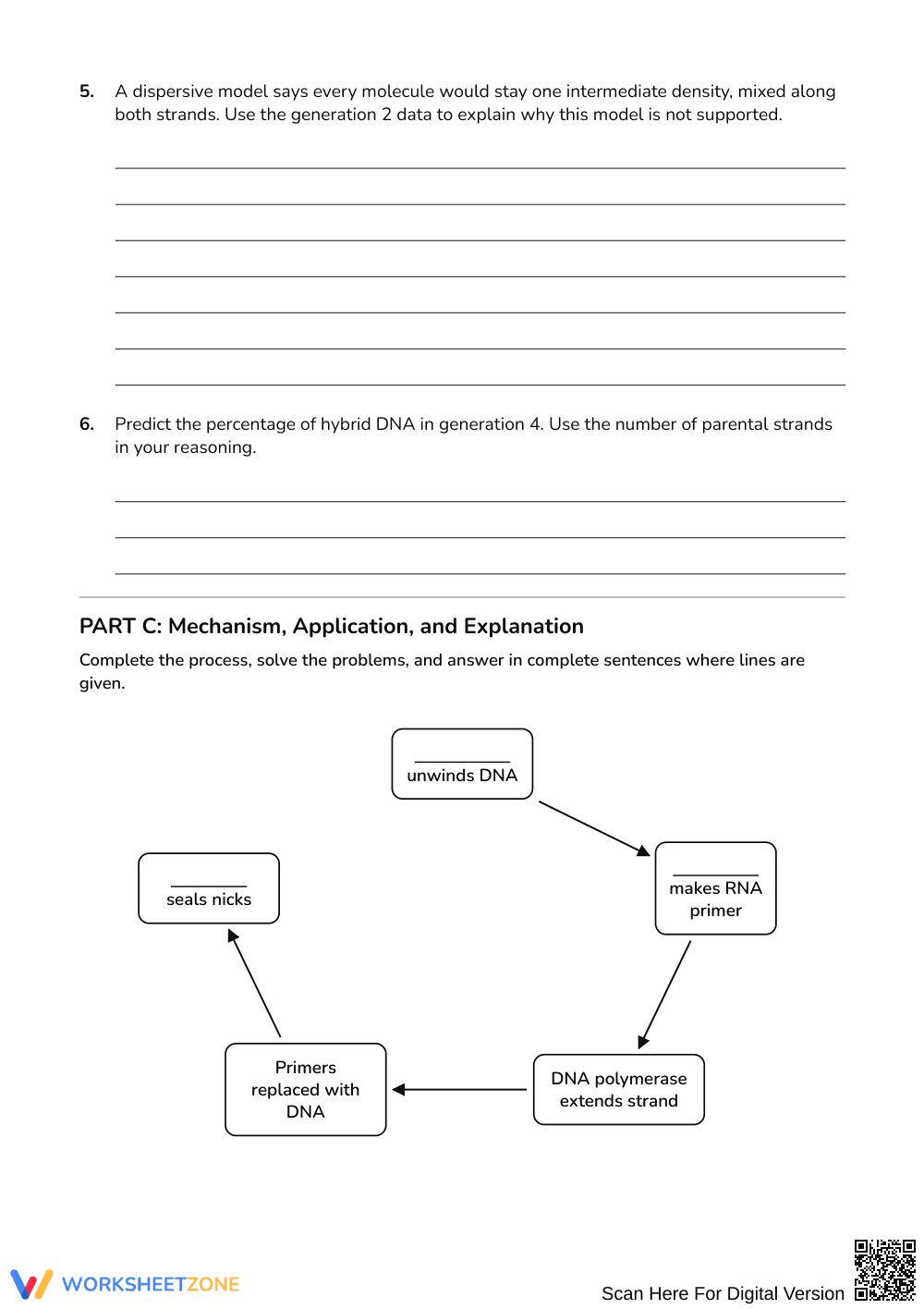
- Independent practice (Part C): Working without cues across 16 tasks, students sequence enzymatic stages, transcribe complementary daughter strands, compute mutation frequencies across 6 billion nucleotides, and compose free-response justifications.
This sequence mirrors the gradual-release model, moving learners systematically from structured anatomical identification toward unprompted scientific argumentation.
Standards Alignment
This resource aligns with high school molecular genetics benchmarks addressing structural models of DNA replication and cell division fidelity. Students construct models demonstrating how complementary base pairing ensures that daughter cells receive identical genetic information. Both standard codes can be copied directly into lesson plans, IEP goals, or district curriculum mapping tools.
How to Use It
Deploy this assessment immediately after completing direct instruction on nucleic acids and cell division. For summative grading, administer it as an end-of-unit exam over 45 to 60 minutes. Alternatively, utilize Parts A and B as mid-unit formative checkpoints during guided workshops. During testing, check whether students accurately distinguish 5'-to-3' synthesis directionality on lagging strands versus leading strands to identify conceptual misconceptions before state testing.
Who It's For
This worksheet serves general biology, honors life science, and introductory AP Biology students in grades 8 through 12. Differentiate for emerging readers by highlighting the diagram word bank or providing sentence starters for open-response questions. Pair this assessment with a physical nucleotide modeling kit or transcription lab.
Structured assessments in molecular biology provide essential evaluation data on whether secondary students master the core mechanics of DNA replication and semiconservative inheritance. According to Fisher & Frey (2014), purposeful assessment frameworks that transition from visual modeling to quantitative data analysis and extended explanatory writing directly support deep scientific literacy and cognitive retention. This 4-page, 23-task curriculum asset addresses high school life science standards by evaluating student ability to identify replication fork enzymes, interpret isotopic density experiments, calculate cellular proofreading error rates, and explain the heritability of somatic versus germline mutations. By combining explicit diagrammatic labeling with empirical evidence analysis, this cumulative task set measures rigorous conceptual synthesis across the full biological mechanism. Educators can implement this print-ready instrument to verify that students explain how complementary base pairing preserves genetic fidelity during cellular reproduction, ensuring thorough readiness for advanced biology coursework.


