


























Views
Downloads



Complete DNA Replication Worksheet | Grade 8-12 Science
Paste this activity's link or code into your existing LMS (Google Classroom, Canvas, Teams, Schoology, Moodle, etc.).
Students can open and work on the activity right away, with no student login required.
You'll still be able to track student progress and results from your teacher account.
This high school science worksheet trains students to analyze quantitative models and empirical datasets related to DNA replication. Learners examine replication fork enzyme functions, calculate replication rates across diverse cell types, and evaluate experimental evidence supporting the semiconservative model of inheritance.
At a Glance
- Grade: 8–12 · Subject: Science
- Standard: Analyze quantitative biological models and evaluate experimental evidence supporting semiconservative replication
- Skill Focus: Data table interpretation, mathematical rate comparisons, and evidence-based scientific claims
- Format: 4 pages · 29 problems · Answer key included · PDF
- Best For: Guided practice, data analysis, unit review
- Time: 45–60 minutes
What's Inside
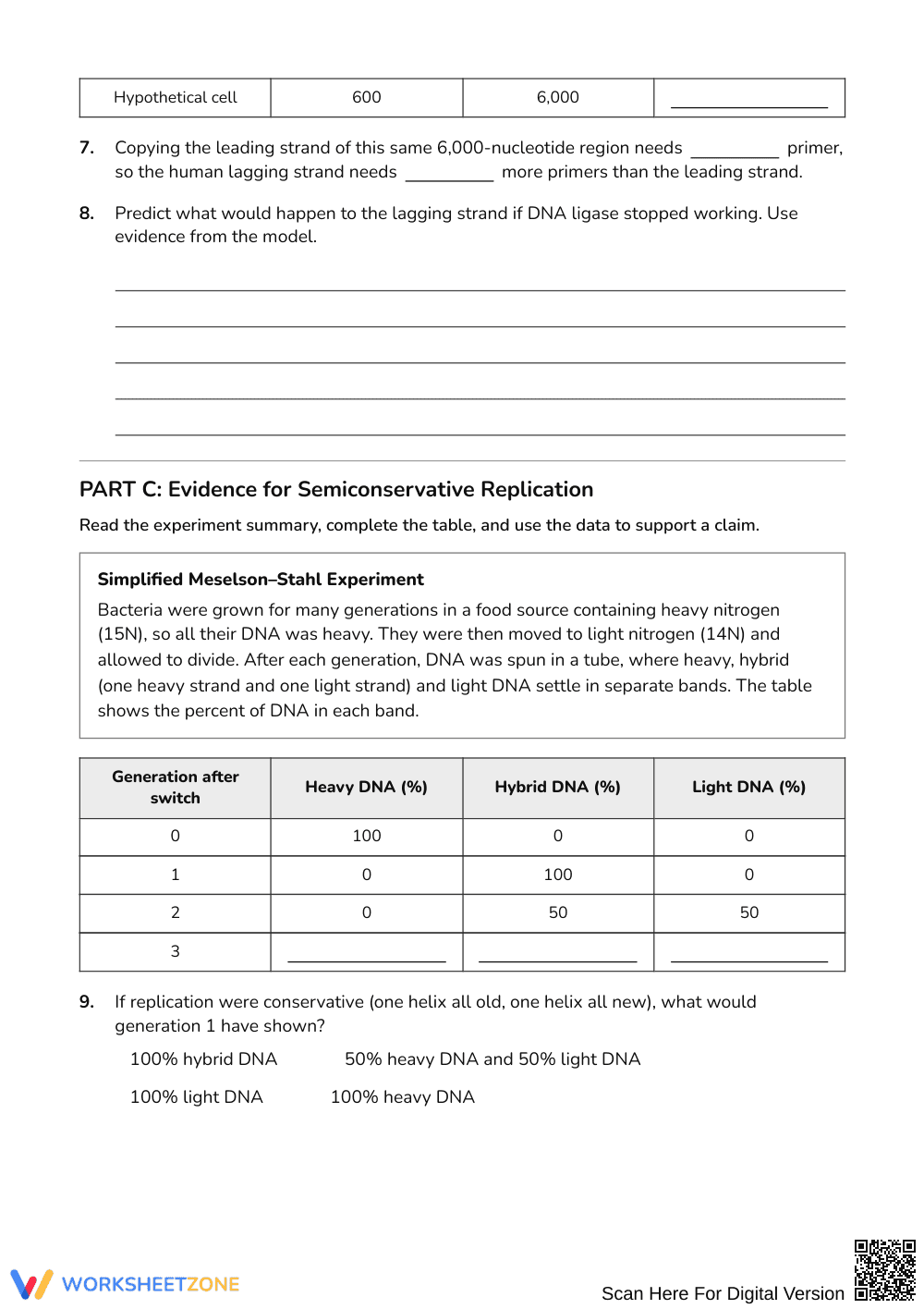
Across four student pages, this resource features 29 scaffolded questions spanning three core areas: diagram labeling of replication fork components, multi-species quantitative comparison tables (bacterium, yeast, and human genomes), and tabular data from the Meselson–Stahl experiment. The comprehensive four-page answer key provides complete numerical solutions, mathematical explanations, and model claim-evidence-reasoning responses.
Skill Progression
- Guided practice (Part A — 9 tasks): Students identify labeled enzymes at a replication fork diagram and explain fundamental biochemical constraints, such as the 5'→3' directional synthesis of lagging strands.
- Supported practice (Part B — 12 tasks): Students calculate genome replication rates per origin, calculate Okazaki fragment quantities across organisms, and deduce how parallel origins accelerate eukaryotic replication.
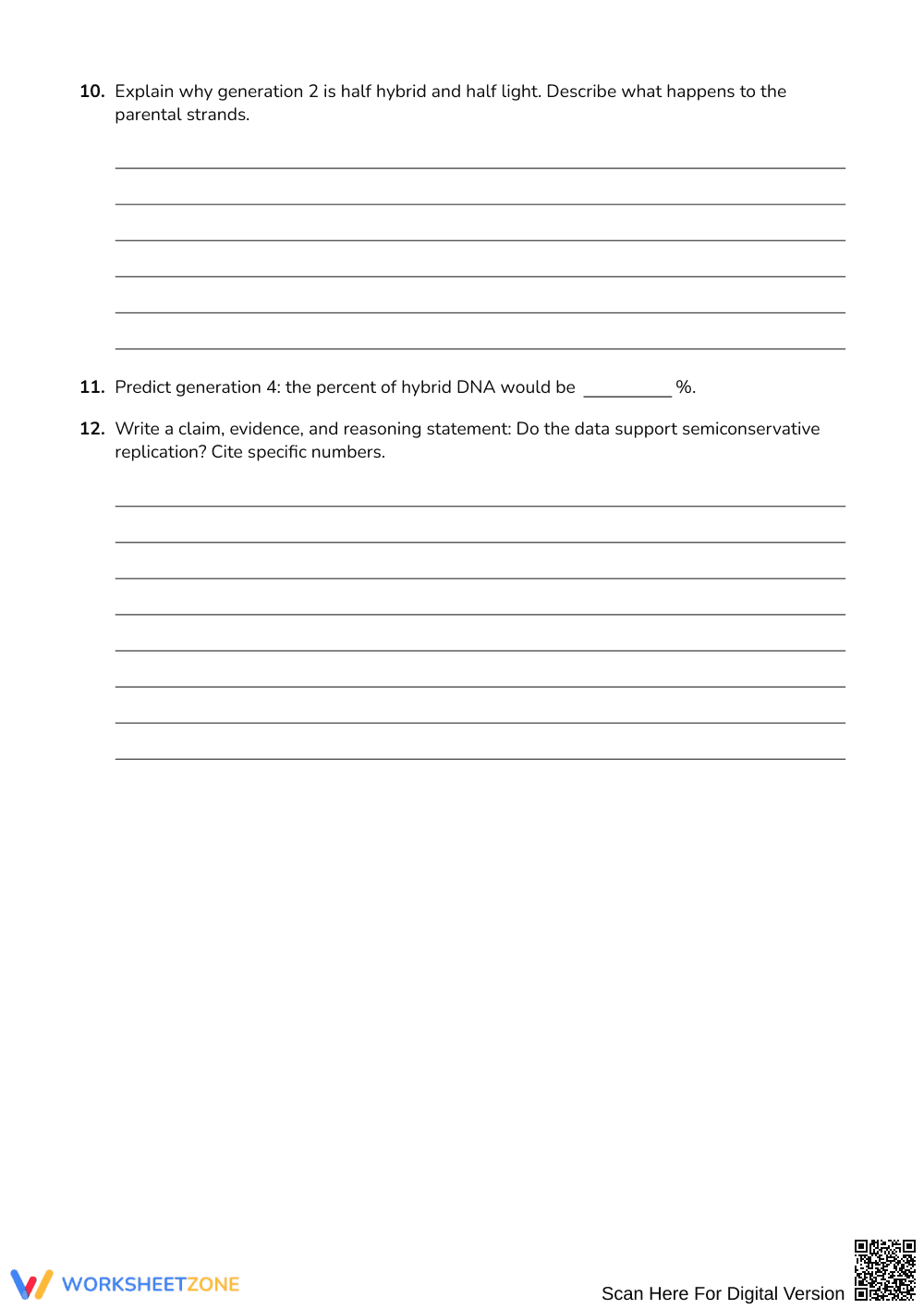
- Independent practice (Part C — 8 tasks): Learners interpret Meselson–Stahl isotope density bands across four generations and formulate an independent claim-evidence-reasoning argument defending semiconservative replication.
This structure follows an intentional gradual-release instructional model that transitions students from structural identification to quantitative synthesis.
Standards Alignment
This worksheet aligns with secondary life science standards requiring students to communicate scientific information regarding the role of DNA in inheritance and model the molecular mechanism of replication. Both standard codes can be copied directly into lesson plans, IEP goals, or district curriculum mapping tools.
How to Use It
Introduce this packet during direct instruction on molecular genetics, assigning Parts A and B immediately after reviewing replication enzymes. Use Part C as a formative assessment check in the following period to verify whether students can distinguish semiconservative outcomes from conservative alternatives. Expect completion in 45 to 60 minutes.
Who It's For
This activity serves students in introductory biology, honors biology, and AP Biology. Embedded scaffolds, such as pre-structured comparison tables and labeled diagram callouts, support English learners and striving readers, while the rate calculations provide rigorous depth. Pair this worksheet directly with an introductory nitrogen-isotope lecture.
According to research highlighted in Fisher & Frey (2014), structured data analysis paired with visual models significantly enhances conceptual retention during complex biological sequences. This worksheet establishes mastery of DNA replication through explicit quantitative analysis, moving beyond passive memorization of enzymes toward authentic scientific interpretation. Students evaluate structural fork diagrams, calculate replication speed across bacterial and human genomes, and verify the physical mechanisms underlying genetic fidelity. By engaging directly with data inspired by the classic Meselson–Stahl investigation, learners build critical scientific literacy skills by translating numerical isotope ratios into robust claim-evidence-reasoning statements. The structured four-page progression ensures that high school science students develop lasting competence in evaluating molecular mechanisms, interpreting tabular rate data, and drawing evidence-based conclusions about genetic continuity across generations.


