































Complete DNA Modeling Worksheet | Grade 8-12 Science

Paste this activity's link or code into your existing LMS (Google Classroom, Canvas, Teams, Schoology, Moodle, etc.).
Students can open and work on the activity right away, with no student login required.
You'll still be able to track student progress and results from your teacher account.
This biological modeling worksheet trains secondary science students to construct, evaluate, and revise scientific representations of the DNA double helix. Across four scaffolded parts, learners connect nucleotide components and base-pairing mechanics to Chargaff's experimental data, molecular dimensions, and nuclear packaging mechanisms to demonstrate genuine conceptual mastery.
At a Glance
- Grade: 8–12 · Subject: Science
- Standard: Construct and revise models explaining DNA structure and inheritance
- Skill Focus: DNA molecular modeling and structural mechanics
- Format: 4 pages · 41 problems · Answer key included · PDF
- Best For: High school biology model-based assessment
- Time: 45–60 minutes
What's Inside
The 4-page resource organizes 41 focused tasks across structural diagrams, comparative data tables, and analytical explanations. It includes labeled diagram callouts, Chargaff's rule nucleotide calculation tables, purine-pyrimidine dimensional reasoning tasks, and chromosome-level packaging models, supported by an exhaustive 4-page matching teacher answer key.
Skill Progression
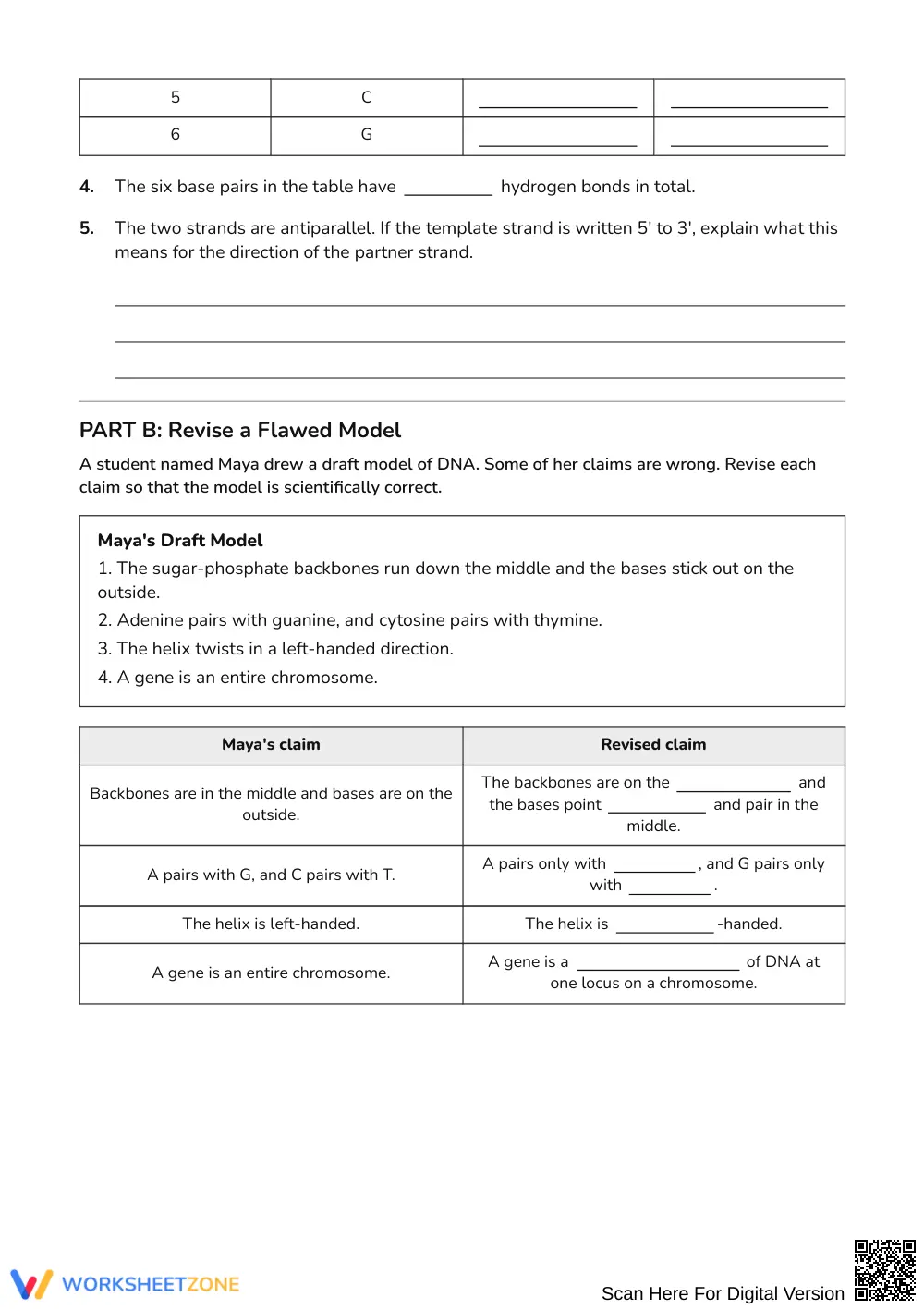
- Guided practice (Part A, 11 tasks): Students identify sugar-phosphate backbones, antiparallel strands, and calculate hydrogen bonding counts using direct diagram scaffolds.
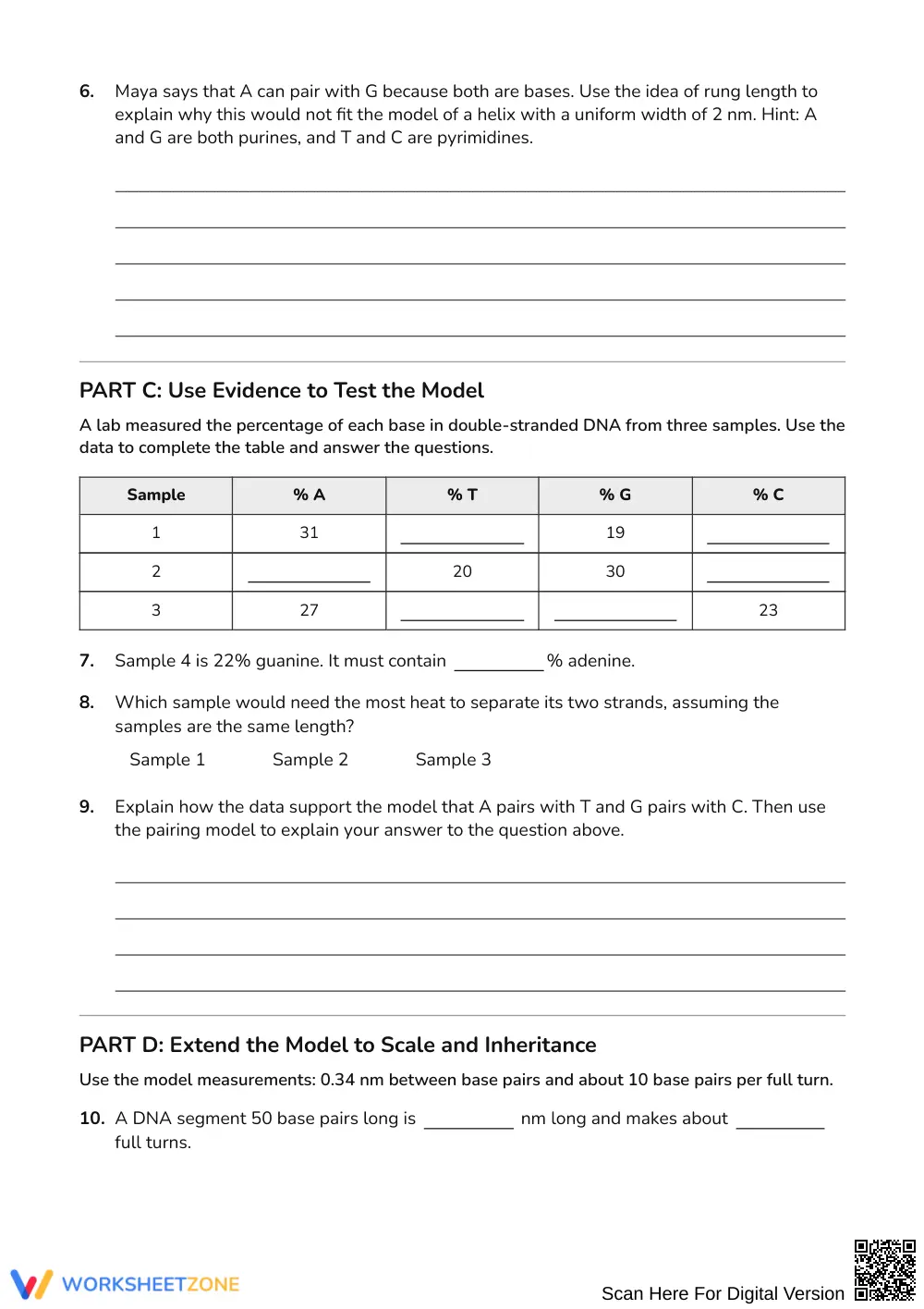
- Supported practice (Parts B & C, 18 tasks): Learners critique flawed scientific claims regarding helix width and evaluate quantitative empirical data to substantiate Watson-Crick base pairing.
- Independent practice (Part D, 12 tasks): Students independently calculate physical nanometer dimensions and synthesize models linking DNA condensation, histones, and Mendelian inheritance patterns.
This structured sequence operationalizes the gradual-release framework, transitioning learners from concrete component labeling to sophisticated conceptual critique.
Standards Alignment
This worksheet aligns directly with high school life science standards requiring students to construct, use, and revise structural models that explain how DNA stores genetic information. Students explain chemical mechanisms including antiparallel 5'-to-3' orientation, purine-pyrimidine base pairing constancy, and chromatin packaging. The alignment supports both general biology and advanced secondary curricula, and can be copied directly into lesson plans, IEP goals, or district curriculum mapping tools.
How to Use It
Deploy this worksheet after direct instruction on nucleotide anatomy to reinforce structural relationships. For formative assessment, check student explanations in Part B regarding rung length; confusion between purines and pyrimidines immediately reveals whether students understand why double-helix width remains uniform. Typical completion time spans 45 to 60 minutes.
Who It's For
Designed for biology students in grades 8 through 12, this activity supports on-grade learners as well as honors students requiring rigorous physical-chemical modeling practice. Pair this resource with a physical double-helix manipulative kit or molecular visualization software to deepen spatial comprehension.
Secondary science curricula require rigorous structural modeling to ground abstract molecular concepts in observable physical laws. According to Fisher & Frey (2014), student cognitive autonomy develops most reliably when visual modeling, error analysis, and quantitative verification are scaffolded systematically within scientific problem sets. This 4-page worksheet guides learners from foundational identification of nucleotides and hydrogen bonds to empirical evaluation of Chargaff's percentages and molecular packaging. By requiring students to diagnose flawed diagrams and calculate spatial constraints such as uniform 2 nm helix width, the resource reinforces how structural characteristics dictate biological function. Teachers receive an evidence-based instructional tool that documents student reasoning across 41 targeted tasks, providing clear documentation of mastery in cellular genetics and inheritance.


