































Complete DNA Error Analysis Worksheet | Grade 8-12 Science

Paste this activity's link or code into your existing LMS (Google Classroom, Canvas, Teams, Schoology, Moodle, etc.).
Students can open and work on the activity right away, with no student login required.
You'll still be able to track student progress and results from your teacher account.
This comprehensive DNA error analysis worksheet trains Grade 8–12 science students to identify, correct, and refute common genetics misconceptions. Students analyze authentic student claims regarding molecular structure, cellular differentiation, mutations, and base-pairing ratios. By critiquing flawed claims and providing scientific justification, learners build durable conceptual mastery over core biological mechanisms.
At a Glance
- Grade: 8–12 · Subject: Science
- Standard: Scientific Argumentation — Evaluate claims, evidence, and reasoning regarding molecular genetics and inheritance
- Skill Focus: DNA error analysis, structure, and claim justification
- Format: 4 pages · 23 problems · Answer key included · PDF
- Best For: Formative review and misconception remediation
- Time: 45–60 minutes
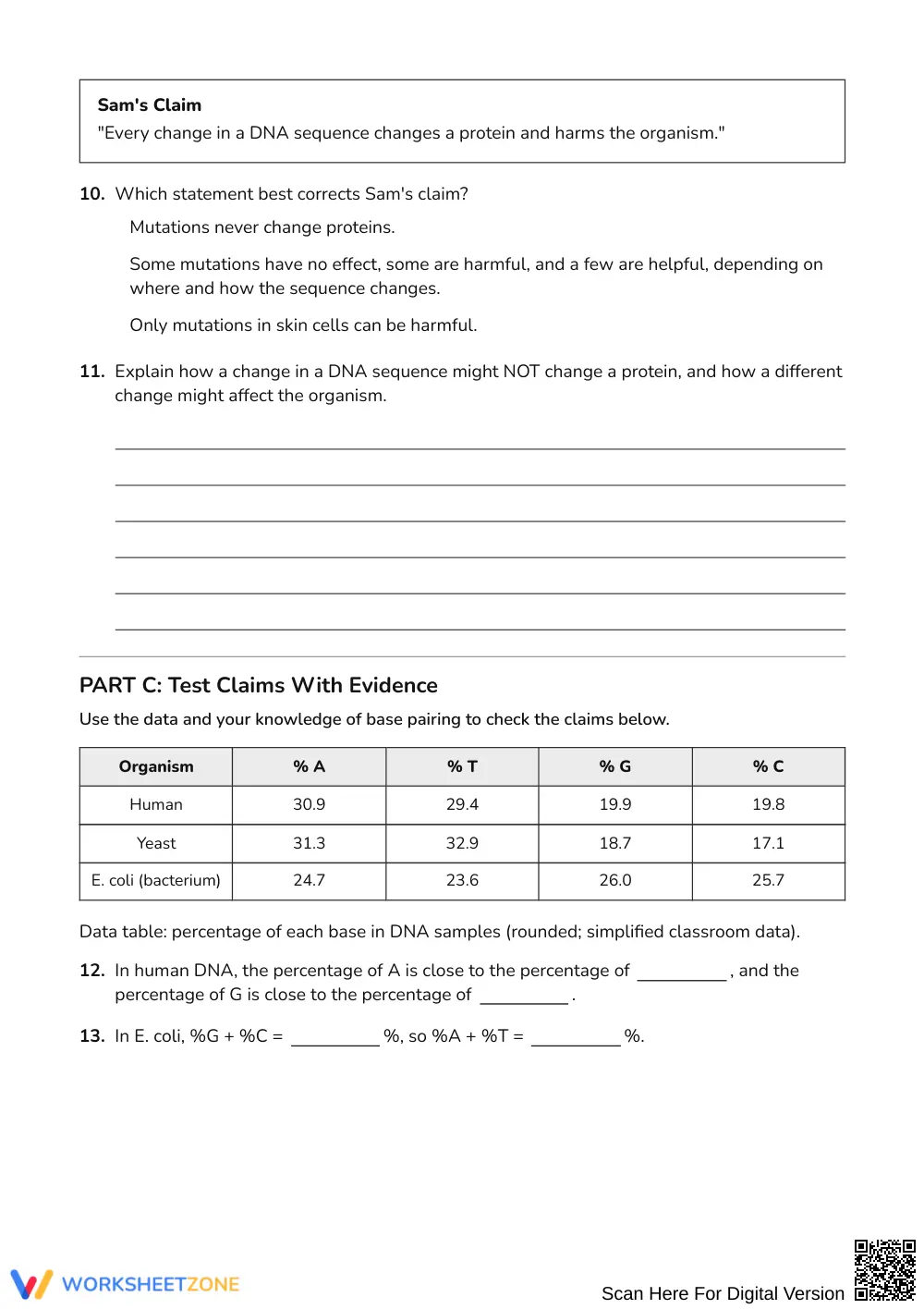
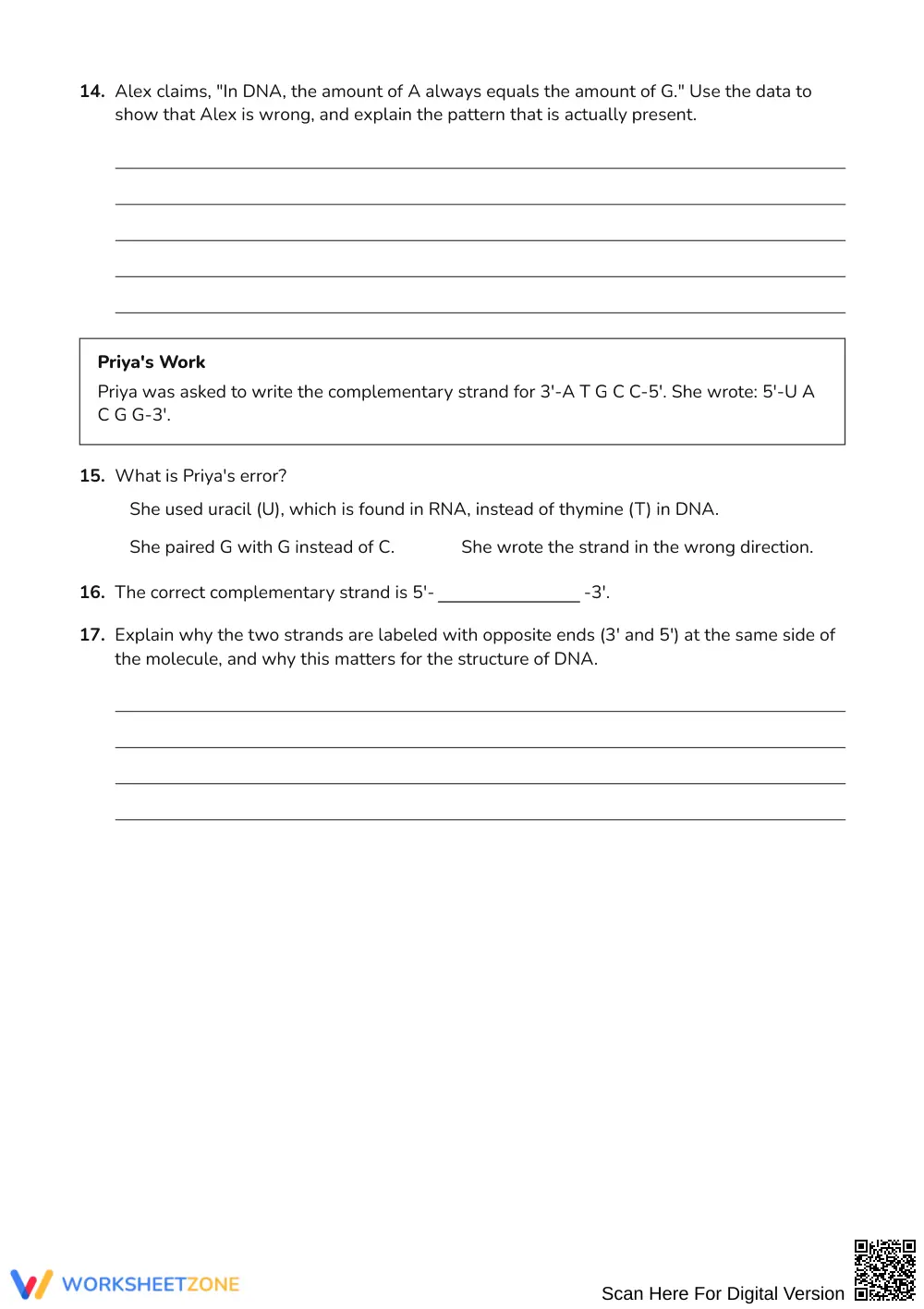
What's Inside: The 4-page student activity features 23 targeted tasks organized across three thematic sections. It incorporates labeled structural models of the double helix, comparative nucleotide data tables, student work samples, multiple-choice error identification items, and constructed-response justification prompts. A complete 4-page teacher answer key provides explicit model corrections and scientific explanations.
Skill Progression
- Guided practice (Part A — 7 tasks): Students inspect a visual double helix model to correct flawed claims about backbone location, complementary base pairing, and antiparallel geometry using explicit structural clues.
- Supported practice (Part B — 8 tasks): Learners evaluate two complex claims surrounding somatic cell differentiation and gene mutations, choosing best-evidence rebuttals before drafting explanatory responses.
- Independent practice (Part C — 8 tasks): Students calculate nucleotide proportions from empirical data across three organisms to disprove faulty base ratios and detect transcription errors in nucleic acid sequences.
This structured progression reflects the gradual release of responsibility model, shifting students from visual model critique to independent empirical data analysis.
Standards Alignment
This worksheet addresses secondary life science expectations for constructing explanations and designing solutions based on evidence. Students demonstrate understanding that DNA contains instructions for traits and directs protein synthesis, refuting the false idea that specialized cells carry different genes. Supporting standards include evaluating evidence regarding how gene mutations affect amino acid sequences. Both standard descriptions can be copied directly into lesson plans, IEP goals, or district curriculum mapping tools.
How to Use It
Deploy this resource during mid-unit formative assessment or immediately following direct instruction on DNA replication and protein synthesis. For collaborative review, have student pairs complete Part A together, verbalizing why the sugar-phosphate backbone remains external before completing Part B individually. Formatively observe whether students mistakenly believe all mutations alter phenotypic traits; use Part B's silent mutation prompt to clarify codon degeneracy. Expect 45 to 60 minutes for complete individual execution.
Who It's For
This activity is designed for middle and high school life science and biology classrooms. For differentiated support, provide struggling learners with an amino acid codon wheel for Part B or highlighted data rows for Part C. Pair this worksheet directly with a physical molecular modeling lab or an introductory DNA transcription and translation lesson.
According to Fisher & Frey (2014), engaging students in systematic error analysis and peer-claim evaluation significantly deepens conceptual retention compared to passive rote recall in secondary science classrooms. By actively identifying flawed scientific claims—such as assuming all somatic cells possess distinct genomes or that every single point mutation harms an organism—learners confront resilient cognitive misconceptions head-on. The 23 structured tasks across these 4 pages require secondary students to articulate accurate biological principles, evaluate Chargaff's empirical base-pairing percentages across multiple organisms, and justify molecular geometry using complementary hydrogen bonding rules. Rigorous educational research confirms that structured argumentation and justification prompts help biology students bridge the critical divide between memorizing abstract molecular facts and applying mechanistic reasoning to complex biological phenomena, generating verified improvements on standardized summative assessments across diverse secondary learning environments.


