































Complete DNA & Chromosomes Worksheet | Grades 8-12 Science

Paste this activity's link or code into your existing LMS (Google Classroom, Canvas, Teams, Schoology, Moodle, etc.).
Students can open and work on the activity right away, with no student login required.
You'll still be able to track student progress and results from your teacher account.
This Grades 8–12 genetics worksheet equips students to identify, correct, and justify common misconceptions about DNA, genes, and chromosomes. Through diagram inspection, claim evaluation, and base-pairing calculations, learners build a robust structural model of genetic material while dispelling persistent confusions surrounding sister chromatids, homologous chromosomes, and nucleotide percentages.
At a Glance
- Grade: Grades 8–12 · Subject: Science
- Standard: Life Science Core Ideas — Clarify relationships among DNA, genes, and chromosomes through targeted error analysis
- Skill Focus: Misconception & Error Analysis
- Format: 4 pages · 34 problems · Answer key included · PDF
- Best For: Post-lecture review and formative assessment
- Time: 45–55 minutes
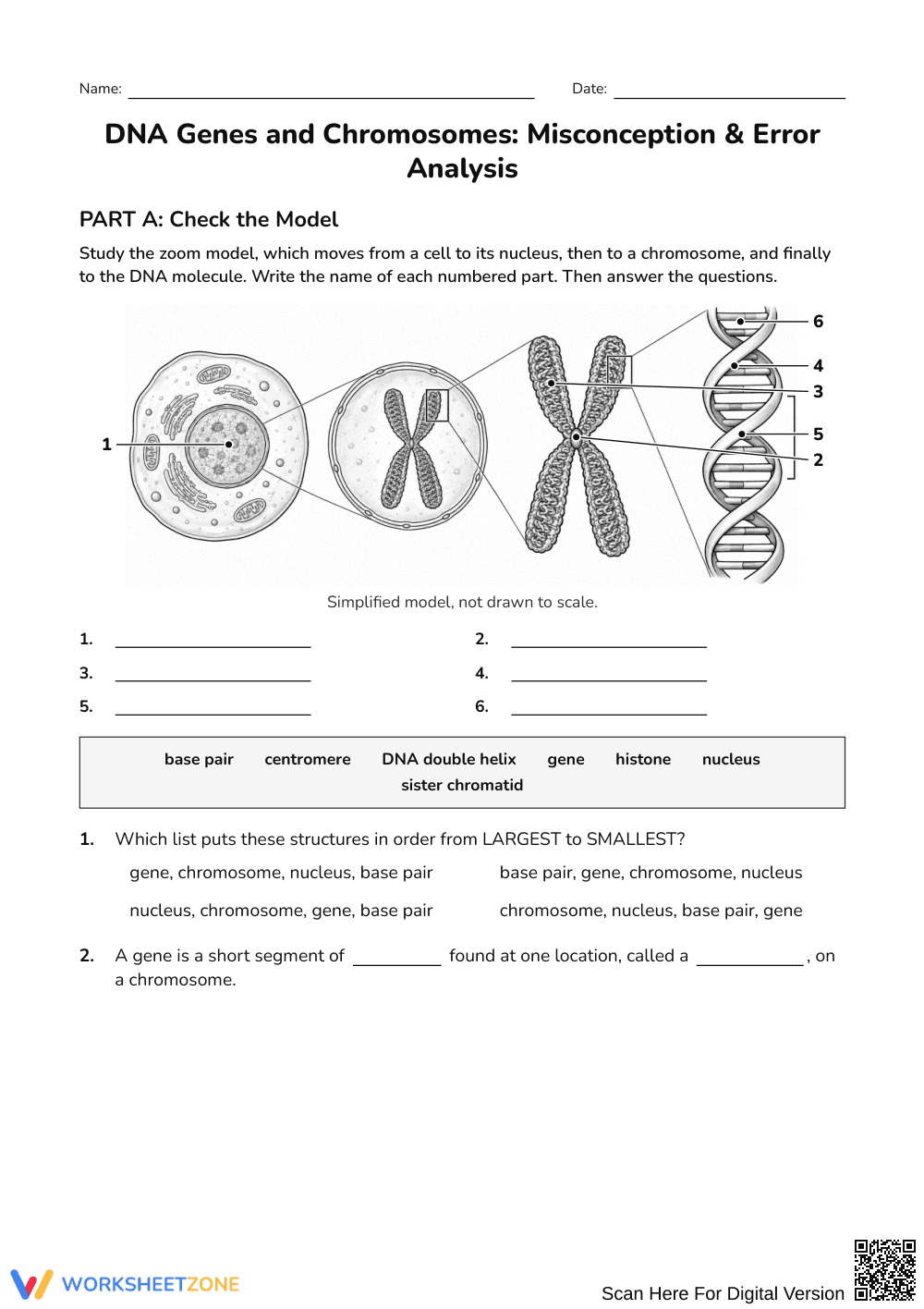
Across 4 structured pages, this resource features a zoom-model diagram exercise, two real-world student claim critiques, a DNA Chargaff-rule error analysis table, and a multi-part synthesis prompt. The comprehensive packet contains 34 targeted tasks, labeled visual diagrams, data tables comparing chromosome and chromatid numbers, and an exhaustive 4-page answer key with model explanations.
Skill Progression
- Guided practice: Students inspect a visual biological zoom model from the cell nucleus down to base pairs, completing matching prompts and ranking structures by physical scale.
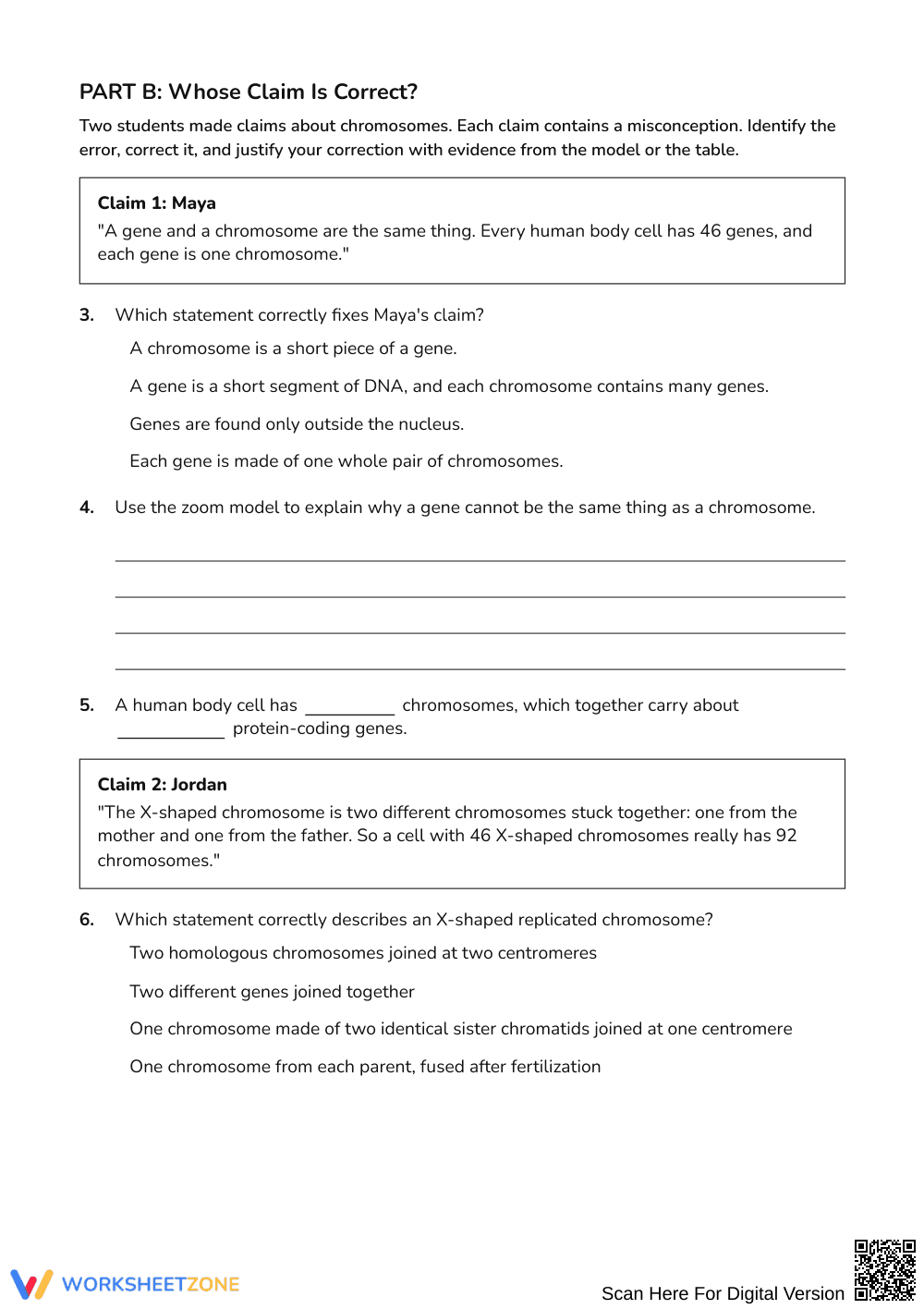
- Supported practice: Students evaluate authentic student claims regarding chromosome-to-gene ratios, sister chromatids versus homologous pairs, and base-pairing rules, using quantitative tables to disprove erroneous reasoning.
- Independent practice: Students synthesize their understanding in a full written scientific explanation accounting for chromosome counts versus chromatid numbers across DNA replication.
This systematic design follows the gradual-release model, shifting students from visual observation to critical evaluation and independent scientific argumentation.
Standards Alignment
This worksheet aligns directly with secondary Life Science standards covering heredity and molecular genetics. Students develop and use models to illustrate that DNA, genes, and chromosomes are hierarchically organized structures dictating organismal traits. These learning targets integrate cleanly into district curriculum mapping tools, high school biology units, and standards-based grading trackers.
How to Use It
Deploy this worksheet after direct instruction on chromosome structure and DNA replication. Use Part B as a collaborative checkpoint where partners argue why Jordan's claim fails before continuing to Chargaff's rules in Part C. Watch for students confusing chromatid counts with chromosome totals during mid-activity checks. The entire activity takes approximately 45 to 55 minutes to complete.
Who It's For
Designed for middle and high school introductory biology, life science, and AP Biology support classes. It provides structured scaffolding for students wrestling with abstract molecular scales. Pair this worksheet directly with a physical chromosome modeling lab or introductory double-helix lecture slides.
According to Fisher & Frey (2014), scaffolded error analysis and structured claim critiques deepen conceptual understanding far more effectively than rote labeling alone. Secondary life science curricula regularly confront deeply entrenched student misconceptions regarding genetic hierarchies, particularly the common false belief that one chromosome represents a single gene or that sister chromatids originate from separate biological parents. This 34-task worksheet systematically dismantles these misconceptions through explicit visual modeling, quantitative data analysis of nucleotide percentages, and comparative chromosome counts before and after DNA replication. By guiding learners through collaborative claim verification and culminating in an evidence-based written explanation, the resource strengthens metacognitive monitoring and scientific argumentation. Teachers obtain immediate diagnostic evidence of student mastery across molecular genetics, making it an indispensable asset for closing comprehension gaps before summative high-stakes biology assessments and standardized science tests.


