


























Views
Downloads



Complete DNA Amplification Worksheet | Grade 9 Biology
Paste this activity's link or code into your existing LMS (Google Classroom, Canvas, Teams, Schoology, Moodle, etc.).
Students can open and work on the activity right away, with no student login required.
You'll still be able to track student progress and results from your teacher account.
This high school biology worksheet develops student mastery of DNA amplification and molecular comparison techniques. Learners analyze the biochemical mechanisms of polymerase chain reaction (PCR), evaluate gel electrophoresis migration dynamics, interpret synthetic paternity and forensic STR profiles, and assess contemporary bioethical dilemmas surrounding genetic privacy in consumer databases.
At a Glance
- Grade: 9 · Subject: Biology
- Standard: High School Biology — Evaluate molecular biotechnology mechanisms and interpret comparative DNA profiles
- Skill Focus: Purpose of DNA Amplification and Comparison
- Format: 5 pages · 12 problems · Answer key included · PDF
- Best For: Genetics unit practice and assessment
- Time: 45–60 minutes
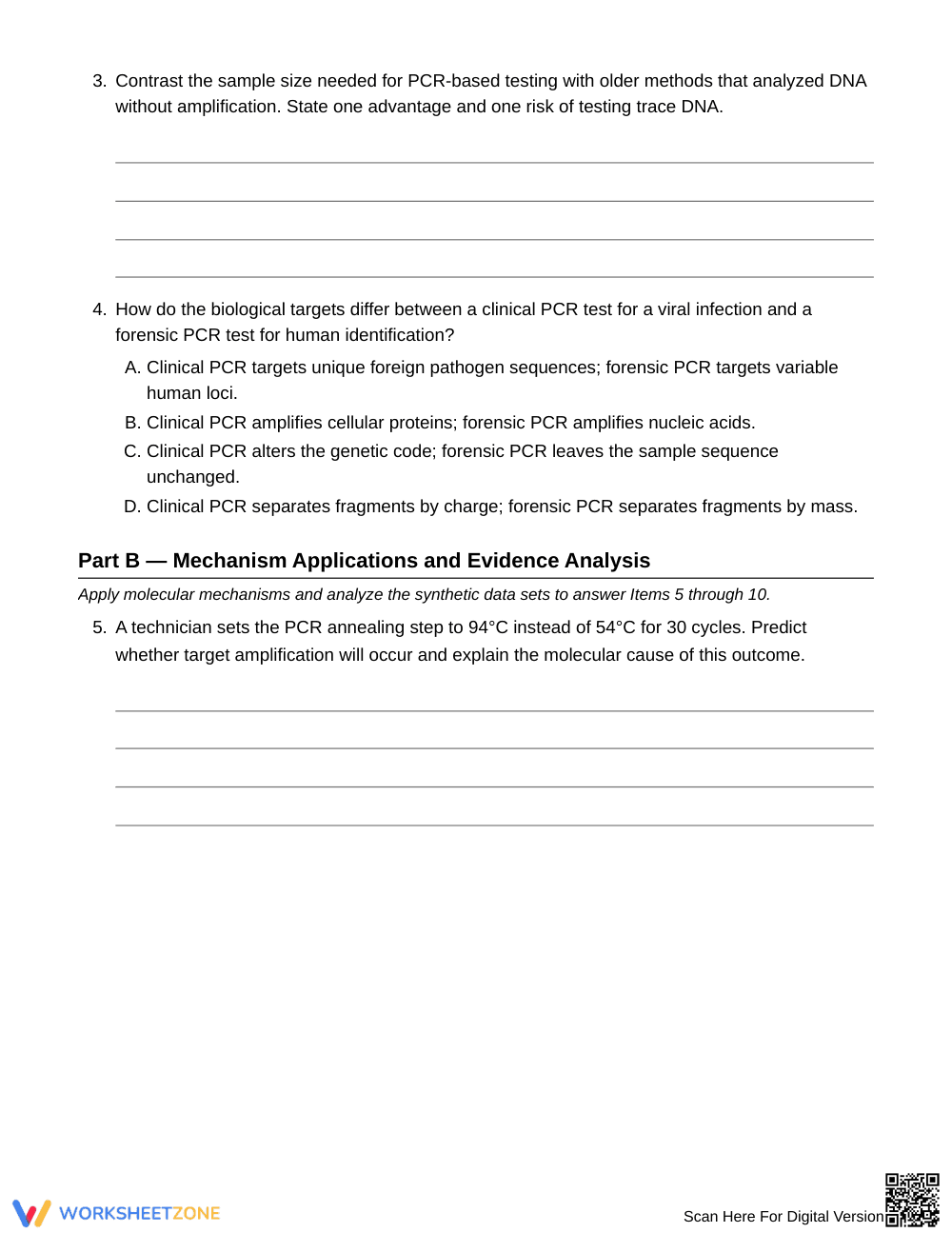
This 5-page instructional resource contains 12 rigorous tasks and a 3-page answer key. The worksheet opens with a core principles reference box defining PCR thermocycling, gel electrophoresis charge dynamics, and short tandem repeat (STR) loci. Students complete conceptual questions, technical mechanism evaluations, synthetic paternity and forensic data sets, and bioethical policy prompts.
Skill Progression
- Guided practice (Tasks 1–4): Students review foundational principles to contrast PCR with electrophoresis, evaluate why non-coding STRs are used over coding genes, and distinguish clinical pathogen tests from forensic identification.
- Supported practice (Tasks 5–10): Learners apply molecular mechanics to predict thermal cycling errors, calculate gel ladder migration, explain primer specificity, and interpret two multi-locus STR data tables.
- Independent practice (Tasks 11–12): Students formulate justified predictions regarding degraded DNA templates and draft a bioethical policy on familial genealogy databases.
This structured sequence utilizes an I Do, We Do, You Do gradual-release framework to move students systematically toward data analysis mastery.
Standards Alignment
This resource aligns with high school molecular genetics standards requiring students to evaluate biotechnology tools, predict the outcome of structural changes in nucleic acids, and analyze comparative DNA profiles to determine biological relationships and forensic matches. Both standard descriptions can be copied directly into lesson plans, IEP goals, or district curriculum mapping tools.
How to Use It
This worksheet serves effectively during mid-unit guided practice or as a review after direct instruction on biotechnology. For formative assessment, evaluate student work on Task 6 (obligate paternal alleles) to verify comprehension of STR fragment inheritance before moving to multi-locus forensic matches. Expect 45 to 60 minutes for student completion.
Who It's For
Designed for Grade 9 Biology students, this resource includes built-in reference definitions that scaffold learners tackling dense technical terminology. Pair this assignment directly with an agarose gel electrophoresis lab demonstration or interactive thermocycler simulation to bridge laboratory mechanics with analytical problem-solving.
Secondary biology instruction in molecular genetics requires students to connect abstract biochemical processes with tangible analytical evidence. According to Fisher & Frey (2014), gradual-release instructional designs that scaffold complex data interpretation through structured modeling significantly enhance student cognitive independence and analytical accuracy. This 12-task DNA technology worksheet bridges theoretical molecular biology and real-world forensic application by guiding learners through polymerase chain reaction mechanisms, charge-to-mass migration physics in gel electrophoresis, and multi-locus short tandem repeat profiling. By progressing from core conceptual distinctions to synthetic paternity data analysis, degraded template predictions, and bioethical policy considerations, the resource reinforces critical scientific reasoning skills. Students cultivate the technical literacy necessary to evaluate modern genetic technologies, analyze forensic evidence sets, and engage meaningfully with the societal implications of genomic databases.


