


























Views
Downloads


Complete Dividing Mixed Numbers Worksheet | Grade 6 Math
Paste this activity's link or code into your existing LMS (Google Classroom, Canvas, Teams, Schoology, Moodle, etc.).
Students can open and work on the activity right away, with no student login required.
You'll still be able to track student progress and results from your teacher account.
Master dividing mixed numbers with clear procedural scaffolds and contextual word problems. This five-page worksheet guides Grade 6 students to convert mixed numbers into improper fractions, multiply by reciprocals, and simplify quotients. Students gain procedural fluency while building the critical fraction division foundations needed for middle school mathematics.
At a Glance
- Grade: 6 · Subject: Math
- Standard:
6.NS.A.1— Solve word problems involving fraction division using models and equations- Skill Focus: Convert and Divide with a Model Solution
- Format: 5 pages · 12 problems · Answer key included · PDF
- Best For: Small group targeted procedural practice
- Time: 40–50 minutes
What's Inside
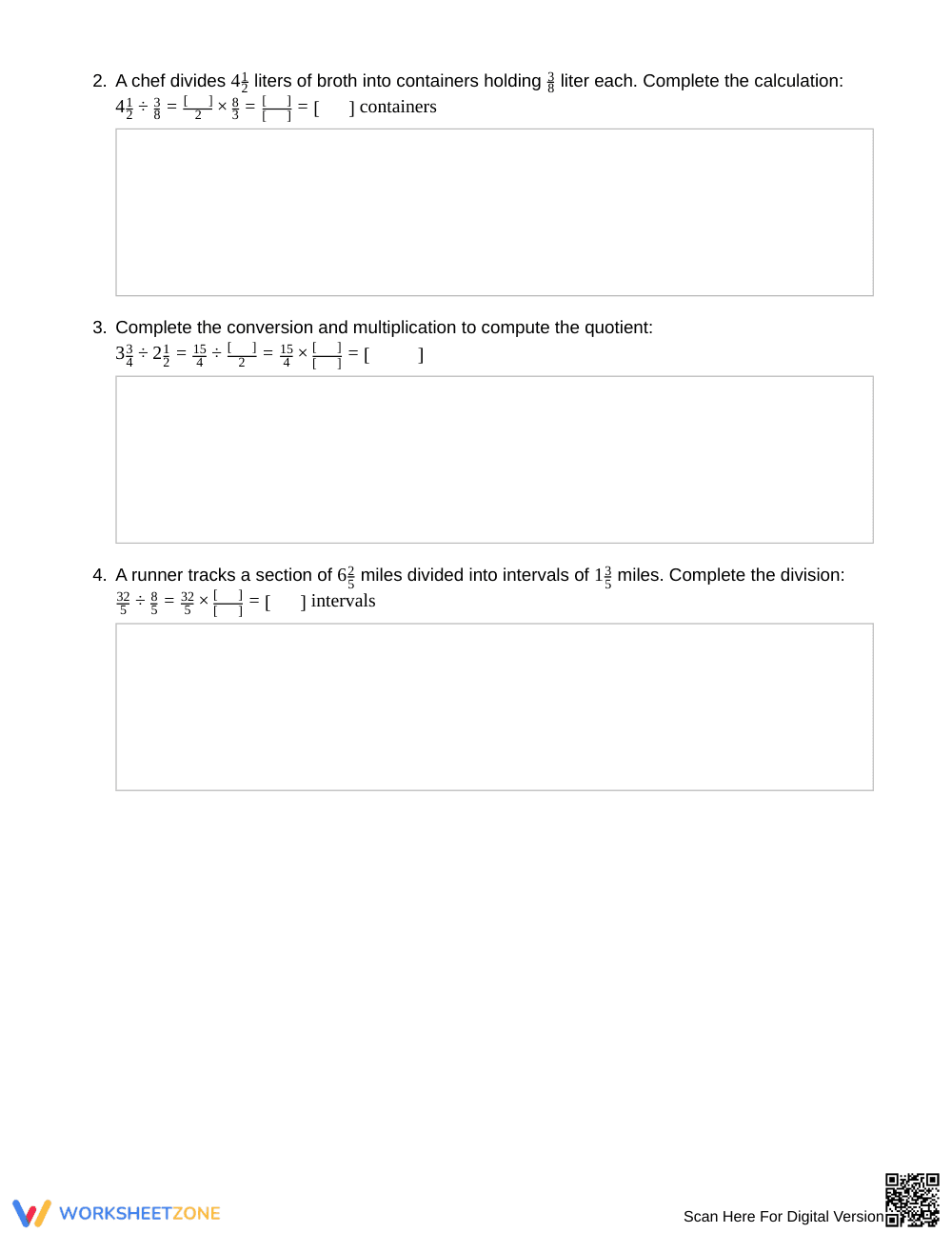
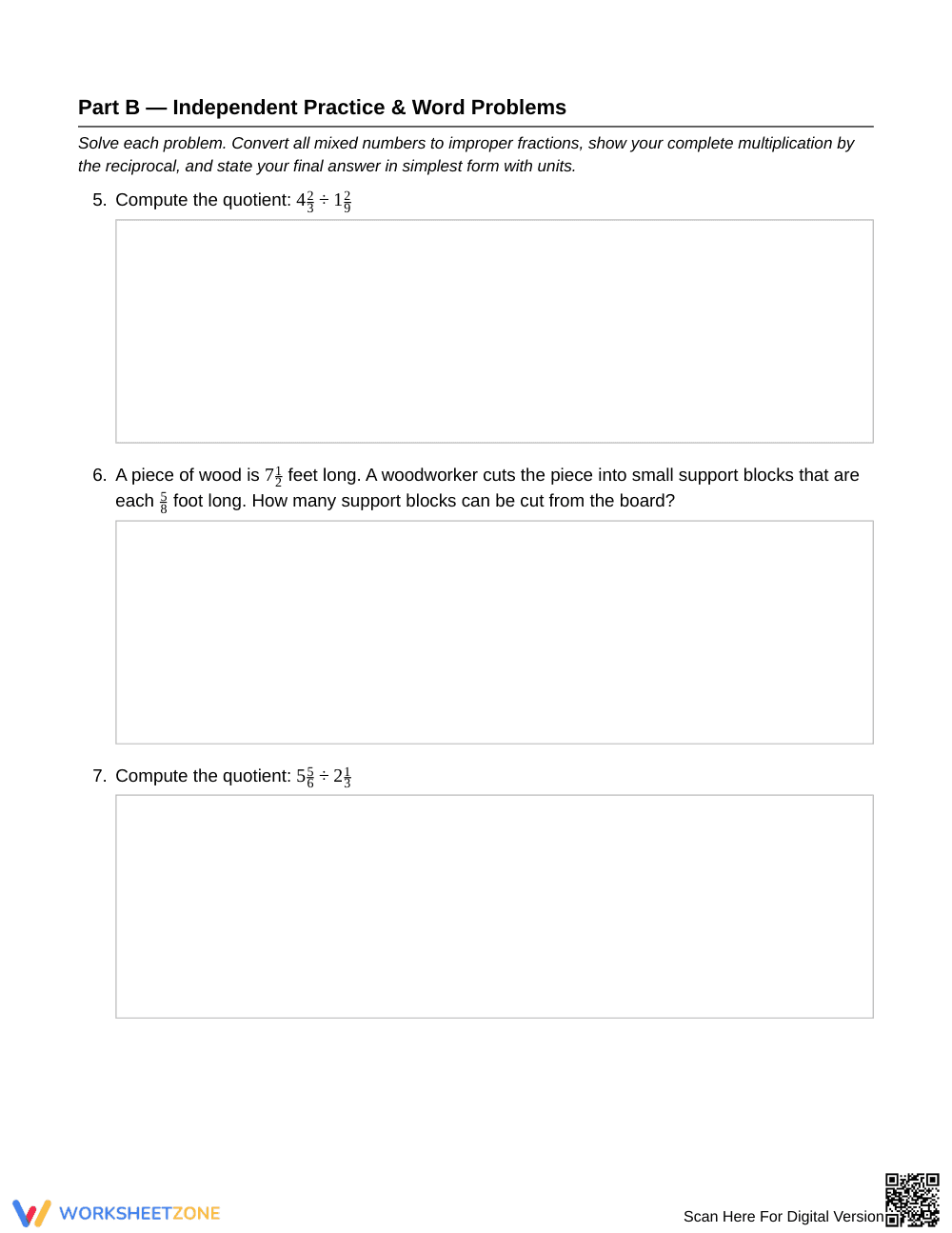
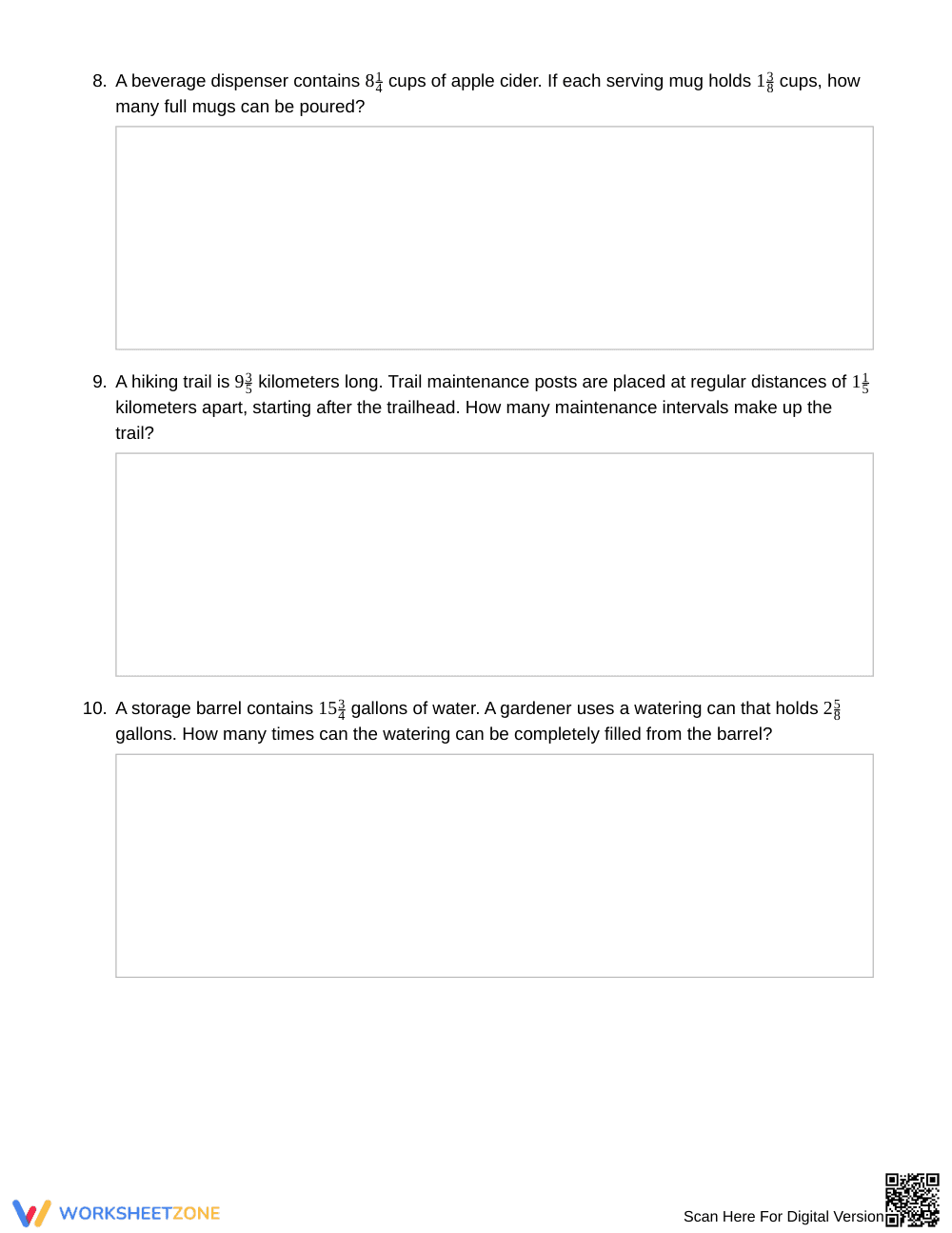
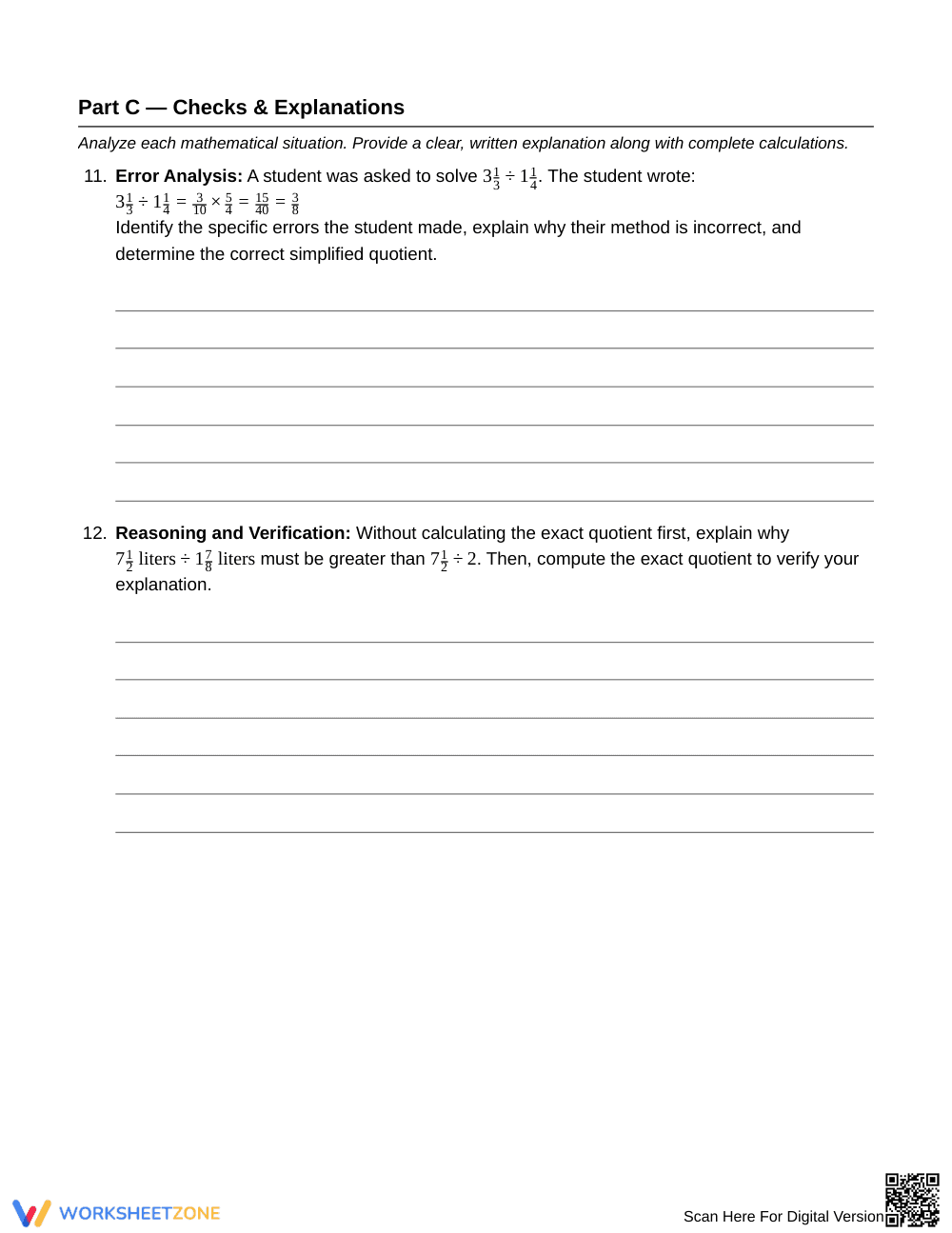
This resource opens with an explicit reference box defining the three-step algorithm alongside two worked measurement models. Practice includes 4 fill-in missing-step items, 6 standard and contextual calculation problems, and 2 reasoning tasks featuring error analysis and quantitative comparison. A complete two-page answer key provides step-by-step improper fraction conversions and simplified solutions.
Skill Progression
- Guided Practice (Part A, 4 problems): Scaffolds the division sequence through structured fill-in-the-blank equations isolating fraction conversions and divisor inversion.
- Supported Practice (Part B, 6 problems): Fades visual scaffolds as students independently execute the full algorithm across numerical calculations and measurement word problems.
- Independent Practice (Part C, 2 problems): Requires higher-order critique through student error analysis and relational inequality justification without initial computation.
This sequence follows the gradual-release model (I Do, We Do, You Do), establishing confident execution before testing diagnostic reasoning.
Standards Alignment
This worksheet aligns directly to primary standard `6.NS.A.1`: Interpret and compute quotients of fractions, and solve word problems involving fraction division. It also reinforces supporting standard `5.NF.B.7` by extending unit fraction division into mixed numbers. Both standard codes can be copied directly into lesson plans, IEP goals, or district curriculum mapping tools.
How to Use It
Deploy this worksheet during guided practice immediately following direct instruction on reciprocal multiplication. For formative assessment, check student work during Part A to verify proper divisor inversion, catching reciprocal errors early. Students typically complete the 12 problems in 40 to 50 minutes.
Who It's For
Designed for Grade 6 math classrooms, this resource supports core practice, intervention groups, and test review. Struggling learners benefit from the core rule reference box, while advanced learners tackle analytical justification in Part C. Pair this worksheet directly with fraction strip models or reciprocal mini-lessons.
Grade 6 standard 6.NS.A.1 requires students to interpret and compute quotients of fractions, solving real-world division problems through visual representations and algebraic equations. According to Fisher & Frey (2014), the gradual-release-of-responsibility framework strengthens procedural fluency when structured tasks explicitly bridge direct modeling to independent analytical execution. This worksheet embodies that instructional architecture: learners begin by referencing modeled solutions and completing partial steps, transition into unprompted multi-step computations, and culminate in error analysis and conceptual verification. By requiring students to justify why division yields specific relative magnitudes before calculating, the resource reinforces mathematical reasoning rather than rote algorithm memorization. Incorporating worked examples alongside independent problem sets reduces cognitive load for sixth-grade learners navigating complex multi-step conversions, ensuring that fraction division mechanisms become durable cognitive assets across subsequent pre-algebraic ratios, rates, and proportional relationships.


