































Complete Digestive System Worksheet | Grades 6-10 Science

Paste this activity's link or code into your existing LMS (Google Classroom, Canvas, Teams, Schoology, Moodle, etc.).
Students can open and work on the activity right away, with no student login required.
You'll still be able to track student progress and results from your teacher account.
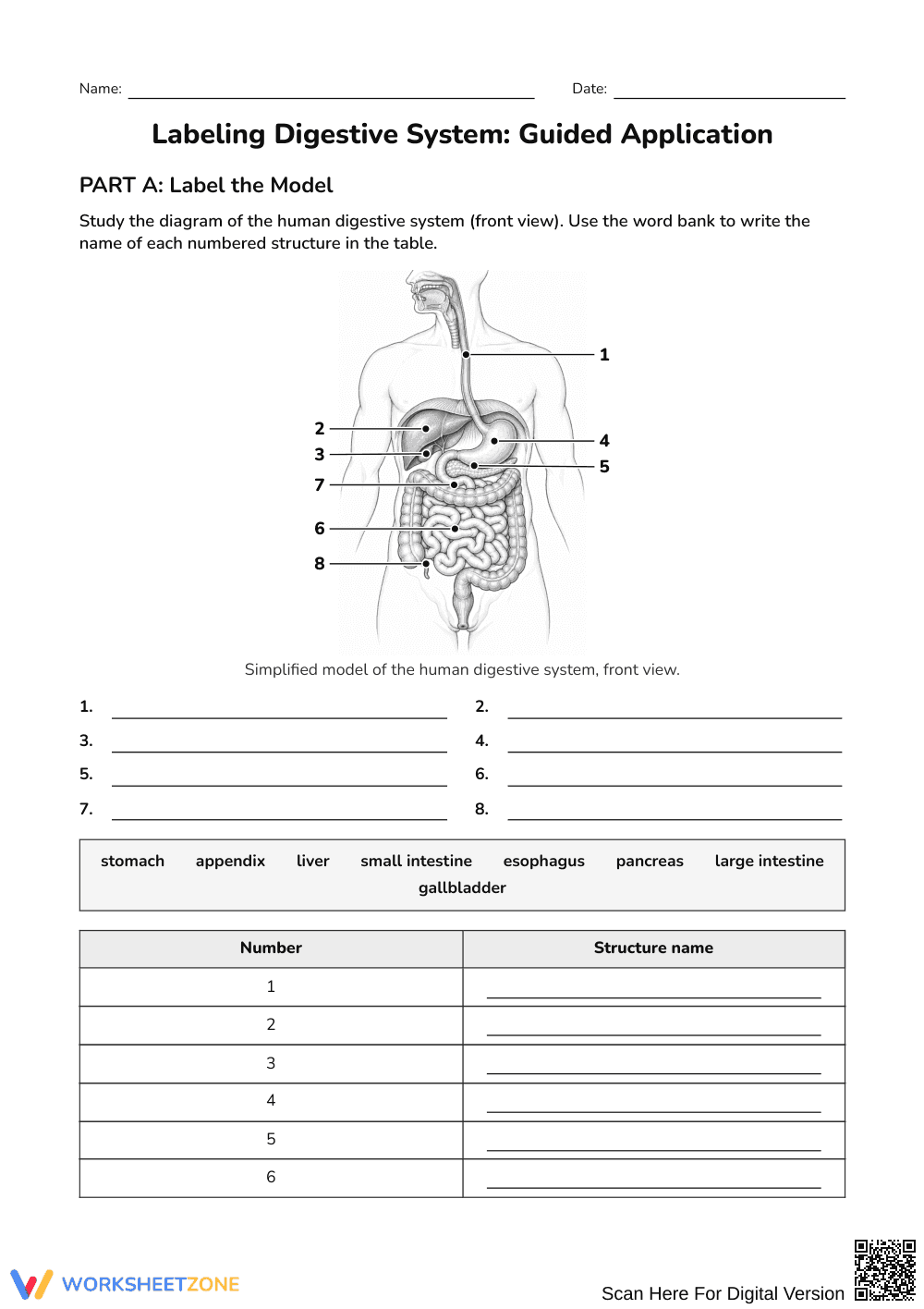
This human digestive system worksheet guides middle and high school students through anatomical labeling and physiology concepts. Students examine body structures, evaluate physiological scenarios, and formulate evidence-based arguments, connecting organ anatomy directly to chemical and mechanical digestion across 25 focused tasks.
At a Glance
- Grade: Grades 6–10 · Subject: Science · Biology
- Standard: Life Science — Model human body systems to explain organ structure and function in digestion
- Skill Focus: Digestive system anatomical labeling and scenario application
- Format: 4 pages · 25 total problems · Full answer key included · Printable PDF
- Best For: Biology unit review, independent practice, and formative assessment
- Time: 40–50 minutes total
What's Inside
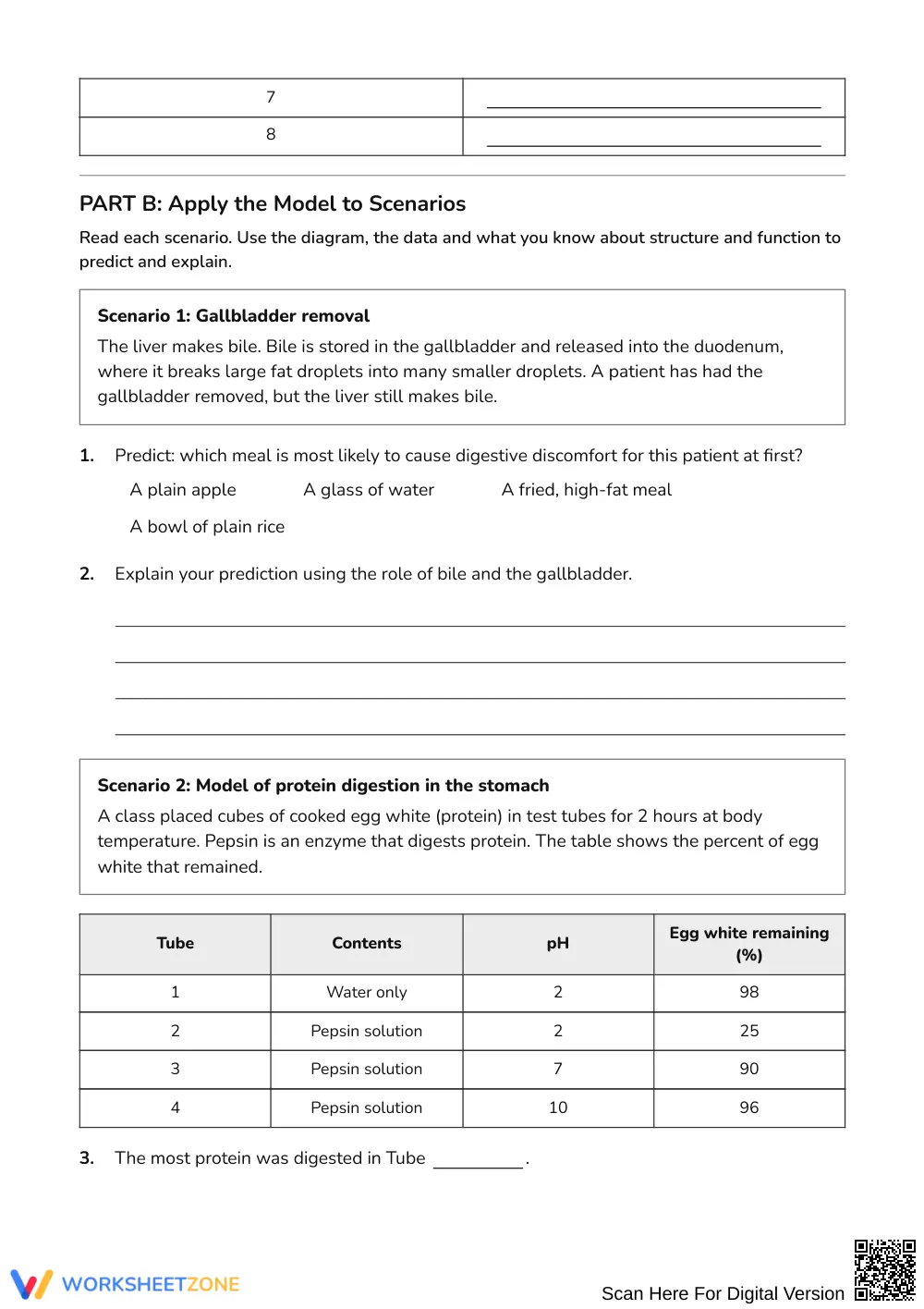
This 4-page worksheet features 25 problems across three sections, supported by an anatomical diagram, a word bank, and experimental data. Students identify eight digestive organs, evaluate three clinical and experimental scenarios on bile, pepsin, and villi surface area, and complete a claim-evidence-reasoning task. A 4-page answer key provides complete explanations.
Skill Progression
- Guided Practice (Part A): Students label 8 numbered organs on the anatomical model using the provided word bank.
- Supported Practice (Part B): Across 14 scenario items, students interpret enzyme data, calculate villi surface area, and predict digestive outcomes.
- Independent Practice (Part C): In 3 concluding tasks, students construct a claim-evidence-reasoning explanation addressing an accessory organ misconception.
This progression mirrors the gradual release of responsibility model, transitioning students from foundational recall to evidence-based analysis.
Standards Alignment
This resource aligns with middle and high school life science standards requiring students to develop and use models explaining how organ systems interact. The tasks target structure-function relationships, nutrient absorption, and enzymatic breakdown. Both standard codes can be copied directly into lesson plans, IEP goals, or district curriculum mapping tools.
How to Use It
Assign this worksheet following direct instruction on organ systems or incorporate it into collaborative lab stations. During independent work, monitor student explanations of the control tube in Scenario 2 to identify misconceptions regarding experimental controls. The entire resource takes approximately 40 to 50 minutes to complete.
Who It's For
Designed for science students in grades 6 through 10, this activity supports varied learning needs. The visual model and word bank scaffold emerging learners, while data analysis challenges advanced students. Pair this resource with an introductory digestive system lesson or an interactive human body organ model.
According to Fisher & Frey (2014), student cognitive autonomy develops most reliably through structured instructional frameworks that deliberately scaffold the transition from foundational knowledge acquisition to complex disciplinary evaluation. This 4-page science activity puts that research into direct practice by guiding students through 25 targeted tasks on digestive system anatomy and physiology. Beginning with diagrammatic organ labeling, learners advance into high-level empirical evaluation by interpreting enzymatic rate tables and computing geometric surface area ratios. The terminal claim-evidence-reasoning task challenges students to defend scientific arguments regarding accessory organ function using concrete textual and diagrammatic evidence. By balancing structured scaffolds like word banks with open-ended experimental interpretation, the instructional sequence prevents cognitive overload while fostering deep conceptual retention. Educators can readily utilize this standards-grounded worksheet to evaluate student mastery of biological structure-function interactions through objective data interpretation and analytical writing.


