




























Complete Digestive System Worksheet | Grade 6-10 Science
Paste this activity's link or code into your existing LMS (Google Classroom, Canvas, Teams, Schoology, Moodle, etc.).
Students can open and work on the activity right away, with no student login required.
You'll still be able to track student progress and results from your teacher account.
This comprehensive science worksheet guides middle and high school students through mastering digestive anatomy and physiological mechanisms. Across 22 targeted items, learners label key digestive structures, trace the continuous alimentary canal, and analyze how specialized micro-structures maximize nutrient absorption. Students transition from identifying organ locations to explaining complex biochemical functions with clear, structured evidence.
At a Glance
- Grade: Grades 6–10 · Subject: Science
- Standard: Structure and Function — Model human organ systems and describe nutrient absorption mechanisms
- Skill Focus: Digestive system anatomical labeling and physiological analysis
- Format: 4 pages · 22 problems · Answer key included · PDF
- Best For: Biology review and mid-unit formative assessment
- Time: 35–45 minutes
What's Inside
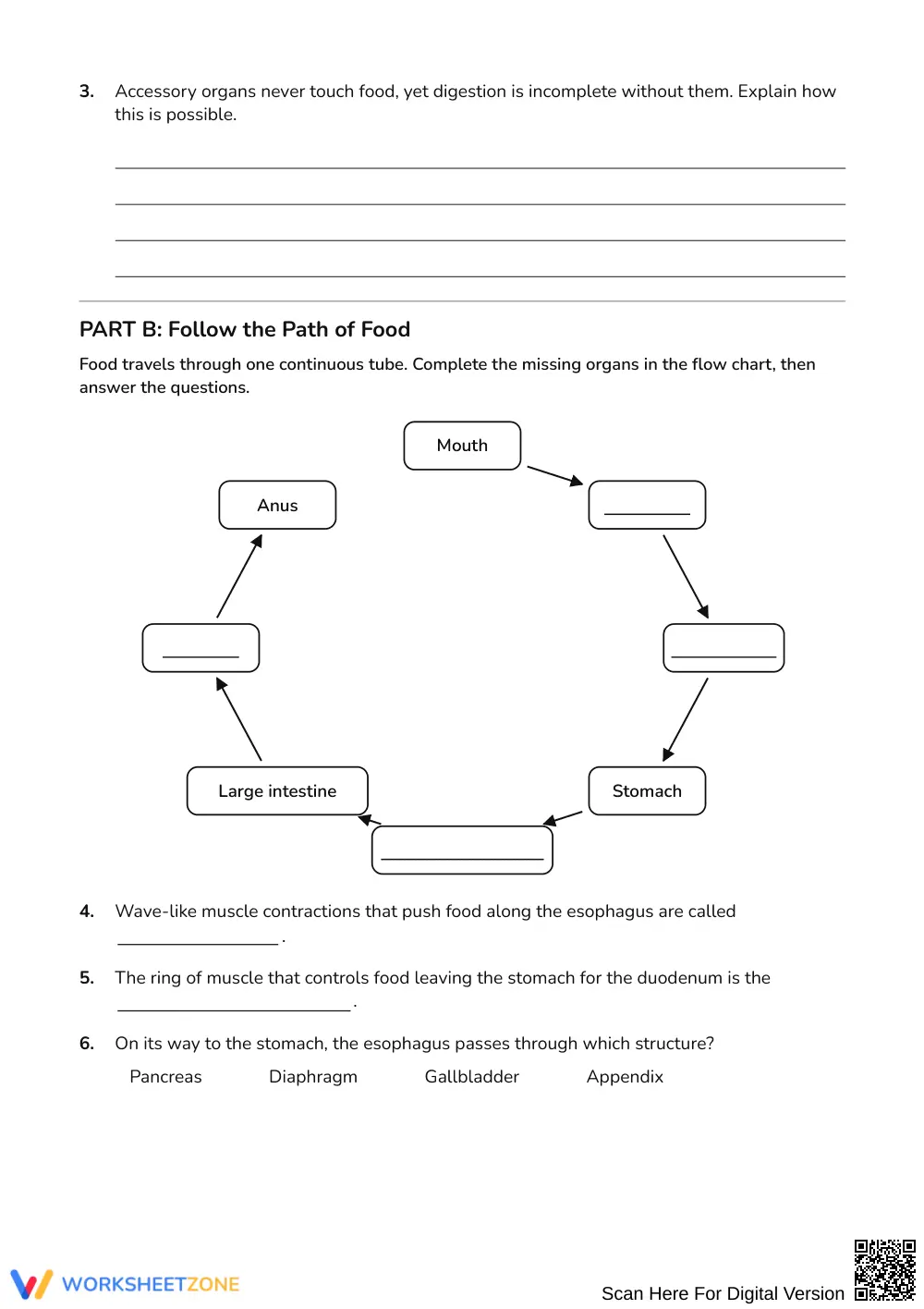
This 4-page science resource contains 22 rigorous items across three progressive sections. Students work with an anatomical front-view model, a word bank, an alimentary canal flowchart, and a quantitative villi surface-area comparison chart. The worksheet features multiple-choice questions, organ classification tasks, and free-response mechanism prompts. A complete 4-page answer key provides labeled diagrams and model explanations.
Skill Progression
- Guided practice (Part A – 10 items): Students label organs using an anatomical diagram and word bank, reinforced by multiple-choice organ questions.
- Supported practice (Part B – 6 items): Learners trace the alimentary canal, distinguishing mechanical from chemical processes while defining peristalsis and sphincters.
- Independent practice (Part C – 6 items): Students evaluate villi through quantitative models, explaining surface area amplification and predicting impacts of gallbladder removal.
This scaffolding follows a gradual-release instructional model, moving learners from visual identification to complex physiological analysis.
Standards Alignment
This worksheet aligns with middle and secondary life science standards focusing on human body systems, specifically modeling how organ systems interact to support nutrient processing. Students demonstrate how multicellular structures possess specialized subsystems that carry out essential life functions. Both standard codes can be copied directly into lesson plans, IEP goals, or district curriculum mapping tools.
How to Use It
Deploy this worksheet directly after direct instruction on the human digestive system as an active review, or utilize it before an end-of-unit exam to check conceptual retention. During independent work, conduct formative assessment observations by checking whether students correctly classify the pancreas and gallbladder as accessory organs rather than food-passages. Completion typically requires 35 to 45 minutes of instructional time.
Who It's For
Designed for life science and introductory biology students in grades 6 through 10, this resource supports varied instructional levels through built-in diagram labeling prompts and analytical extension questions. For English language learners, pair this worksheet with an interactive anatomical model or an illustrated vocabulary anchor chart during collaborative practice.
According to Fisher & Frey (2014), structured progression from perceptual identification to conceptual synthesis significantly deepens scientific literacy and long-term retention. This digestive system resource exemplifies targeted anatomical skill development by combining visual labeling, sequential pathway mapping, and quantitative surface-area modeling. Students systematically master the plain-English skill of identifying digestive organs and analyzing structure-function relationships in biological absorption. By establishing clear distinction between alimentary pathway organs and accessory glands, the 22 tasks systematically counter common student misconceptions. Furthermore, connecting micro-anatomical structures like villi to macro-level transport rates helps secondary learners construct durable scientific explanations supported by quantitative evidence. Research confirms that pairing schematic diagrams with analytical free-response tasks promotes deeper schema development than isolated vocabulary drill. Educators can confidently implement these 4 pages to cultivate rigorous anatomical reasoning across diverse middle and early high school biology classrooms.


