
































Complete Density Unit Consistency Worksheet | Grade 7

Paste this activity's link or code into your existing LMS (Google Classroom, Canvas, Teams, Schoology, Moodle, etc.).
Students can open and work on the activity right away, with no student login required.
You'll still be able to track student progress and results from your teacher account.
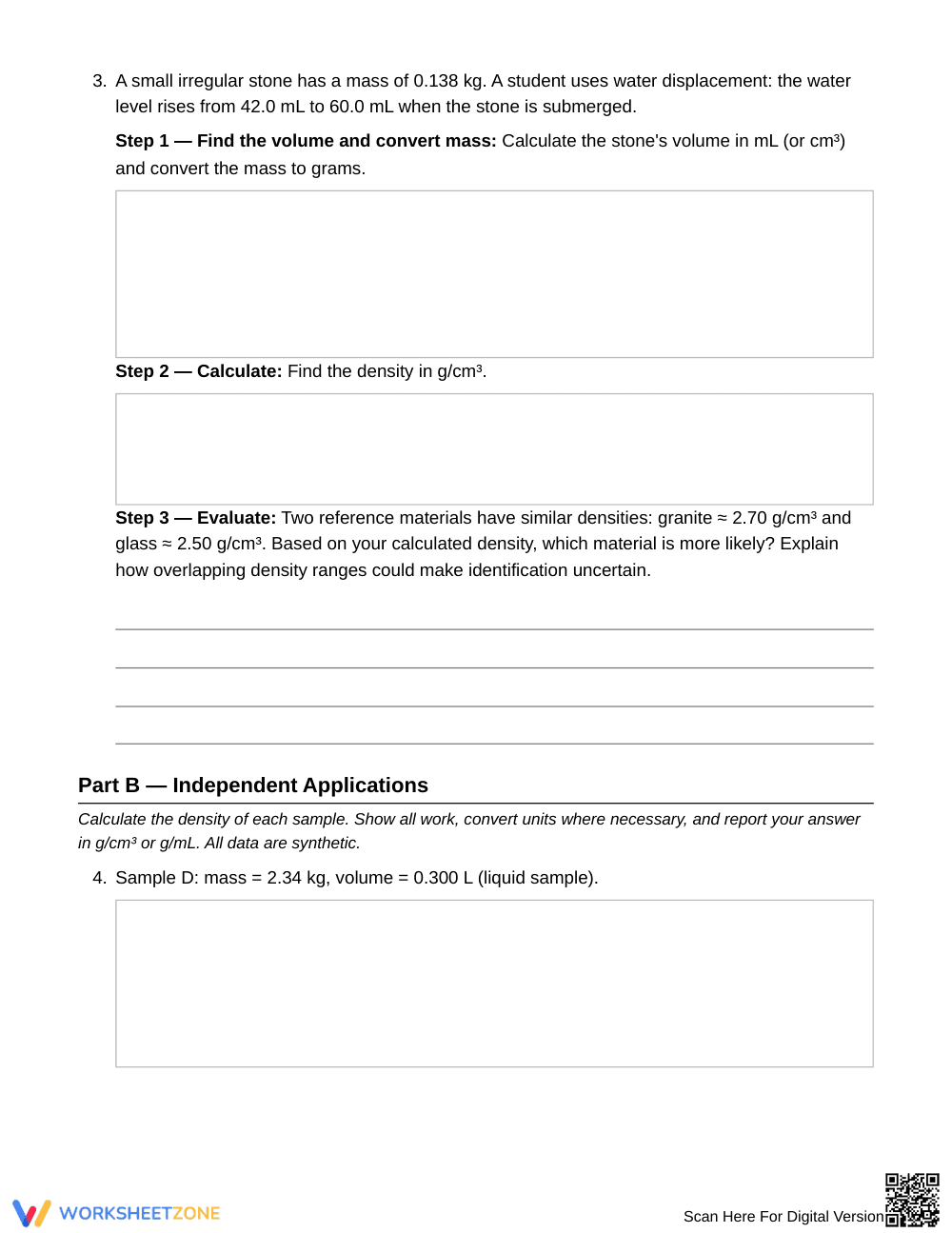
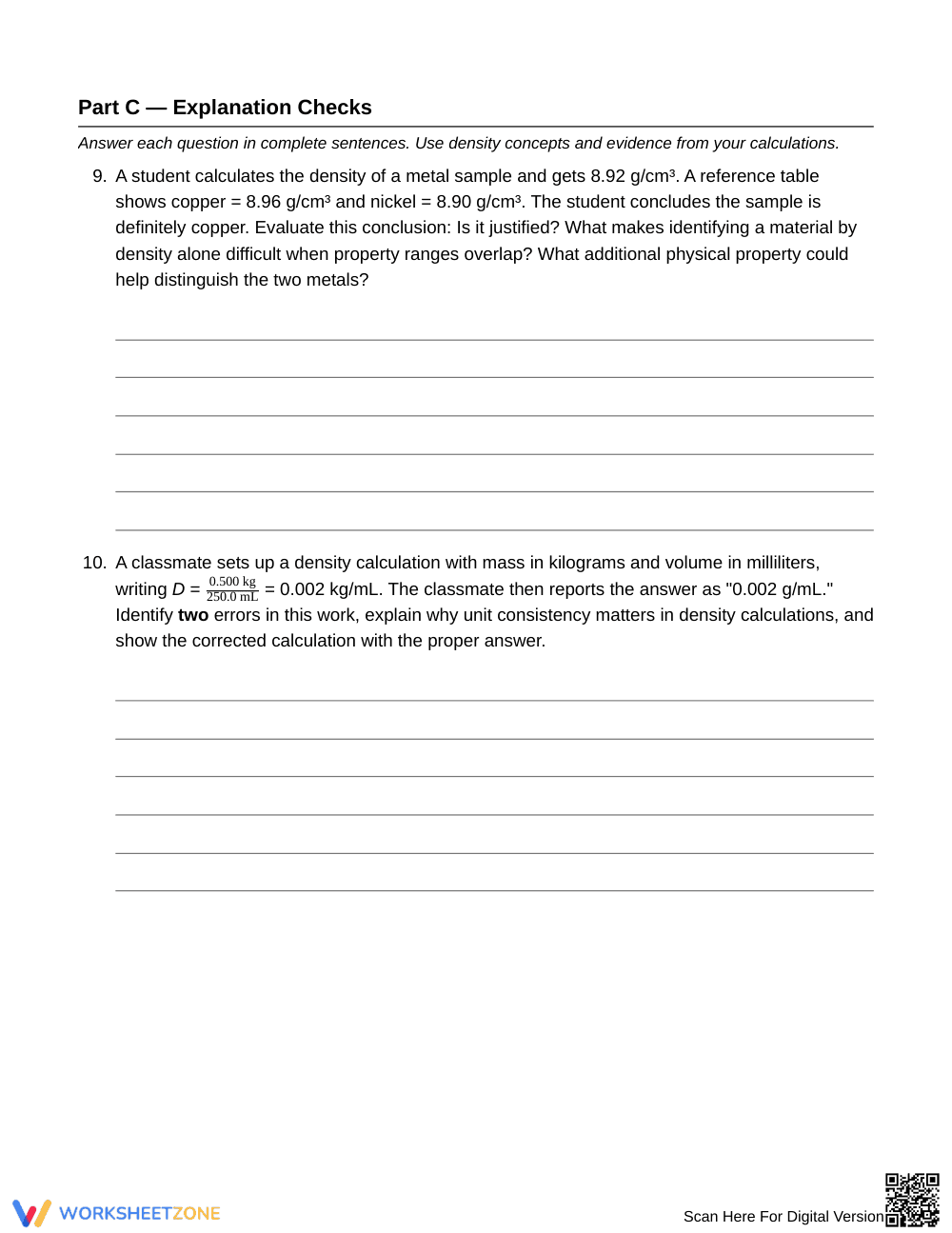
This physical science worksheet equips middle school students to master the density formula while converting units accurately. Students practice identifying given units, converting kilograms to grams and liters to milliliters, calculating density, and comparing results to reference values to classify unknown substances.
At a Glance
- Grade: 7 · Subject: Science
- Standard: Calculate density using mass and volume measurements with consistent metric units
- Skill Focus: Density calculations and unit conversions
- Format: 5 pages · 10 problems · Answer key included · PDF
- Best For: Independent physical science practice
- Time: 35–45 minutes
What's Inside
The resource features a reference formula box, unit conversion guides, two step-by-step worked examples, 10 structured student problems, and a comprehensive 3-page answer key showing full computational steps and conceptual explanations.
Skill Progression
- Guided Practice (Part A, Problems 1–3): Students follow a structured three-step protocol (Convert, Calculate, Compare/Predict) to convert metric units, solve for density, and evaluate materials against physical property tables.
- Supported Practice (Part B, Problems 4–8): Students independently solve multi-step density problems involving solids, liquids, water displacement measurements, and comparative substance analysis.
- Independent Practice (Part C, Problems 9–10): Students analyze experimental errors, critique sample calculations with mismatched units, and construct written arguments about material identification.
This structured progression leverages the gradual release of responsibility model, guiding learners from scaffolded unit conversions to higher-order error analysis.
Standards Alignment
This worksheet targets middle school physical science objectives requiring students to analyze and interpret data on the properties of substances before and after substances interact. Students determine characteristic properties such as density to distinguish pure substances. These concepts integrate into standard curriculum pacing guides and STEM unit plans.
How to Use It
Implement this activity immediately following direct instruction on the density formula and water displacement. During guided practice, circulate to verify that students multiply by 1,000 when converting kilograms to grams before dividing mass by volume. The full worksheet takes approximately 35 to 45 minutes to complete, making it ideal for classwork, structured lab follow-up, or formative assessment.
Who It's For
This resource is designed for Grade 7 science classrooms, introductory physical science courses, and Tier 2 math-in-science intervention groups. Pair this worksheet with hands-on graduated cylinder lab investigations or an anchor chart displaying metric conversion factors.
Mastering characteristic physical properties requires students to coordinate algebraic formulas with foundational unit measurement skills. According to Fisher & Frey (2014), structured scaffolds that pair explicit worked examples with multi-tiered independent application significantly enhance procedural fluency and conceptual transfer in STEM disciplines. This 5-page worksheet provides middle school science students with 10 targeted tasks focused on calculating density ($D = m/V$), converting between metric units (such as kilograms to grams and liters to milliliters), and evaluating substance identification scenarios using reference property tables. By combining guided unit alignment, water displacement calculations, and qualitative error-analysis prompts, the resource ensures students build reliable problem-solving habits that bridge mathematical computation and scientific reasoning.


