































Complete Density Measurement Worksheet | Grade 7 Science

Paste this activity's link or code into your existing LMS (Google Classroom, Canvas, Teams, Schoology, Moodle, etc.).
Students can open and work on the activity right away, with no student login required.
You'll still be able to track student progress and results from your teacher account.
This Grade 7 science worksheet guides students through designing experimental measurement procedures to identify unknown substances using density and physical properties. Students evaluate experimental uncertainty, control variables in water displacement, and analyze multi-property data sets to distinguish closely matched materials.
At a Glance
- Grade: 7 · Subject: Science
- Standard: Analyze physical properties and design measurement procedures to determine material density
- Skill Focus: Design a Measurement Procedure
- Format: 5 pages · 10 problems · Answer key included · PDF
- Best For: Lab preparation and experimental design practice
- Time: 45–60 minutes
Across 5 pages, students engage with a structured calibration database featuring five metal alloys, reference density ranges, Mohs hardness, and magnetic properties. The resource contains 10 rigorous analytical problems organized into three progressive parts, complete with an extensive 3-page teacher answer key detailing mathematical steps, error sources, and model evaluations.
Skill Progression
- Guided practice (Part A — 2 problems): Students apply mathematical formulas to predict water displacement volumes and select secondary diagnostic tests.
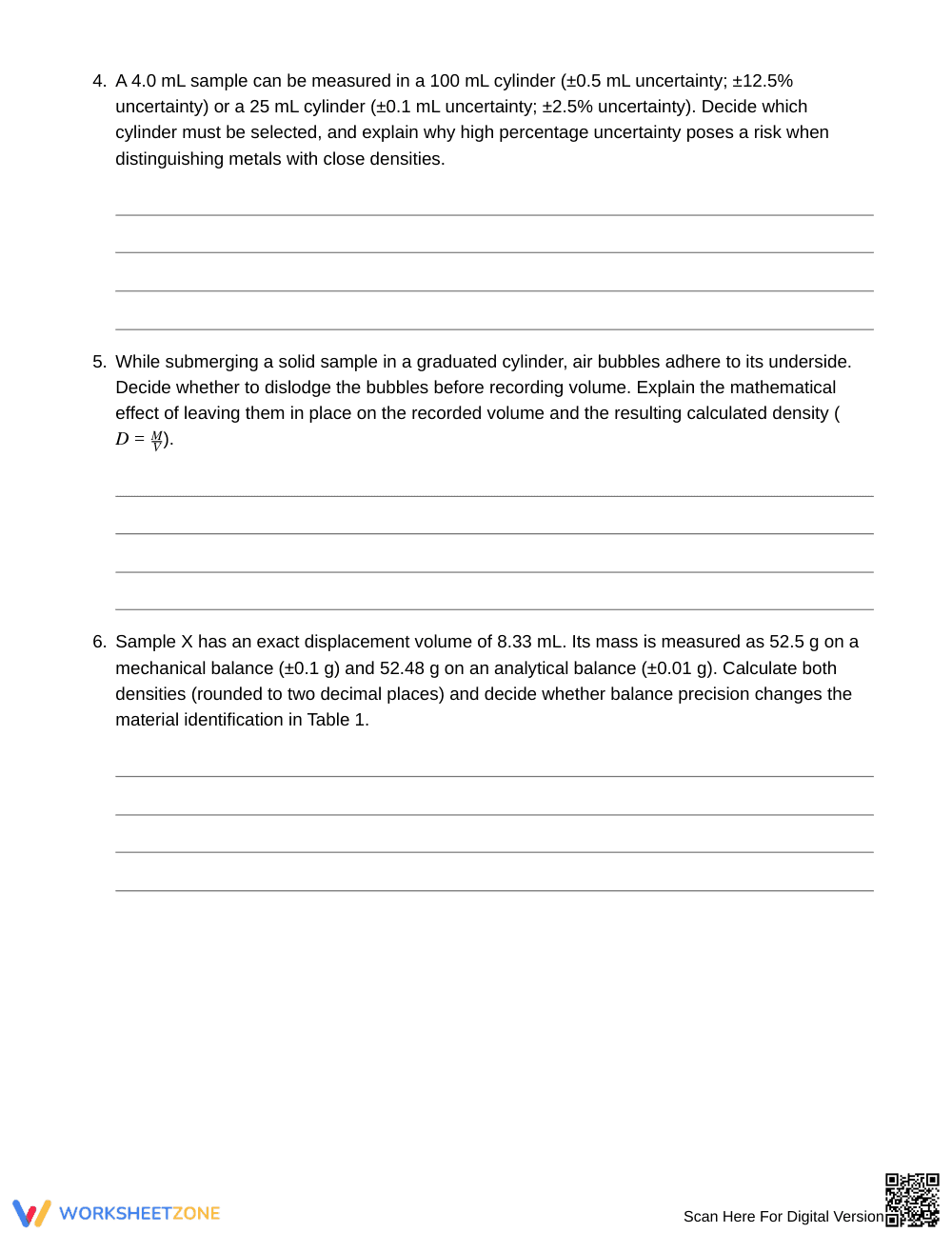
- Supported practice (Part B — 6 problems): Learners evaluate measurement precision across 25 mL versus 100 mL graduated cylinders, balance sensitivities, air bubble systematic errors, and variable isolation.
- Independent practice (Part C — 2 problems): Students analyze complete multi-property data sets to identify unknown specimens and evaluate competing experimental models comparing single-trial displacement against multi-sample slope analysis.
This structure follows a gradual-release instructional model that transitions students from formula application to advanced procedural critique.
Standards Alignment
This resource reinforces middle school physical science principles requiring students to analyze and interpret data on the characteristic properties of substances. Students demonstrate that density remains an intensive property regardless of sample size while identifying how tool precision limits experimental certainty. Both standard codes can be copied directly into lesson plans, IEP goals, or district curriculum mapping tools.
How to Use It
Implement this worksheet during direct laboratory instruction as a pre-lab procedural planning activity or following a hands-on displacement lab to deepen data analysis skills. During work time, formatively assess student explanations on how adhering air bubbles artificially inflate measured volume and lower calculated density. The entire 10-task sequence typically requires 45 to 60 minutes of focused classroom work.
Who It's For
This activity supports Grade 7 science classrooms, introductory physical science units, and middle school STEM electives. It provides targeted scaffolding for developing quantitative lab reasoning and pairs naturally with a hands-on density laboratory station or a physical properties anchor chart.
According to instructional research by Fisher & Frey (2014), structured procedural scaffolds and progressive data evaluation tasks significantly enhance middle school students' scientific reasoning and quantitative problem-solving skills. When Grade 7 physical science learners evaluate experimental measurement procedures, calculate density ratios, and account for tool uncertainty across graduated cylinders and balances, they build robust mental models of intensive versus extensive properties. This 5-page curriculum resource provides 10 scaffolded tasks that guide students from direct mathematical predictions to complex multi-property unknown identification. By challenging students to compare single-trial protocols against multi-sample linear slope analysis, the curriculum directly targets common misconceptions surrounding displaced volume and experimental error. Grounded in rigorous science practices, these structured analytical exercises ensure students develop the necessary evidence-based argumentation skills required for advanced secondary science laboratory investigations.


