


























Views
Downloads




Complete Defending Text Structure Worksheet | Grade 6 ELA
Paste this activity's link or code into your existing LMS (Google Classroom, Canvas, Teams, Schoology, Moodle, etc.).
Students can open and work on the activity right away, with no student login required.
You'll still be able to track student progress and results from your teacher account.
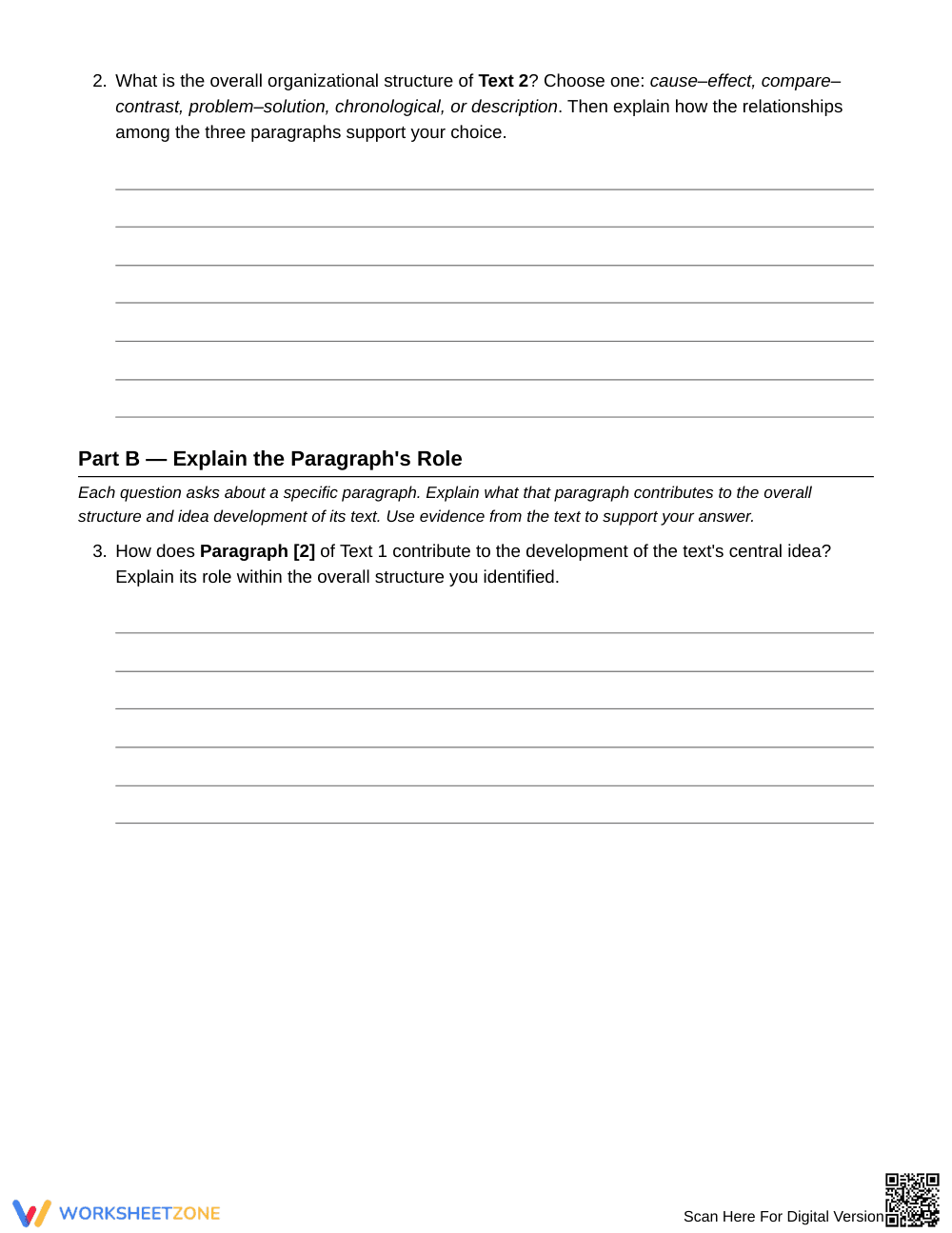
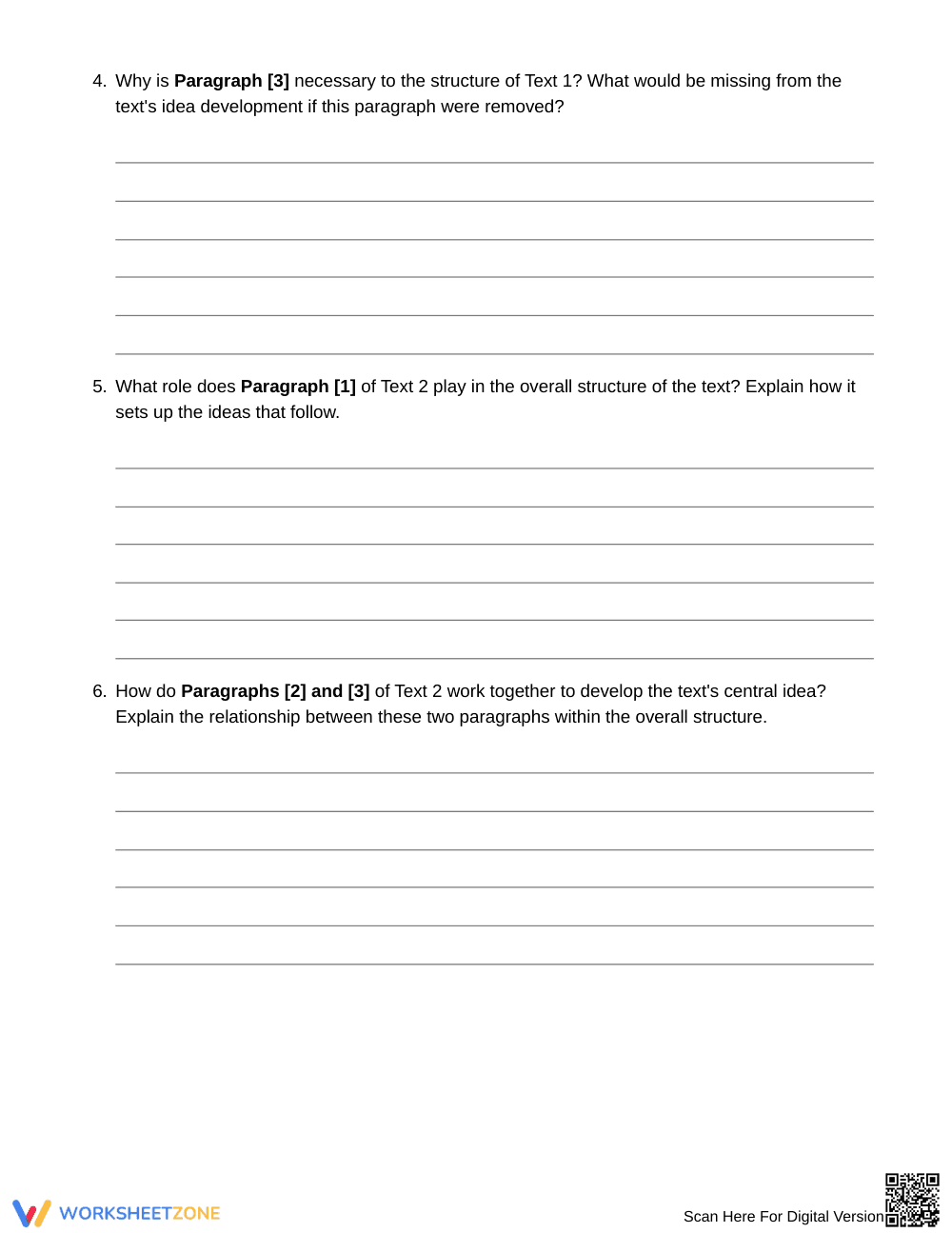
This informational text structure worksheet trains Grade 6 students to analyze and defend how authors organize ideas without relying on signal words. By evaluating relationships across two multi-paragraph passages, learners explain how paragraphs contribute to overall text design and justify their structural choices using text-based evidence.
At a Glance
- Grade: 6 · Subject: ELA
- Standard:
RI.6.5— Analyze how a particular sentence, paragraph, chapter, or section fits into the overall text structure- Skill Focus: Defending Informational Text Structure Without Signal Words
- Format: 5 pages · 8 problems · Answer key included · PDF
- Best For: Independent text analysis practice and formative skill reinforcement
- Time: 35–45 minutes
What's Inside
The 5-page printable packet features two original non-fiction reading passages—"The Dust Bowl's Reach" and "Two Paths to Clean Water"—paired with 8 text-dependent analytical tasks. A foundational reference box clarifies how to identify cause-effect, compare-contrast, problem-solution, chronological, and descriptive patterns solely through logical connections. A comprehensive 4-page answer key provides complete written defense models and sample explanations for every question.
Skill Progression
- Guided Practice (Part A, 2 tasks): Students classify the overarching pattern of each passage using an initial relationship reference box, establishing baseline pattern identification without signal words.
- Supported Practice (Part B, 4 tasks): Learners analyze paragraph function, explaining how individual paragraphs build upon preceding ideas to advance central themes and support macro-structure.
- Independent Practice (Part C, 2 tasks): Students evaluate and refute plausible competing organizational models, writing evidence-backed arguments that explain why alternative structural interpretations fail.
This intentional sequence applies a gradual-release instructional model that transitions learners from basic pattern recognition to sophisticated textual defense.
Standards Alignment
This resource focuses on `RI.6.5`: analyze how a particular sentence, paragraph, chapter, or section fits into the overall structure of a text and contributes to the development of ideas. Supporting standard `RI.6.1` addresses citing textual evidence. Both standard codes align directly with lesson plans and curriculum maps.
How to Use It
Deploy this worksheet after direct instruction on non-fiction text structures. Have students complete Part A and Part B in pairs before tackling Part C as an independent exit assessment. During work time, verify that students cite inter-paragraph logic rather than relying on transitional words. Expected completion time is 35 to 45 minutes.
Who It's For
This exercise serves Grade 6 ELA students, middle school intervention groups, and advanced Grade 5 readers. Pair this activity with an informational text structure anchor chart or a modeling lesson on paragraph function.
Mastering standard RI.6.5 requires Grade 6 students to analyze how specific paragraphs fit into overall text structure and contribute to idea development through logical relationships rather than relying on obvious transition words. According to Fisher & Frey (2014), structured close reading routines that demand explicit textual defense significantly strengthen middle school reading comprehension and analytical writing fluency. When adolescents dissect authorial organization by comparing competing structural models, they move beyond passive pattern matching to evaluate how complex ideas interconnect across an entire passage. This instructional worksheet equips teachers with paired informational passages and scaffolded prompts that guide students through classifying organizational frameworks, isolating paragraph functions, and systematically dismantling plausible misconceptions. By prioritizing deep structural analysis over simple keyword searches, this curriculum tool reinforces foundational informational literacy skills that support sustained academic success across secondary content areas.


