

































Complete Critical Lenses Worksheet | Grade 12 English IV

Paste this activity's link or code into your existing LMS (Google Classroom, Canvas, Teams, Schoology, Moodle, etc.).
Students can open and work on the activity right away, with no student login required.
You'll still be able to track student progress and results from your teacher account.
This Grade 12 literary criticism worksheet trains students to apply Marxist, formalist, and moral critical lenses while respecting strict textual boundaries. Working through a multi-page narrative, learners identify verifiable textual evidence, critique speculative character assumptions, and distinguish between stated economic motivations and unresolved moral ambiguities.
At a Glance
- Grade: 12 · Subject: English IV
- Standard:
RL.11-12.1— Cite strong textual evidence and determine where the text leaves matters uncertain- Skill Focus: Lens, Evidence, and Interpretive Limits
- Format: 6 pages · 10 problems · Answer key included · PDF
- Best For: Literary criticism and advanced close reading
- Time: 45–60 minutes
What's Inside
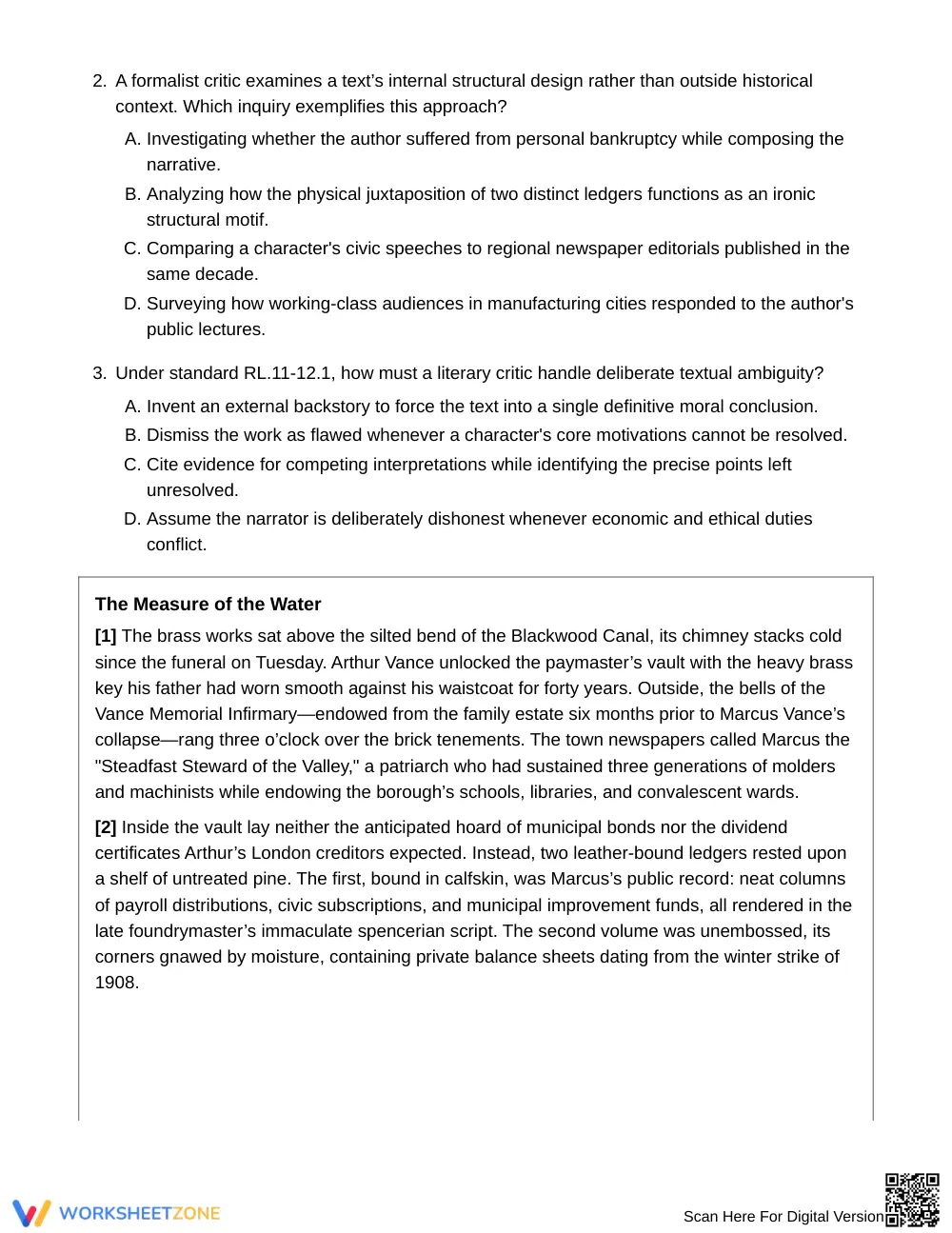
The 6-page printable set features an introductory reference framework defining critical lenses and evidentiary boundaries, followed by the complete short story "The Measure of the Water." Students engage with 10 total items, including 3 conceptual multiple-choice questions, 5 text-dependent analytical prompts, 2 extended synthesis tasks, and a comprehensive 3-page answer key.
Skill Progression
- Guided Practice (Part A): 3 multiple-choice questions evaluate theoretical distinctions between structural evidence, socioeconomic analysis, and speculative author psychology using scaffolded options.
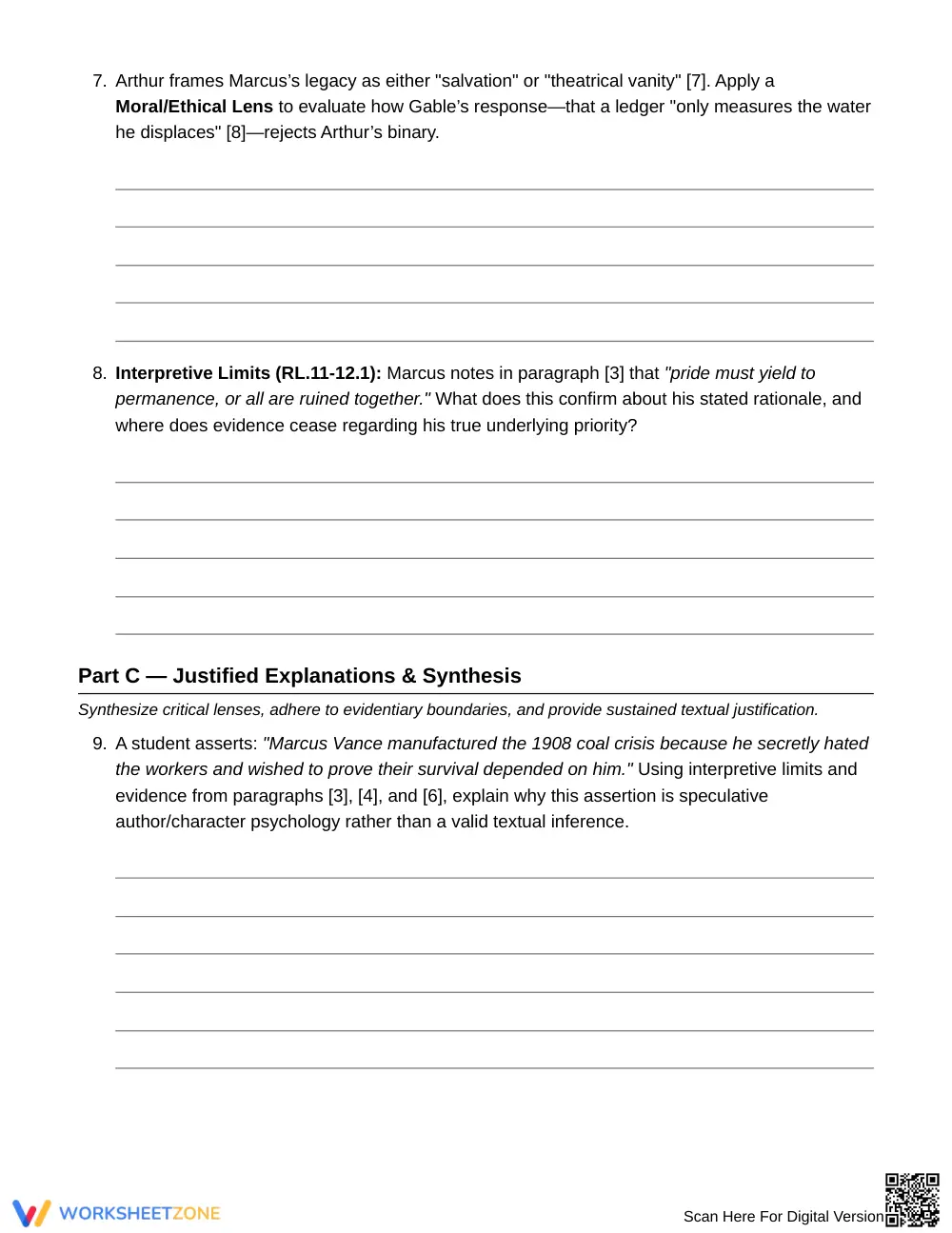
- Supported Practice (Part B): 5 targeted analysis prompts guide students to apply specific critical lenses to numbered paragraphs while pinpointing explicit textual limits.
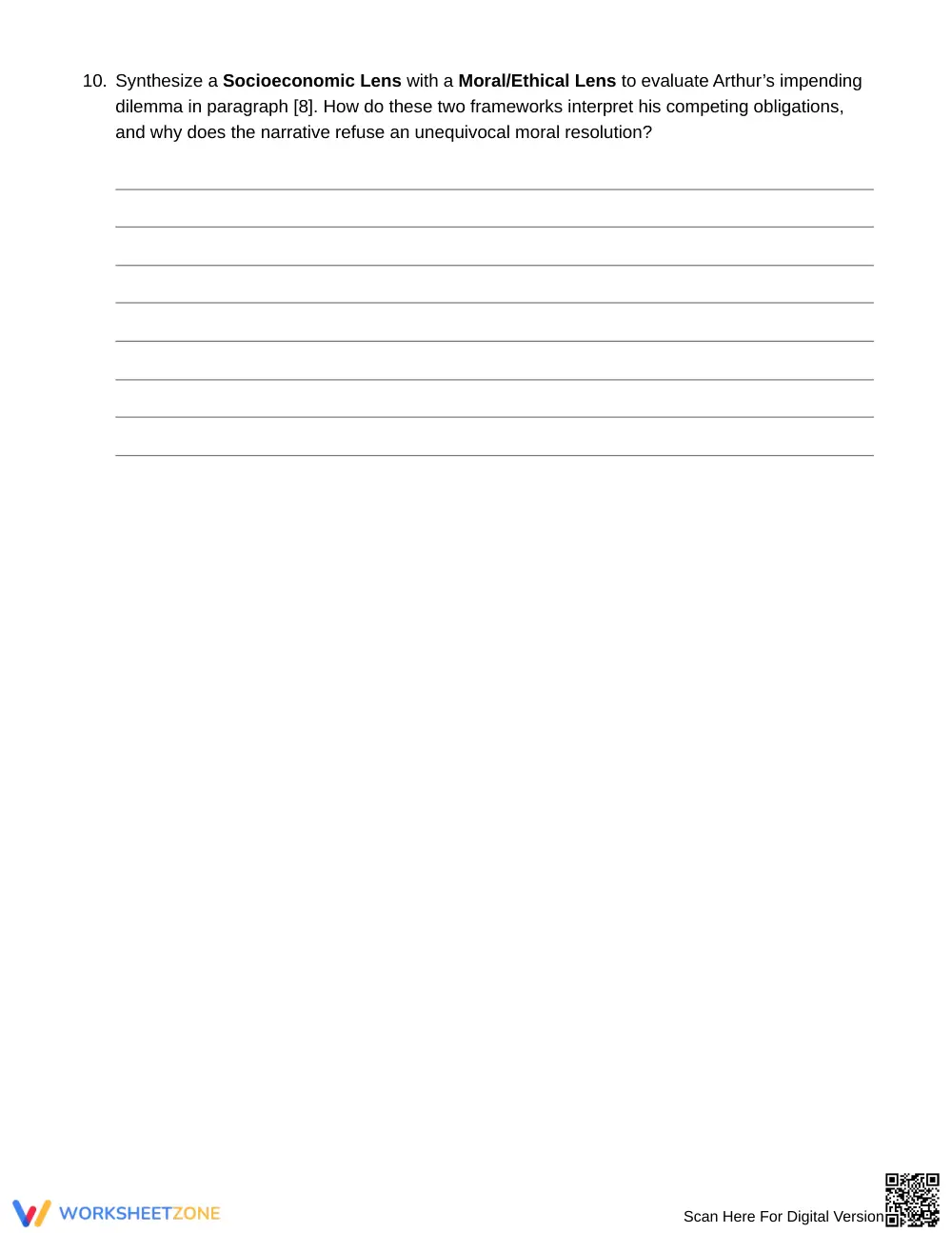
- Independent Practice (Part C): 2 sustained synthesis prompts challenge learners to refute ungrounded character claims and weigh competing frameworks without teacher prompting.
This sequence reinforces the gradual-release model, shifting students from foundational theoretical identification to autonomous, evidence-bounded critical evaluation.
Standards Alignment
This activity centers on `RL.11-12.1`, which requires students to cite strong, thorough textual evidence to support analysis of what the text says explicitly and inferentially, including determining where the text leaves matters uncertain. It also supports `RL.11-12.3` by examining how complex character choices interact with organizational structures. Both standard codes can be copied directly into lesson plans, IEP goals, or district curriculum mapping tools.
How to Use It
Deploy this resource during a literary criticism unit immediately following direct instruction on critical theory, or assign it as an advanced analytical assessment before college-level research papers. For formative assessment, examine student responses in Part B to verify whether they cite direct textual phrases or drift into speculative psychology. Typical completion time is 45 to 60 minutes.
Who It's For
This worksheet is designed for Grade 12 English IV, Advanced Placement Literature, and dual-enrollment humanities students. Differentiated support is embedded through the foundational framework box and paragraph-referenced questions. Pair this resource with an anchor chart detailing critical lenses or an introductory lecture on industrial-era labor relations.
Rigorous textual interpretation in secondary English language arts requires students to balance critical theoretical frameworks against strict evidentiary thresholds. Under standard RL.11-12.1, twelfth-grade scholars must cite strong and thorough textual evidence to substantiate analytical claims while delineating where an author leaves motives or narrative consequences deliberately ambiguous. Research from Fisher & Frey (2014) on close reading and disciplinary literacy emphasizes that advanced comprehension develops when instructional tasks systematically require students to isolate textual facts from uncorroborated reader speculation. By distinguishing between socioeconomic structures, formal aesthetic elements, and unsubstantiated character psychology across complex prose, this instructional resource trains learners to identify verifiable textual realities without overreaching into conjecture. Grounding analytical writing in documented textual citations ensures that students master high-level literary theory while adhering to the evidential rigor demanded by college-preparatory coursework and standardized academic writing benchmarks.


