































Complete Counterevidence Worksheet | Grade 10 English II

Paste this activity's link or code into your existing LMS (Google Classroom, Canvas, Teams, Schoology, Moodle, etc.).
Students can open and work on the activity right away, with no student login required.
You'll still be able to track student progress and results from your teacher account.
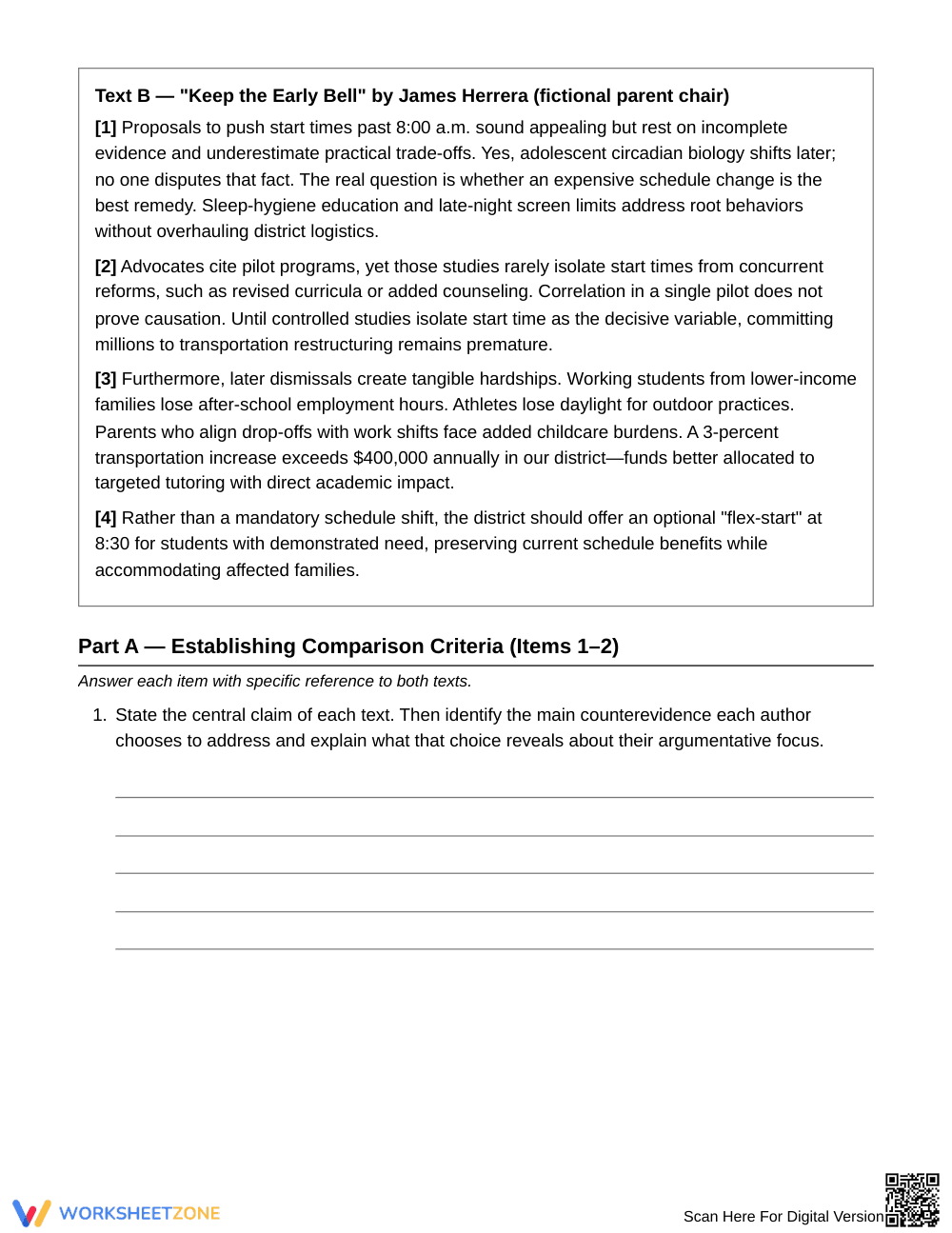
This high school English worksheet equips tenth-grade students to critically evaluate opposing arguments. Working with paired texts on school start schedules, learners dissect argumentative strategies—conceding, refuting, and reframing—to determine whether an author's response to counterevidence is logically valid, relevant, and supported by sufficient facts.
At a Glance
- Grade: 10 · Subject: English II
- Standard:
RI.9-10.8— Evaluate argument validity, reasoning integrity, and evidence sufficiency across opposing non-fiction texts- Skill Focus: Compare Responses to Counterevidence
- Format: 5 pages · 10 tasks · Complete 3-page answer key included · PDF
- Best For: Paired-text argumentative analysis and rhetorical evaluation units
- Time: 45–60 minutes
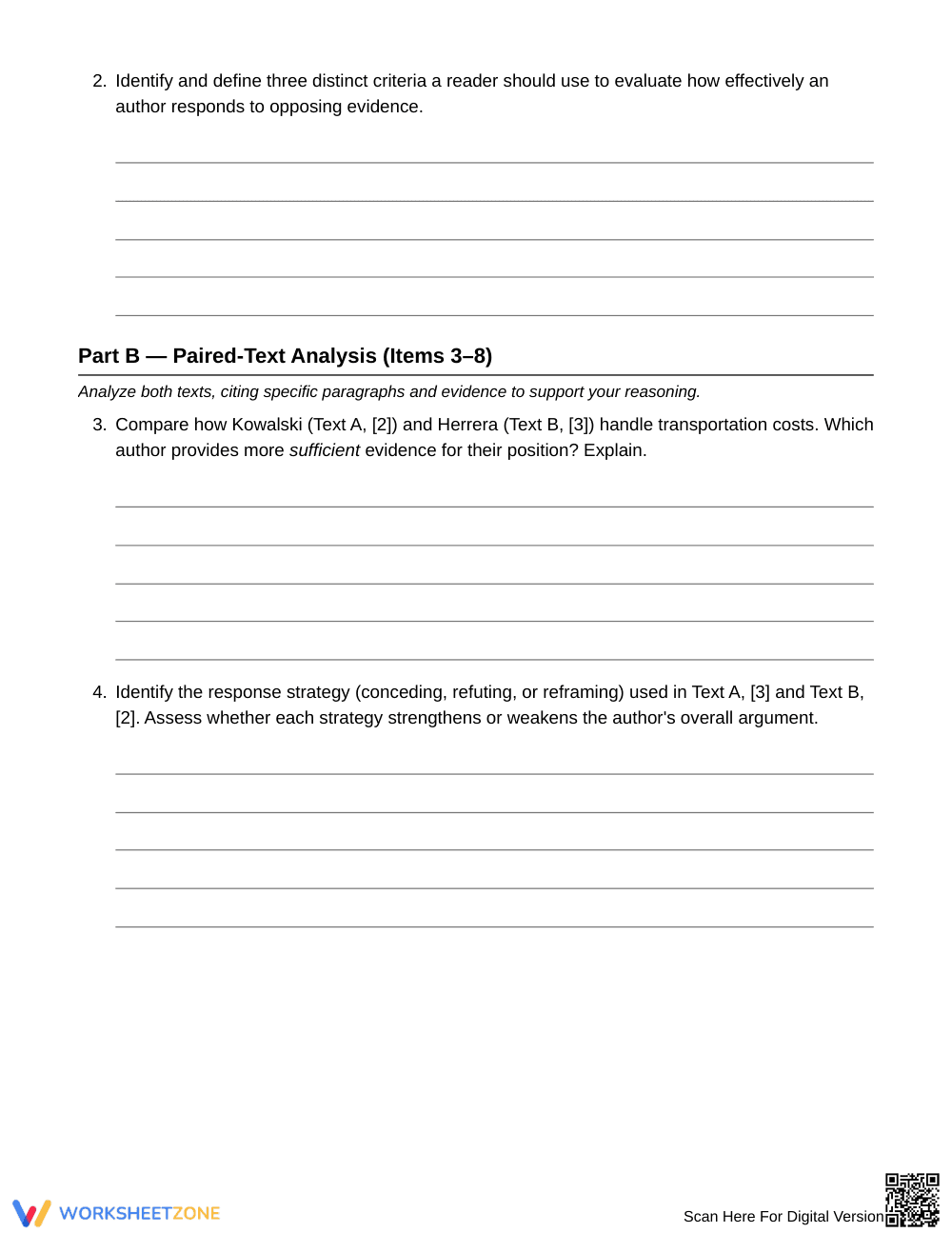
What's Inside: Across 5 printable pages, this resource features two opposing fictional articles addressing high school start times: "Later Bells, Better Learning" and "Keep the Early Bell." A foundational "Reminder" box defines concession, refutation, and reframing. Ten structured tasks require students to analyze claims, critique pilot data, and identify logical fallacies, supported by a 3-page teacher answer key.
Skill Progression
- Guided practice (Items 1–2): Students identify central claims and establish three criteria for evaluating counterevidence handling.
- Supported practice (Items 3–8): Students cite specific paragraphs to compare transportation evidence, classify response strategies, and evaluate causal reasoning.
- Independent practice (Items 9–10): Students synthesize findings to judge overall persuasiveness and compose a targeted argument revision.
This sequence implements gradual release, transitioning students smoothly from defining criteria to independent synthesis.
Standards Alignment
This worksheet directly targets primary Common Core standard RI.9-10.8: "Delineate and evaluate the argument and specific claims in a text, assessing whether the reasoning is valid and the evidence is relevant and sufficient; identify false statements and fallacious reasoning." Additionally, it supports RI.9-10.6 by having students evaluate how competing authors craft opposing viewpoints. Both standard codes can be copied directly into lesson plans, IEP goals, or district curriculum mapping tools.
How to Use It
Use this worksheet after direct instruction on counterclaims and rhetorical appeals. During guided analysis, have student partners complete Parts A and B to dissect each author's logic. For formative assessment, check Item 5 to ensure students understand reframing before moving on. Alternatively, assign Part C as an individual evaluative assessment. Completion takes 45 to 60 minutes.
Who It's For
This lesson is designed for tenth-grade English II students preparing for state reading assessments and argumentative writing. The included reminder box supports struggling readers, while the revision tasks challenge advanced learners. Pair this printable with a mini-lesson on logical fallacies for maximum effectiveness.
Evaluating paired non-fiction arguments requires secondary learners to examine not only what authors state, but how they respond when confronted with conflicting data. Grounded in Common Core standard RI.9-10.8, this resource develops students' ability to compare responses to counterevidence across competing informational texts. As highlighted in research by Fisher & Frey (2014) on close reading and purposeful argumentative discourse, secondary students demonstrate substantial gains in analytical reasoning when instructional tasks require them to delineate evidence sufficiency and evaluate whether rhetorical rebuttals are logically valid. By navigating authentic policy debates regarding high school schedules, tenth-grade learners move beyond passive comprehension to scrutinize concessions, refutations, and reframing strategies. This structured instructional approach provides measurable data on student mastery of informational text critique, ensuring learners acquire the necessary evaluative habits required for collegiate literacy, persuasive writing, and standardized reading assessments.


