
































Complete Corroborating Details Worksheet | Grade 8 ELA

Paste this activity's link or code into your existing LMS (Google Classroom, Canvas, Teams, Schoology, Moodle, etc.).
Students can open and work on the activity right away, with no student login required.
You'll still be able to track student progress and results from your teacher account.
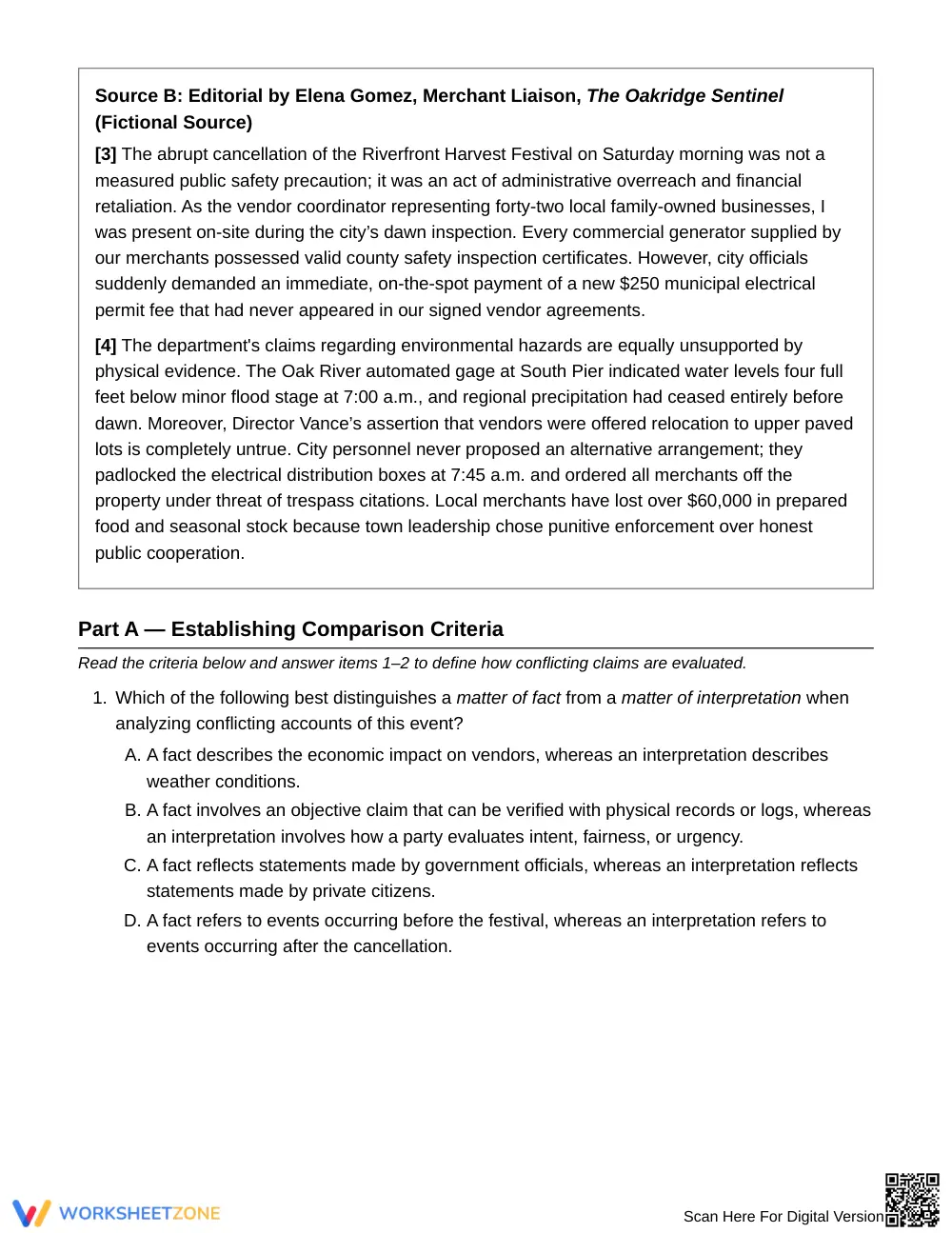
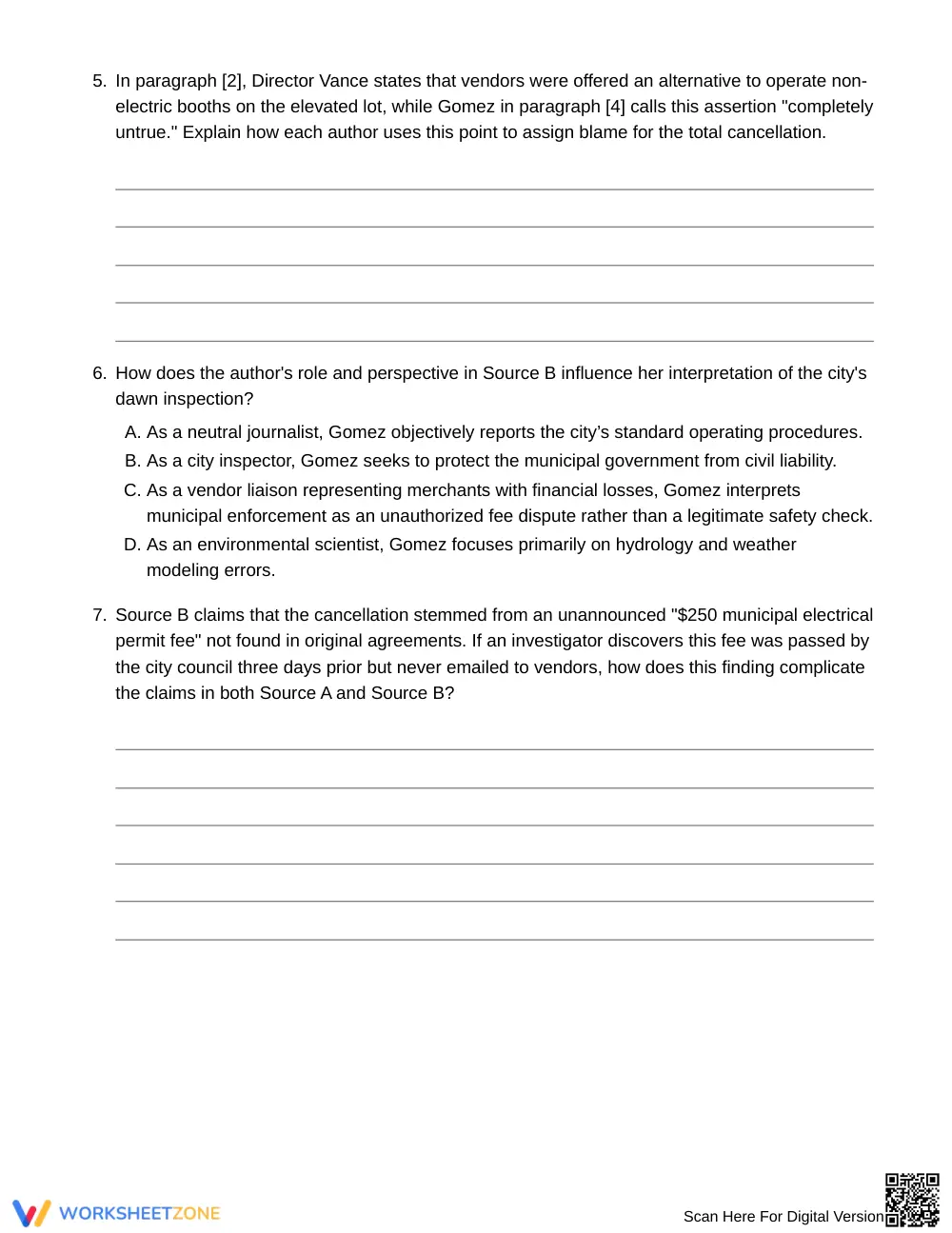
This reading comprehension worksheet teaches eighth-grade students how to analyze conflicting nonfiction texts and corroborate disputed details. Learners evaluate competing official and merchant perspectives surrounding a festival cancellation, distinguishing objective factual contradictions from author bias and framing to determine what external evidence resolves discrepancies.
At a Glance
- Grade: 8 · Subject: ELA
- Standard:
RI.8.9— Analyze how two texts present conflicting facts or interpretations on the same topic- Skill Focus: Corroborate a Disputed Detail
- Format: 5 pages · 10 problems · Answer key included · PDF
- Best For: Comparative paired-text close reading
- Time: 45–60 minutes
What's Inside
This 5-page resource includes a critical strategy anchor box defining fact versus interpretation, two high-interest paired informational passages, and 10 targeted text-dependent questions across multiple-choice, short-response, and evaluative synthesis formats. A detailed 3-page answer key provides complete model responses, evidence citations, and rationales for classroom review.
Skill Progression
- Guided practice (Tasks 1–2): Students establish foundational criteria by distinguishing objective facts from interpretive framing and identifying external corroborating evidence.
- Supported practice (Tasks 3–8): Learners perform paired-text analysis across 6 problems, isolating conflicting claims on permits, river levels, and procedural interactions.
- Independent practice (Tasks 9–10): Students synthesize both accounts through 2 high-level evaluative questions, writing an objective finding of fact.
This structured progression reflects the gradual release of responsibility model, guiding learners from conceptual identification toward rigorous independent source evaluation.
Standards Alignment
This resource aligns directly with RI.8.9: "Analyze a case in which two or more texts provide conflicting information on the same topic and identify where the texts disagree on matters of fact or interpretation." Both standard codes can be copied directly into lesson plans, IEP goals, or district curriculum mapping tools.
How to Use It
Deploy this worksheet after direct instruction on source credibility or during a comparative text analysis unit. For formative assessment, examine student responses to Task 4 to observe whether students recognize hydrologic data as a factual contradiction or an interpretive risk assessment. The complete 10-problem sequence is designed for a focused 45- to 60-minute instructional block.
Who It's For
This resource is built for general education eighth-grade ELA classrooms, secondary reading intervention, and high school transition support. Scaffolded strategy notes assist striving readers, while nuanced rhetorical questions challenge advanced learners. Pair this printable with an anchor chart on author perspective or rhetorical bias.
According to research from Fisher & Frey (2014) on close reading and text-dependent questioning, middle school literacy gains accelerate when students routinely evaluate multiple sources with conflicting evidentiary claims. This worksheet operationalizes Common Core standard RI.8.9 by guiding Grade 8 readers through the cognitive work of distinguishing verifiable factual disputes from subjective authorial interpretations. Across 10 structured analytical tasks, students dissect competing municipal and merchant accounts of a public event, evaluating discrepancies in hydrologic measurements, safety certifications, and administrative procedures. By requiring learners to identify the exact forms of external evidence needed to corroborate disputed assertions, the resource builds critical informational literacy and analytical reasoning skills. Teachers obtain measurable evidence of student proficiency in cross-text synthesis, enabling targeted intervention and standards-aligned progress monitoring during paired-text non-fiction units.


