




























Complete Corroborating Accounts Worksheet | Grade 7 ELA
Paste this activity's link or code into your existing LMS (Google Classroom, Canvas, Teams, Schoology, Moodle, etc.).
Students can open and work on the activity right away, with no student login required.
You'll still be able to track student progress and results from your teacher account.
Teach middle school readers to evaluate multiple informational sources with this rigorous corroboration activity. Students examine two contrasting perspectives on a municipal bike lane pilot, identifying shared facts, isolating selective evidence, and analyzing how author viewpoints shape conflicting arguments. This resource builds critical cross-text analysis skills essential for Grade 7 reading comprehension.
At a Glance
- Grade: 7 · Subject: ELA
- Standard:
RI.7.9— Compare how two authors shape presentations by emphasizing different evidence- Skill Focus: Corroborate Across Two Accounts
- Format: 5 pages · 12 problems · Answer key included · PDF
- Best For: Paired-text analysis and reading comprehension practice
- Time: 40–55 minutes
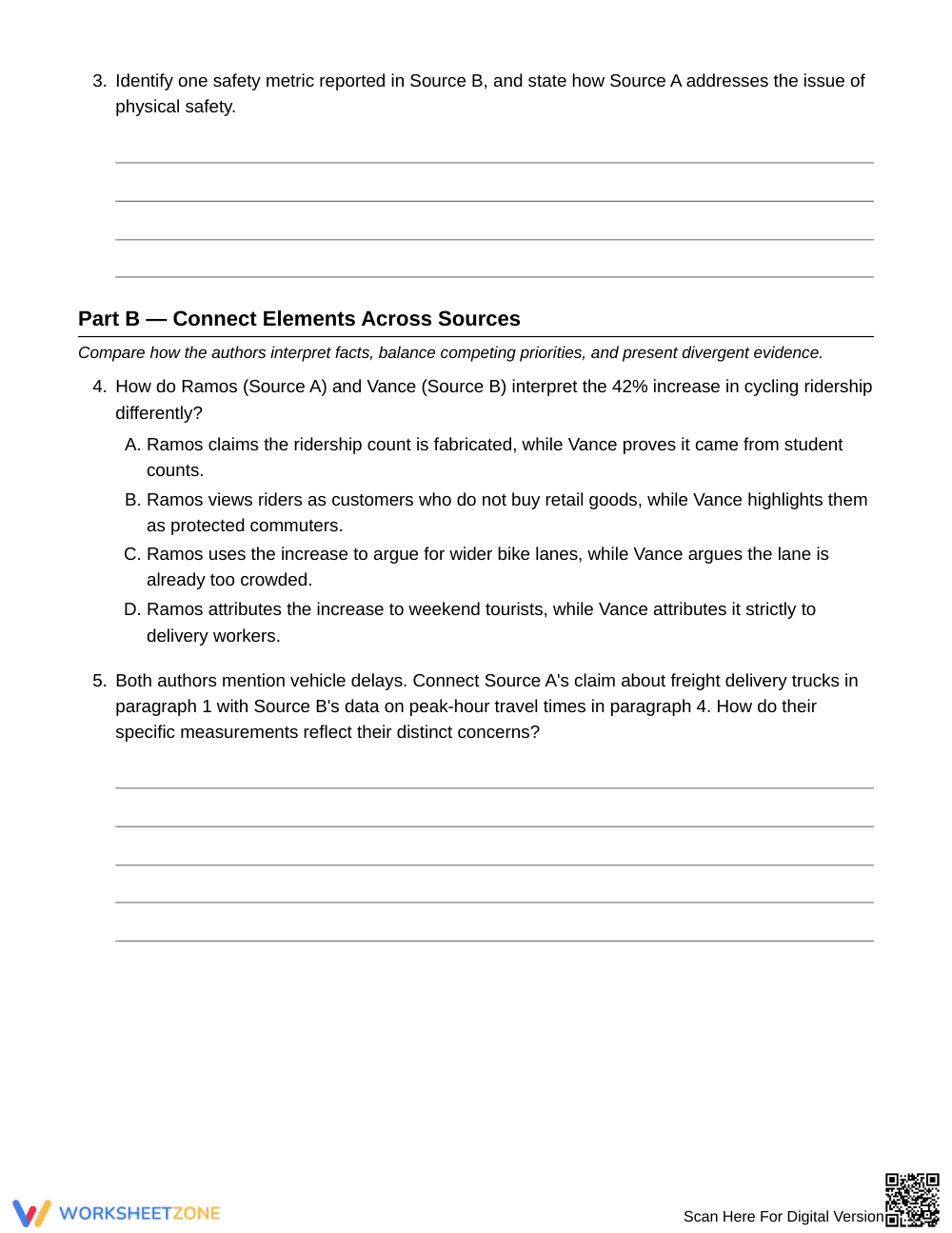
This 5-page printable packet includes two paired passages, an introductory Corroboration Checklist, 12 targeted text-dependent tasks, and a full 3-page answer key. Students read an op-ed from a business alliance alongside a transportation department report, comparing data points, examining omitted evidence, and evaluating contrasting viewpoints.
Skill Progression
- Guided Practice (Part A): 3 questions direct students to identify shared metrics and track specific claims across both texts.
- Supported Practice (Part B): 6 questions challenge learners to connect competing perspectives, evaluate author roles, and analyze why sources omit key data.
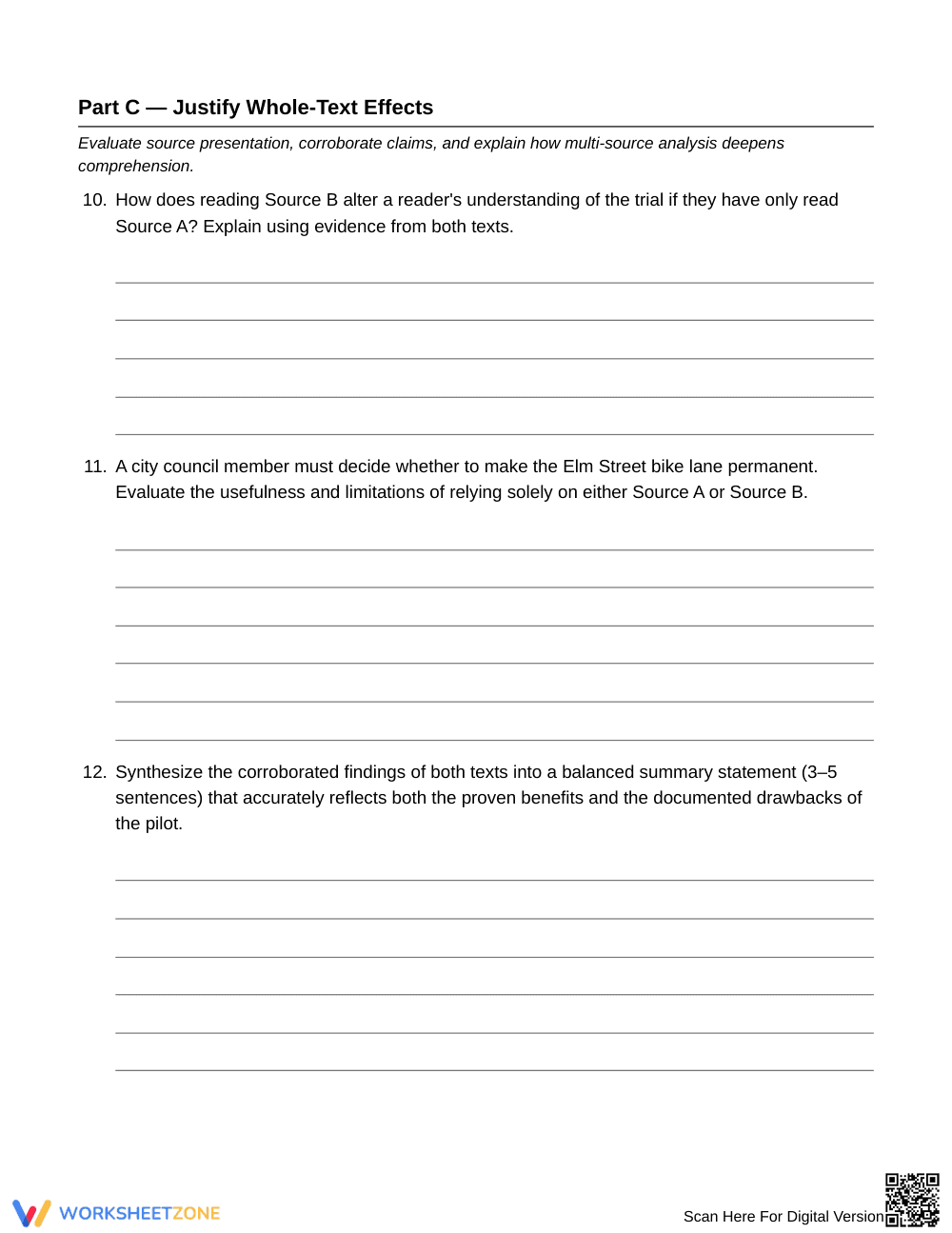
- Independent Practice (Part C): 3 synthesis prompts require students to evaluate source limitations and compose a balanced summary.
This progression applies the gradual release model to guide students from factual identification to complex multi-text synthesis.
Standards Alignment
This worksheet aligns to RI.7.9: "Compare and contrast a text to another text in a different medium or analyze how two or more authors writing about the same topic shape their presentations of key information by emphasizing different evidence or advancing different interpretations of facts." It also reinforces RI.7.6 regarding author perspective. Both standard codes can be copied directly into lesson plans, IEP goals, or district curriculum mapping tools.
How to Use It
Assign this resource after direct instruction on paired texts or during an argumentative reading unit. Circulate during Part B to monitor whether students distinguish between empirical disagreement and differing author priorities. The packet requires 40 to 55 minutes to complete and works well for partner analysis, small-group instruction, or independent assessment.
Who It's For
This activity supports Grade 7 ELA classes, advanced Grade 6 readers, and Grade 8 intervention groups. The Corroboration Checklist scaffolds multi-text reading for English language learners. Pair this worksheet with an anchor chart on source credibility or an instructional lesson on informational text structures.
Mastering multi-source corroboration under standard RI.7.9 empowers Grade 7 students to evaluate how distinct authors present similar events by highlighting specific data and framing interpretations. Research from Fisher & Frey (2014) demonstrates that structured cross-text analysis significantly improves reading comprehension, moving adolescents beyond basic recall into evaluative synthesis. By examining conflicting civic accounts regarding commercial parking and traffic safety, students learn to detect omitted details, identify institutional perspectives, and synthesize corroborated evidence. This 12-task learning progression scaffolds the transition from factual matching to high-level multi-source synthesis, fostering analytical habits essential for secondary research. Consequently, students develop the critical reading stamina and evaluative reasoning required for standardized assessments and informed civic participation.


