




























Views
Downloads



Complete Computing Concepts Word Search | Grades 7–8 ELA

Paste this activity's link or code into your existing LMS (Google Classroom, Canvas, Teams, Schoology, Moodle, etc.).
Students can open and work on the activity right away, with no student login required.
You'll still be able to track student progress and results from your teacher account.
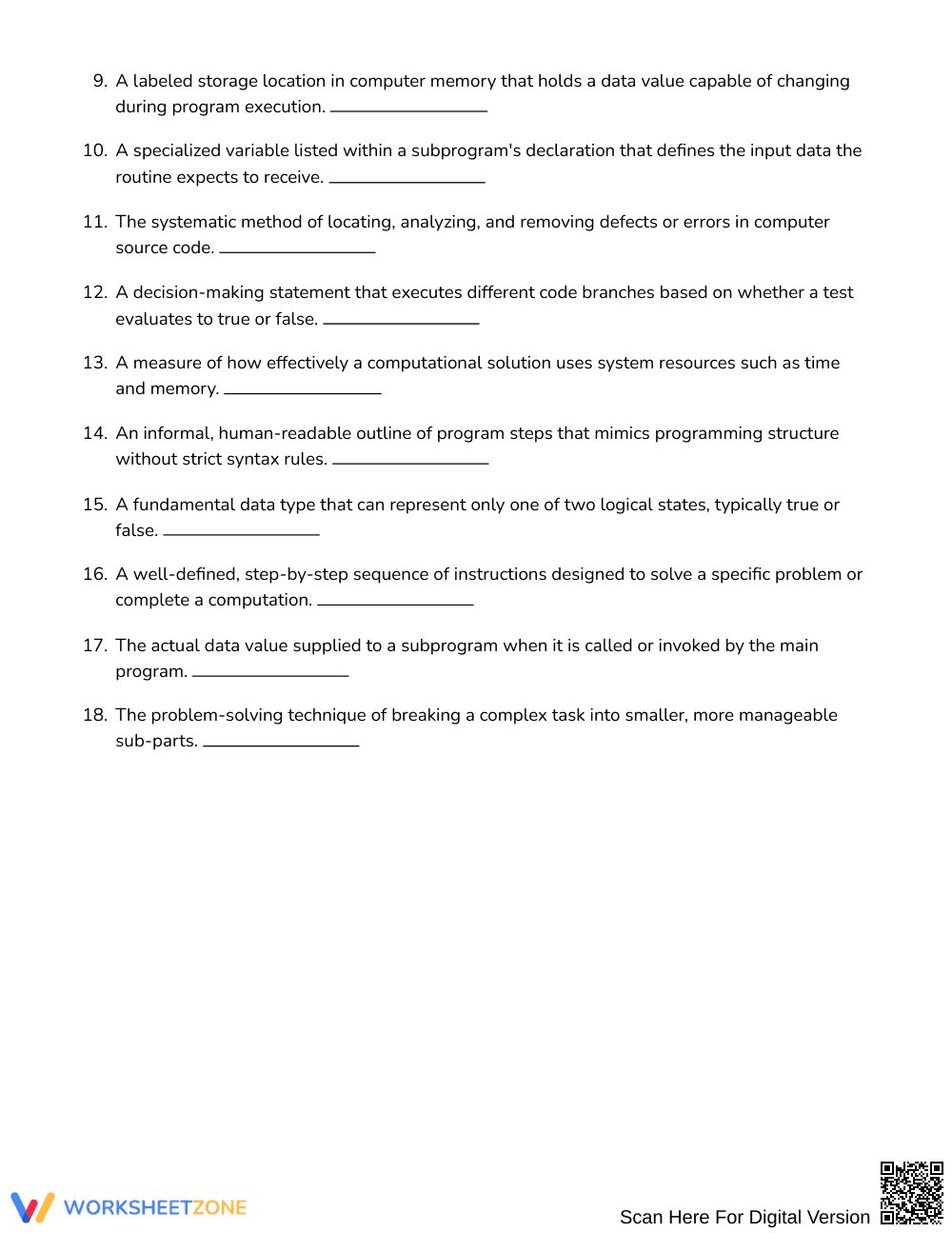
This Grades 7–8 computing concepts and problem-solving review word search reinforces foundational computer science vocabulary through targeted definition matching. Students analyze 18 technical clues to identify key terms like algorithm, abstraction, and debugging before locating them in the letter grid, building interdisciplinary literacy that bridges English Language Arts and digital technology.
At a Glance
- Grade: Grades 7–8 · Subject: English Language Arts (ELA)
- Standard: Not standards-assessed — vocabulary enrichment
- Skill Focus: Computing concepts and problem-solving review
- Format: 3 pages · 18 words · Answer key included · PDF
- Best For: Cross-curricular STEM vocabulary review
- Time: 25–35 minutes
What's Inside
This 3-page printable resource includes an 18-word search puzzle paired with comprehensive definition clues and a full 4-page answer key. Rather than relying on rote memorization, students read contextual definitions for core computational thinking concepts and programming terminology, consult a shuffled word bank, and locate every term within the puzzle grid.
Puzzle Structure and Mechanics
The activity features a dense 20 x 20 letter grid containing 18 hidden vocabulary terms. Words run in all 8 compass directions: north, northeast, east, southeast, south, southwest, west, and northwest. A shuffled word bank provides reference support, while rigorous definitions prompt students to connect abstract computational principles directly with correct terminology.
Standards Alignment
This activity provides specialized cross-curricular vocabulary enrichment rather than formal standard-specific assessment. Designed to strengthen informational text comprehension and technical language acquisition in middle school ELA and introductory technology courses, it deepens academic word knowledge without requiring standardized code tracking.
How to Use It
Introduce this word search after direct instruction on computational thinking to consolidate student understanding, or assign it as an independent station task during an interdisciplinary STEM unit. During class, monitor whether students solve the clues before searching or rely solely on letter hunting. Expect most learners to complete the puzzle within 25 to 35 minutes.
Who It's For
This activity suits Grades 7–8 learners in English Language Arts, introductory coding, or media literacy classes. Educators can scaffold the activity by having striving readers underline keywords in each clue, while advanced students can define terms independently before referencing the shuffled bank. Pair this activity with a computational thinking anchor chart.
Vocabulary acquisition in technical domains requires structured encounters with precise academic language, as domain-specific terms represent foundational conceptual schemas rather than isolated definitions. According to Fisher & Frey (2014), intentional exposure to disciplinary vocabulary through paired clues and retrieval tasks significantly improves reading comprehension of complex informational texts. This computing concepts and problem-solving review word search engages middle school students in active lexical processing across an 18-word set spanning algorithms, abstraction, data structures, and program execution. By requiring students to interpret analytical clues before identifying terms arranged across an 8-directional 20 x 20 letter grid, the activity transforms passive word recognition into purposeful retrieval practice. Secondary learners develop cognitive fluency with non-routine terminology, enabling smoother transitions between technical reading materials and applied problem-solving tasks across modern academic curricula. Consequently, educators establish meaningful scaffolding that supports sustained long-term retention.


