




























Complete Comparing Evidence Worksheet | Grade 7 ELA
Paste this activity's link or code into your existing LMS (Google Classroom, Canvas, Teams, Schoology, Moodle, etc.).
Students can open and work on the activity right away, with no student login required.
You'll still be able to track student progress and results from your teacher account.
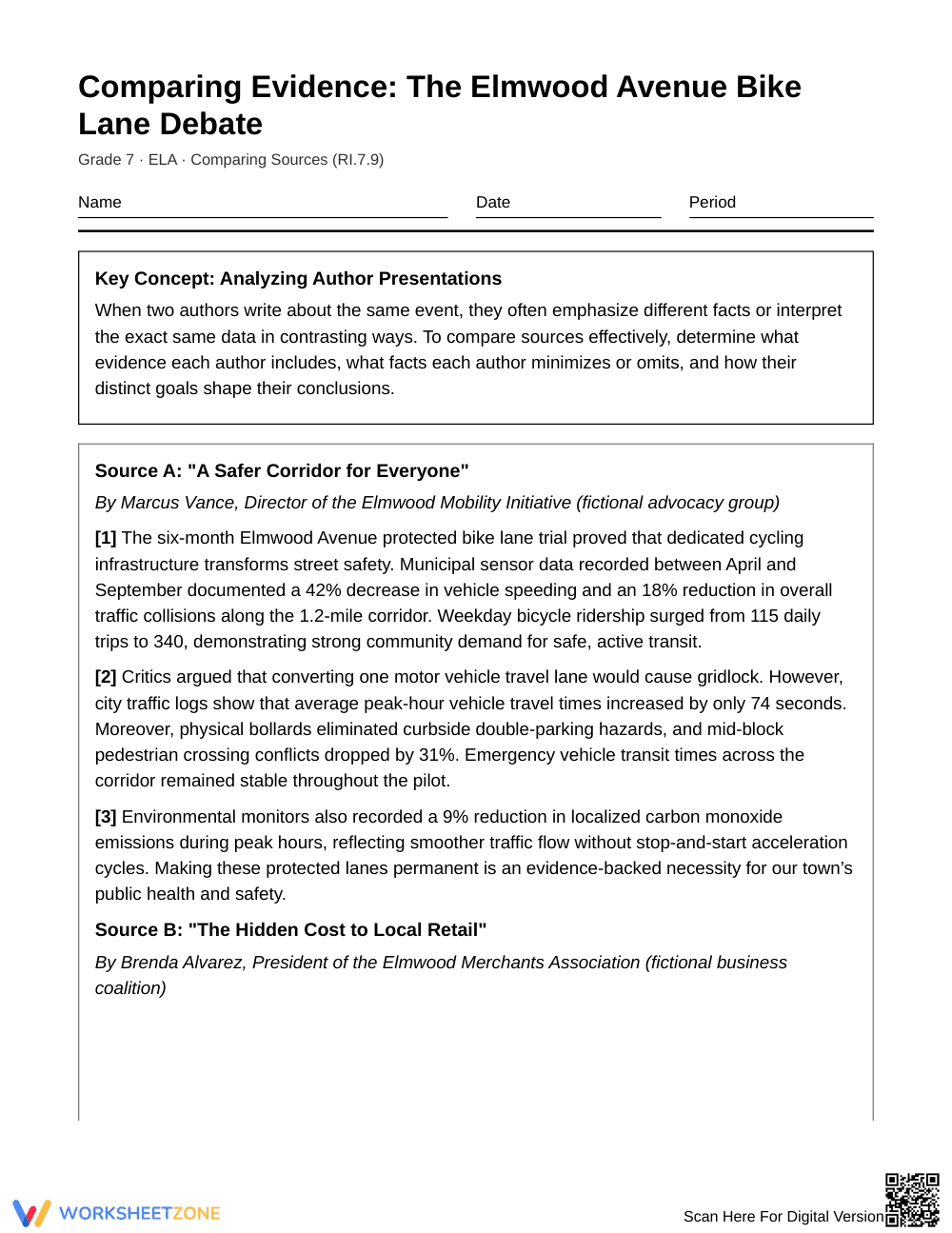
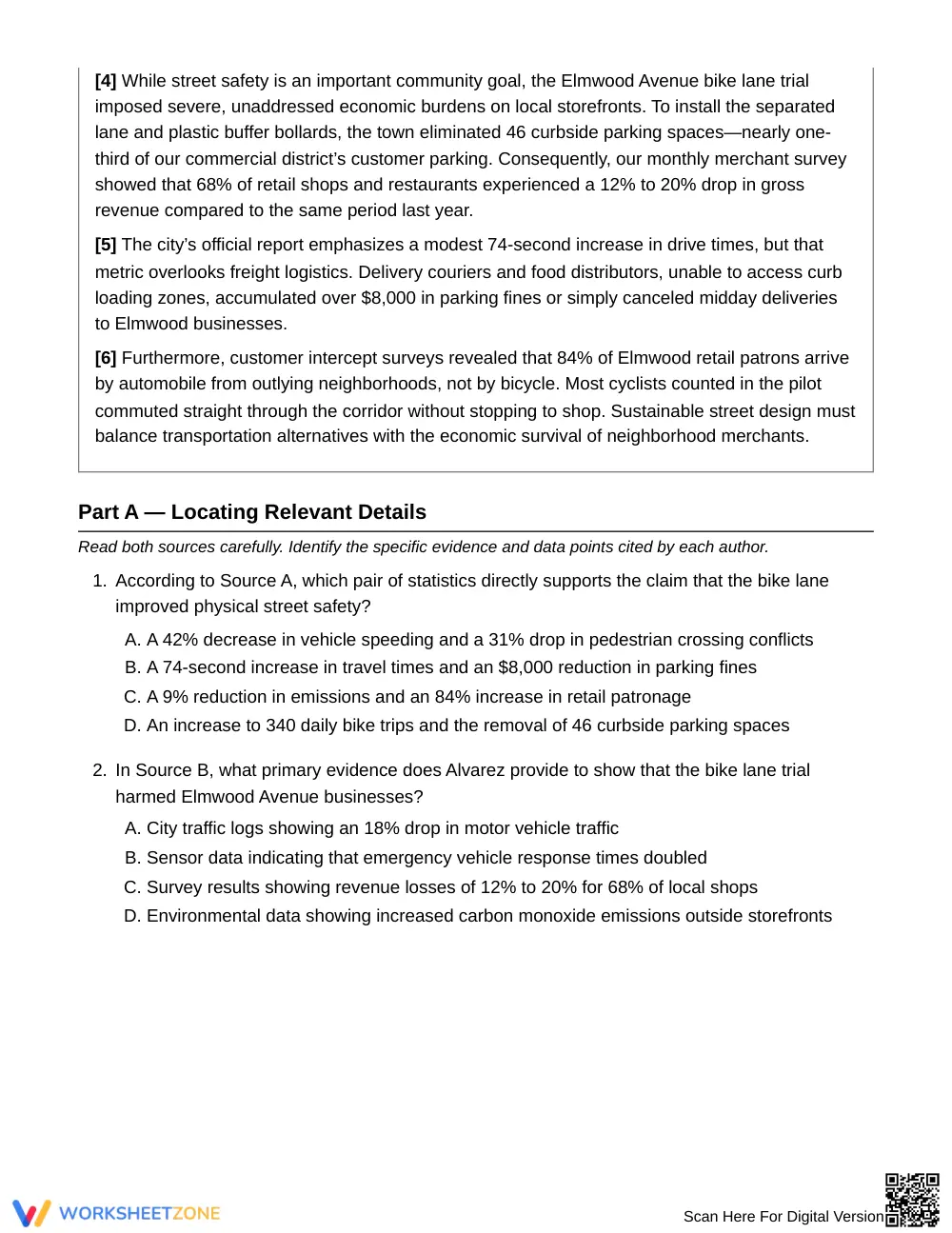
This Grade 7 informational text worksheet equips students to compare how two authors present conflicting evidence on the same topic. Working through a simulated civic debate regarding urban bike lanes, learners evaluate municipal data, analyze contrasting interpretations of identical facts, and synthesize competing viewpoints to form evidence-backed conclusions.
At a Glance
- Grade: 7 · Subject: English Language Arts
- Standard:
RI.7.9— Compare how two authors present conflicting evidence on the same core topic.- Skill Focus: Compare Relevant Evidence across paired nonfiction sources
- Format: 5 pages · 12 rigorous problems · Answer key included · Printable PDF
- Best For: Informational paired text analysis and argument evaluation
- Time: 40–50 minutes of instructional time
What's Inside
This 5-page resource features two opposing fictional perspectives regarding a municipal bike lane project, followed by 12 analytical tasks. The worksheet integrates multiple-choice identification items, comparative analytical prompts, and extended synthesis tasks. A comprehensive 3-page answer key provides complete exemplar responses, textual citations, and sample policy compromise arguments to support efficient grading.
Skill Progression
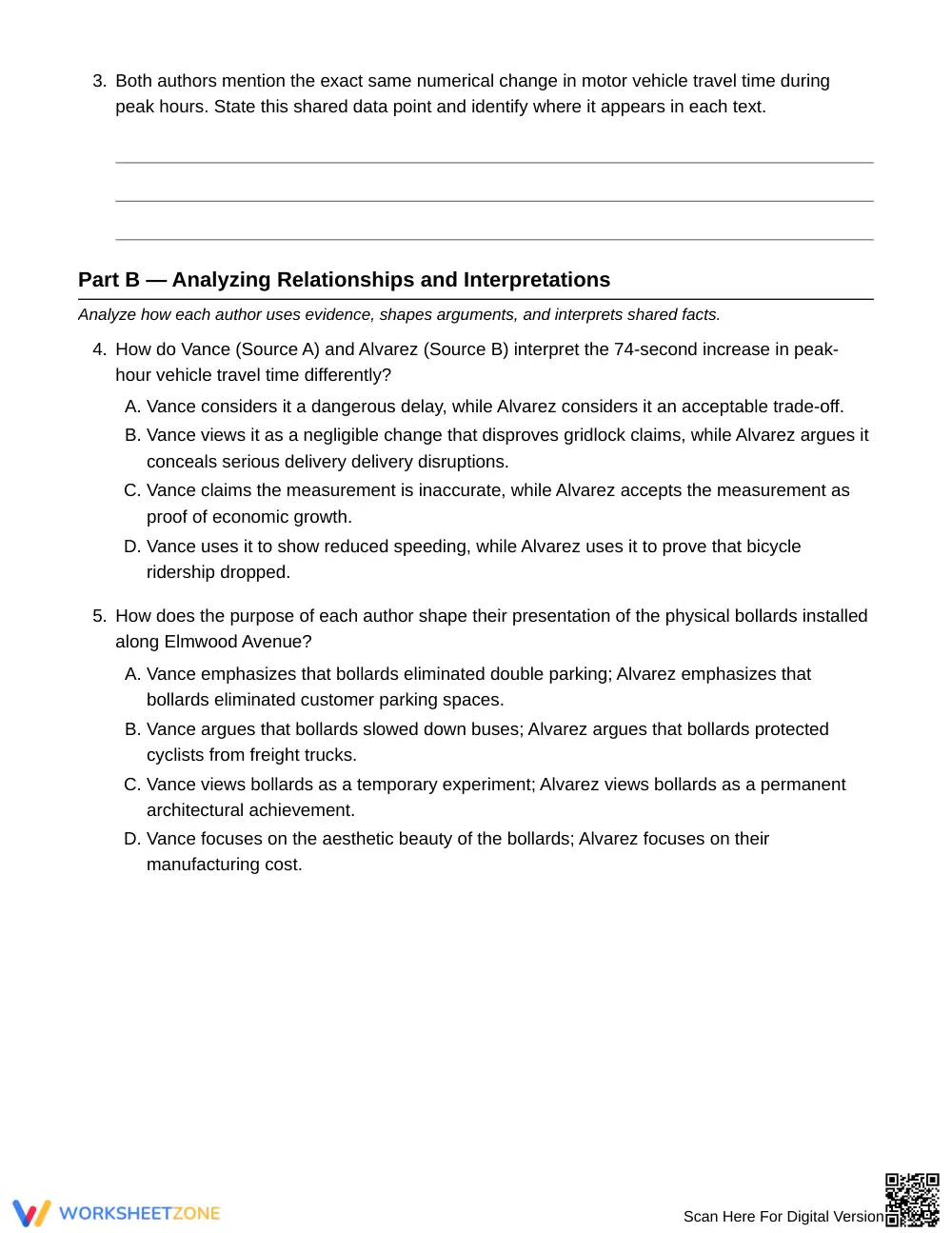
- Guided practice: Part A includes 3 targeted questions focused on locating explicit data points and identifying shared metrics across both texts.
- Supported practice: Part B provides 6 analytical prompts that examine how authorial purpose shapes evidence selection, rhetoric, and data framing.
- Independent practice: Part C challenges students with 3 synthesis prompts requiring objective source evaluation and evidence-based policy formulation.
This scaffolded progression reflects a gradual release model, guiding learners from basic fact retrieval to nuanced critical analysis.
Standards Alignment
This worksheet directly targets RI.7.9: "Compare and contrast one author's presentation of events with that of another (e.g., a memoir written by and a biography on the same person)." It also supports RI.7.8 by requiring students to track and evaluate specific evidentiary claims across conflicting informational passages. Both standard codes can be copied directly into lesson plans, IEP goals, or district curriculum mapping tools.
How to Use It
Administer this activity during mid-unit comparative reading instruction after introducing point-of-view concepts. It works effectively as an active paired-text partner workshop or as a summative assessment following a persuasive writing unit. During independent work time, circulate to verify that students accurately distinguish between sensor-derived quantitative facts and survey-based stakeholder opinions. The expected completion window is 40 to 50 minutes.
Who It's For
Designed for Grade 7 general education classrooms, this resource supports on-grade readers while providing clear scaffolds for developing analysts and English learners through chunked text paragraphs. Pair this activity with an anchor chart outlining author bias or use it alongside a direct instruction lesson on rhetorical framing.
According to findings from Fisher & Frey (2014) on close reading and text-dependent questioning, adolescent learners develop critical reading proficiency most effectively when prompted to interrogate conflicting perspectives across complex, paired informational texts. Standard RI.7.9 tasks seventh-grade readers with comparing and contrasting how two different authors present similar events or use divergent data to justify opposing claims. Rather than simply evaluating isolated facts, students must analyze rhetorical framing, determine what information each author highlights or minimizes, and evaluate the credibility of varied evidence types ranging from municipal sensors to commercial stakeholder surveys. By moving through structured text-dependent prompts that require text citation and synthesis, students strengthen their analytical reasoning and argumentative writing readiness. This targeted instructional sequence provides the rigorous textual engagement necessary for secondary students to master cross-textual evaluation across academic content areas.


