



























Complete Compare Text Structures Worksheet | Grade 6 ELA
Paste this activity's link or code into your existing LMS (Google Classroom, Canvas, Teams, Schoology, Moodle, etc.).
Students can open and work on the activity right away, with no student login required.
You'll still be able to track student progress and results from your teacher account.
Help sixth-grade readers analyze how organizational choices shape meaning. Students examine two paired informational passages containing identical facts about library services—one structured as a comparison and the other as problem/solution—to evaluate how structure influences reader takeaways.
At a Glance
- Grade: 6 · Subject: ELA
- Standard:
RI.6.5— Analyze how a particular sentence, paragraph, or section fits into the overall text structure- Skill Focus: Compare Two Ways to Organize the Same Facts
- Format: 5 pages · 10 problems · Answer key included · PDF
- Best For: Informational text structure analysis practice
- Time: 30–45 minutes
What's Inside
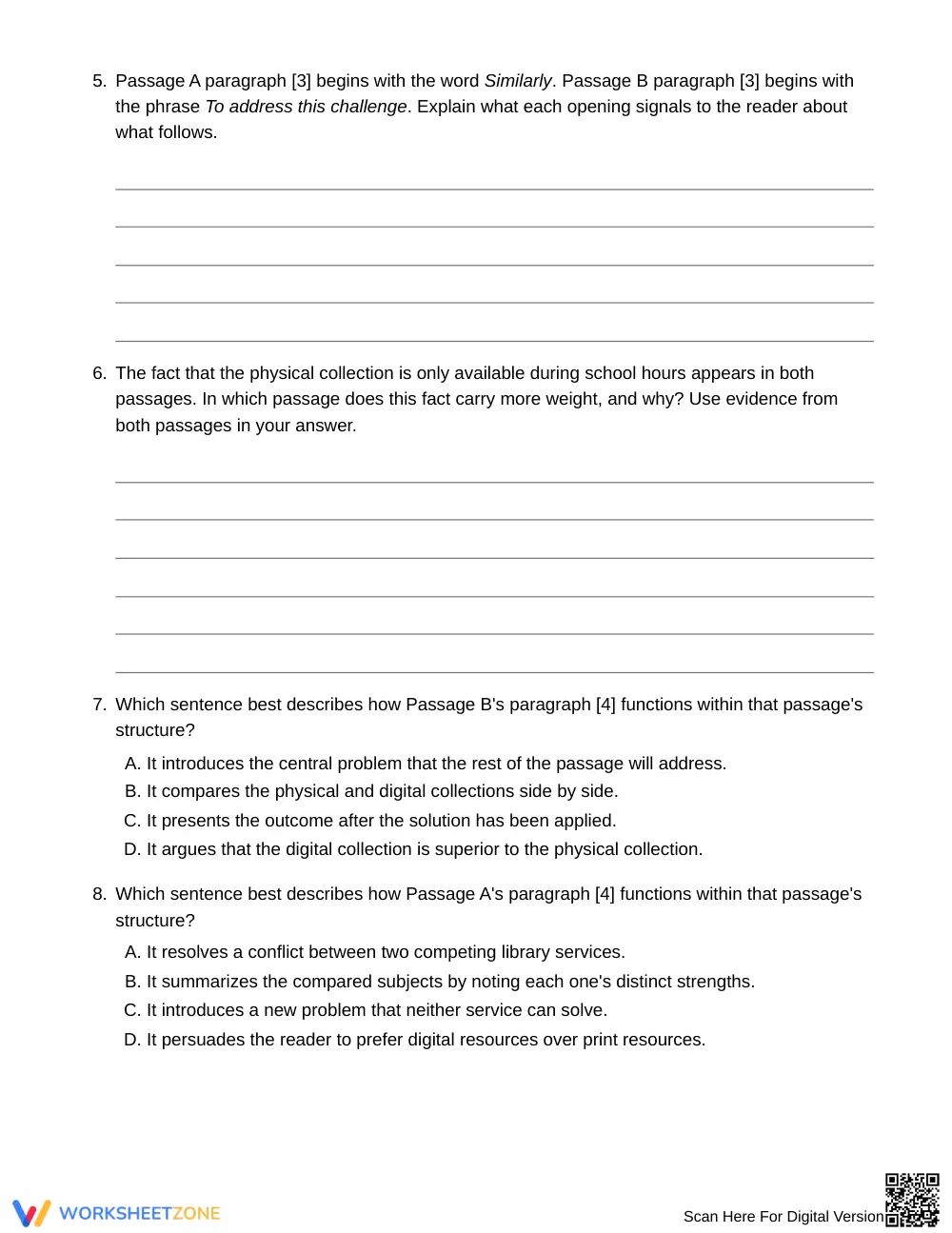
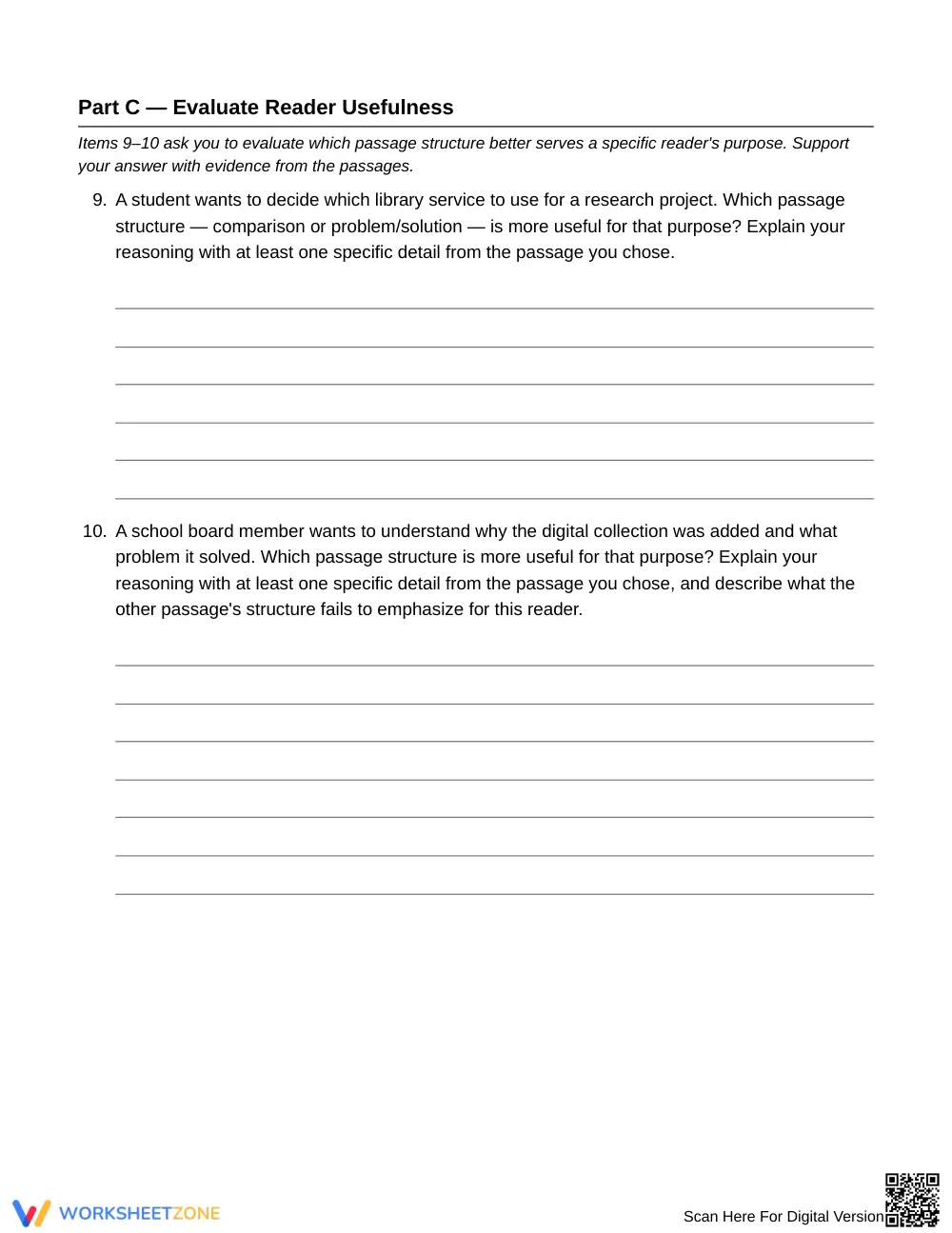
This five-page printable includes a signal word reminder box, two paired 200-word passages sharing factual data, and 10 analytical questions spanning structural identification, detail mapping, and purpose evaluation. A four-page answer key provides complete model responses for every item.
Skill Progression
- Guided practice (Items 1–2): Students identify the overarching text structures of Passage A and Passage B, citing textual signal words as explicit evidence.
- Supported practice (Items 3–8): Students map shared details across both texts using short-answer responses, a comparison table, and targeted multiple-choice questions examining paragraph function.
- Independent practice (Items 9–10): Students evaluate which organizational framework best serves different audience goals, justifying their conclusions with textual evidence.
This sequence implements a gradual-release framework that shifts students from baseline structural recognition to sophisticated comparative analysis.
Standards Alignment
This resource aligns directly to `RI.6.5`: Analyze how a particular sentence, paragraph, or section fits into the overall structure of a text and contributes to idea development. It also supports `RI.6.1` by requiring explicit textual evidence. Both standard codes can be copied directly into lesson plans, IEP goals, or district curriculum mapping tools.
How to Use It
Deploy this worksheet during guided practice following direct instruction on informational text structures, or assign it after instruction as an analytical assessment. Formatively check Part B, Item 4 to verify whether students distinguish how identical details serve contrasting rhetorical purposes. Expected completion time is 30 to 45 minutes.
Who It's For
This activity is designed for Grade 6 ELA classrooms, reading intervention, and English language learners needing structured text models. The built-in signal word box scaffolds striving readers, while Part C extends analytical thinking. Pair this resource with an informational text anchor chart or mini-lesson.
According to Fisher & Frey (2014), explicit instruction in text structure substantially enhances adolescent reading comprehension by providing clear cognitive frameworks to organize and interpret complex informational content. This Grade 6 worksheet directly supports standard RI.6.5, guiding learners to analyze how identical factual data functions within two contrasting organizational frameworks: comparison structure and problem-and-solution structure. By evaluating paired passages side by side, students investigate how transitional signal words, sentence placements, and structural emphasis alter reader takeaways and authorial focus. The 10 scaffolded tasks require students to identify organizational patterns, map corresponding details across texts, evaluate paragraph functions, and assess structural utility for specific reader purposes. Grounded in evidence-based literacy research, this exercise equips educators with rigorous, standards-aligned practice that strengthens analytical reading skills and deepens informational text mastery across middle school ELA curricula.


