































Complete Compare Tables & Equations | Grade 6

Paste this activity's link or code into your existing LMS (Google Classroom, Canvas, Teams, Schoology, Moodle, etc.).
Students can open and work on the activity right away, with no student login required.
You'll still be able to track student progress and results from your teacher account.
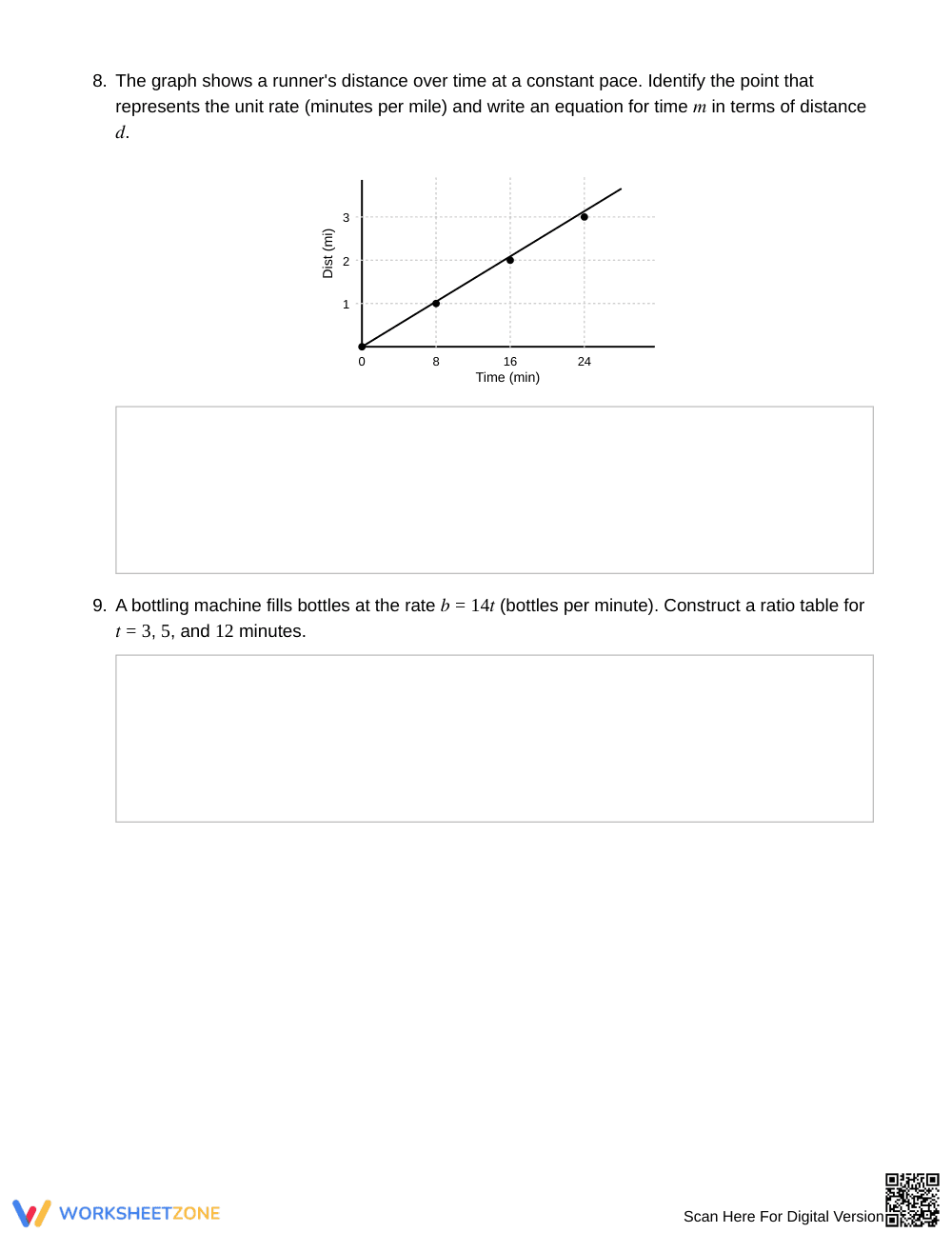
This Grade 6 math worksheet strengthens students' ability to compare and translate among ratio tables, tape diagrams, double number lines, graphs, and equations. Across 12 carefully sequenced problems, learners identify unit rates, convert between forms, and evaluate whether two representations agree—building the flexible reasoning that standard 6.RP.A.3 demands.
At a Glance
- Grade: 6 · Subject: Math
- Standard:
6.RP.A.3— Use ratio and rate reasoning to solve real-world and mathematical problems- Skill Focus: Compare tables, diagrams, and equations
- Format: 5 pages · 12 problems · Answer key included · PDF
- Best For: Guided or independent ratio practice
- Time: 30–45 minutes
What's Inside
The worksheet opens with a concise reference box summarizing four equivalent-ratio representations—ratio tables, tape diagrams, double number lines, equations of the form y = rx, and coordinate graphs. The 12 problems span three parts across 5 pages, and a full answer key is included for efficient grading or self-checking.
Skill Progression
- Guided practice (Part A, 3 problems): Students read a single representation and extract the unit rate or find a missing value. Scaffolding is highest here, isolating one representation per problem.
- Supported practice (Part B, 6 problems): Students translate between representations and compare rates across contexts such as driving speeds, paint mixing ratios, and juice recipes. Problems require constructing ratio tables from diagrams and writing equations from tables.
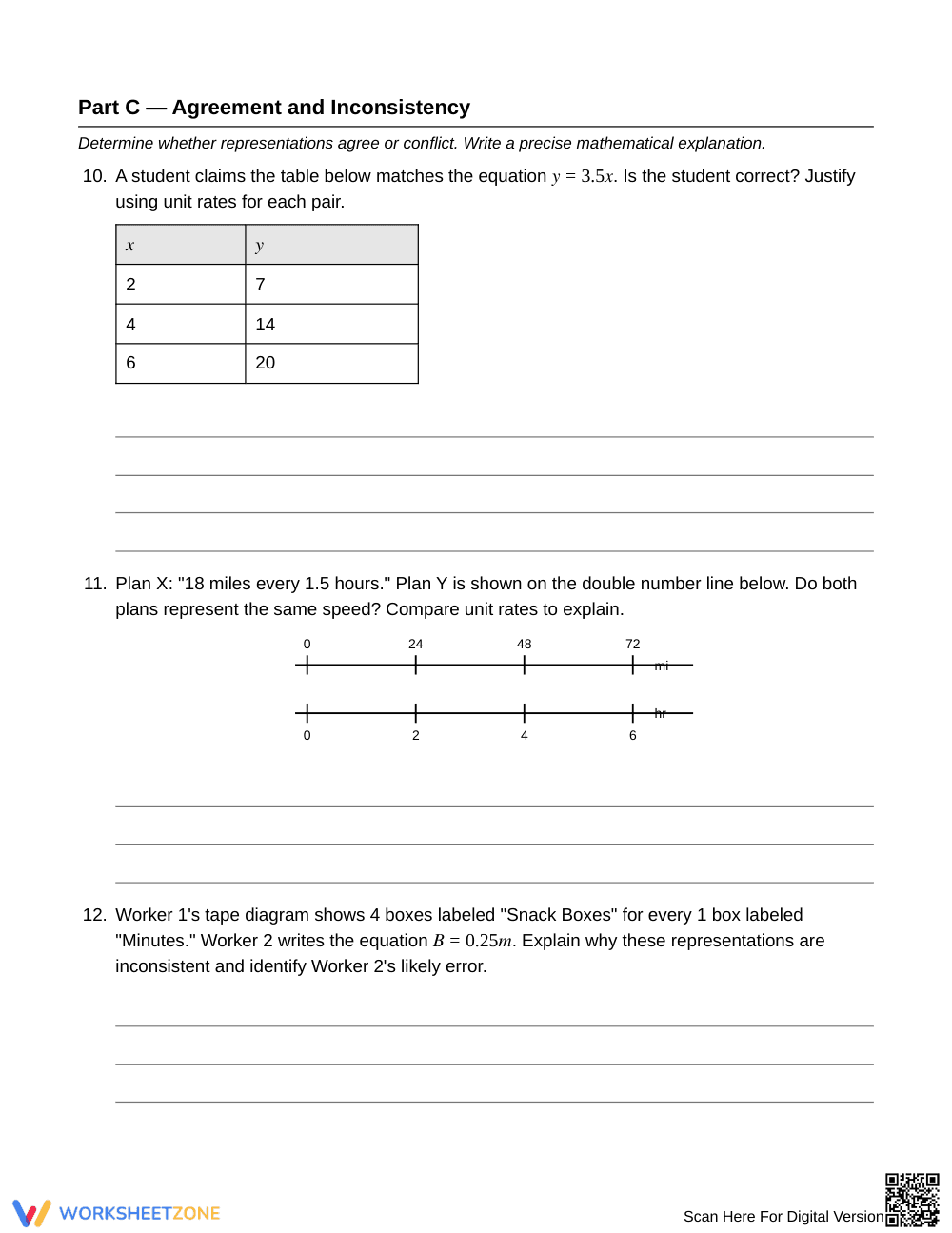
- Independent practice (Part C, 3 problems): Students determine whether two representations agree or conflict and write precise mathematical justifications, targeting higher-order reasoning.
This gradual-release structure ensures students move from recognition to translation to critical evaluation within a single sitting.
Standards Alignment
Every problem maps to 6.RP.A.3: Use ratio and rate reasoning to solve real-world and mathematical problems. Part B problems that involve writing equations of the form d = rt also reinforce 6.RP.A.3b. Both codes can be copied directly into lesson plans or curriculum mapping tools.
How to Use It
Assign Part A as a warm-up after direct instruction, then use Parts B and C for collaborative or independent practice. Alternatively, assign the full worksheet as a formative check at the end of a ratio unit. Most students complete all 12 problems in 30 to 45 minutes.
Who It's For
Designed for Grade 6 students working at or near grade level on ratio reasoning. For students needing support, pair the worksheet with an anchor chart showing all four representations. For advanced learners, ask them to create a coordinate graph for any Part B problem.
The 12 problems on this 6.RP.A.3 worksheet ask Grade 6 students to read, translate, and critically compare ratio tables, tape diagrams, double number lines, graphs, and equations. Research from Fisher & Frey (2014) confirms that a gradual-release framework—moving from guided to supported to independent practice—produces stronger transfer of mathematical reasoning than massed problem sets at a single difficulty level. By requiring students to justify agreement or inconsistency between representations in Part C, the worksheet targets analytical reasoning that the 2024 NAEP framework identifies as a persistent gap in middle-grades proportional thinking. Teachers can use the included answer key for immediate feedback, a practice shown to accelerate concept consolidation in ratio and rate contexts.


