































Complete Codon Sequencing Worksheet | Grades 8–12 Science

Paste this activity's link or code into your existing LMS (Google Classroom, Canvas, Teams, Schoology, Moodle, etc.).
Students can open and work on the activity right away, with no student login required.
You'll still be able to track student progress and results from your teacher account.
Mastering protein synthesis requires students to track how biological information changes form and location across each stage of gene expression. This comprehensive four-page science worksheet equips high school learners to sequence cellular events, transcribe DNA to mRNA, interpret genetic code charts, and evaluate the functional consequences of point mutations across 34 structured practice items.
At a Glance
- Grade: Grades 8–12 · Subject: Science
- Standard: Life Science — Order gene expression stages and explain molecular changes across steps
- Skill Focus: Codon translation and sequencing protein synthesis
- Format: 4 pages · 34 problems · Answer key included · PDF
- Best For: Targeted practice and review
- Time: 45–60 minutes
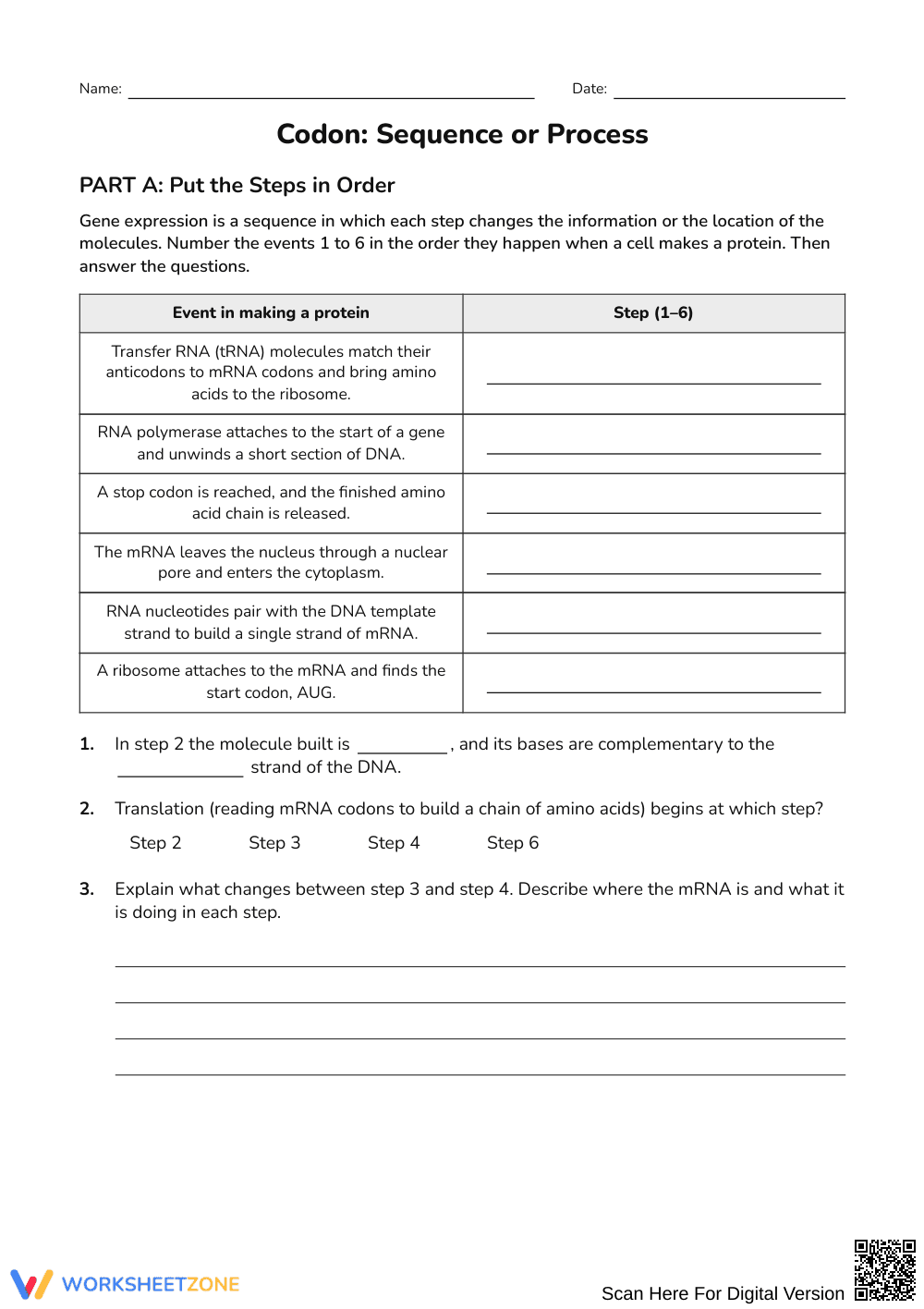
This 4-page worksheet guides learners through 34 focused items across three distinct learning segments. Part A features a chronological sequencing chart and short-answer questions exploring transcription and translation transitions. Part B provides a complete 64-codon genetic reference chart and DNA template strand for practicing base-pairing and tRNA anticodon matching. Part C presents comparative mutation strips examining silent, missense, and nonsense mutations alongside an exhaustive 4-page answer key.
Skill Progression
- Guided practice (Part A, 9 items): Students sequence fundamental events from RNA polymerase binding to polypeptide release, analyzing cellular location and molecule functions.
- Supported practice (Part B, 11 items): Learners apply complementary base-pairing rules and utilize the included codon table to convert DNA triplets into mRNA codons and amino acid chains.
- Independent practice (Part C, 14 items): Students independently analyze mutated mRNA sequences, identifying point mutation classes and explaining phenotypic effects on inherited traits.
This structured sequence reflects the gradual-release framework (I Do, We Do, You Do), establishing foundational conceptual understanding before requiring independent analytical synthesis.
Standards Alignment
This resource aligns directly with secondary Life Science standards governing molecular genetics, cellular processes, and the Central Dogma. Students model how nucleotide sequences specify amino acid sequences in proteins and explore how environmental or replication errors generate phenotypic variation. Alignment targets can be copied directly into lesson plans, IEP goals, or district curriculum mapping tools.
How to Use It
Implement this activity directly after initial instruction on transcription and translation to consolidate multi-step biochemical pathways. Alternatively, assign Part C as a collaborative inquiry station during an instructional unit on genetics and mutation mechanisms. When conducting formative observations, check student transitions between mRNA codons and tRNA anticodons in Part B to intercept transcription-translation conflations early. Anticipated completion time is 45 to 60 minutes.
Who It's For
This resource serves general biology, life science, and introductory AP Biology students in Grades 8 through 12. Built-in codon reference tables support English learners and striving readers, while mutation analysis tasks offer rigorous extensions for advanced learners. Pair this printable with an interactive ribosome simulation or transcription diagram.
Research highlighted in Fisher & Frey (2014) demonstrates that structured scaffolded practice significantly accelerates scientific literacy and conceptual retention when complex multi-phase biological systems are deconstructed into sequential mechanical phases. This instructional resource enables secondary science students to systematically order gene expression stages and explain molecular changes occurring across transcription and translation. By pairing explicit codon reference charts with comparative mutation analysis strips, the 34-item problem set guides learners from rote sequence recall to analytical evaluation of biological structure and function. Students develop critical problem-solving capabilities as they trace single-base nucleotide alterations through transcription codons, peptide linkages, and resulting cellular phenotypes. This evidence-based progression ensures that learners internalize core biochemical principles, bridge abstract molecular models with observable genetic traits, and master the foundational mechanics of protein synthesis for classroom and assessment success.


