































Complete Codon & Mutation Worksheet | Grades 8-12 Science

Paste this activity's link or code into your existing LMS (Google Classroom, Canvas, Teams, Schoology, Moodle, etc.).
Students can open and work on the activity right away, with no student login required.
You'll still be able to track student progress and results from your teacher account.
This comprehensive genetics resource guides students through decoding mRNA sequences, analyzing mutation types, and evaluating functional protein outcomes. Learners practice translating codons, identifying reading frame shifts, and interpreting quantitative enzyme activity data to determine how nucleotide substitutions and deletions disrupt polypeptide function.
At a Glance
- Grade: Grades 8–12 · Subject: Science
- Standard: Life Science — Construct explanations based on evidence for how genetic variations affect protein structure
- Skill Focus: Codon chart translation, mutation analysis, and evidence-based interpretation
- Format: 4 pages · 22 problems · Answer key included · PDF
- Best For: High school biology direct practice
- Time: 45–60 minutes
What's Inside
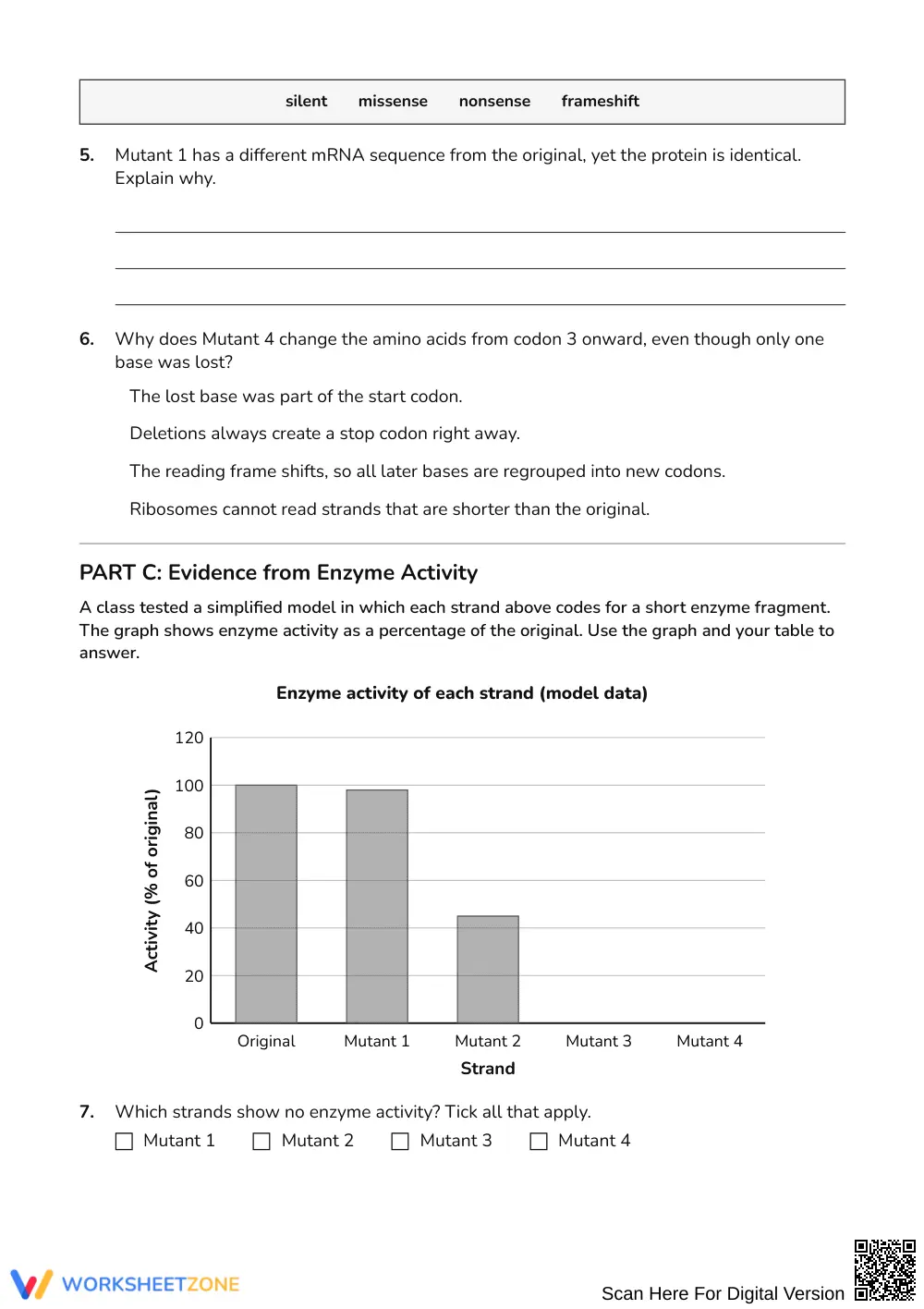
The four-page printable worksheet includes reference codon tables, molecular models of mutated mRNA strands, and a quantitative enzyme activity bar graph. Students work through 22 sequential tasks spanning multiple-choice items, structured translation tables, and open-response mechanistic explanations supported by a complete 4-page answer key.
Skill Progression
- Guided practice (Part A, 4 items): Students use a standard codon table to look up amino acids, determine redundancy, and recognize start and stop codons with structured prompts.
- Supported practice (Part B, 7 items): Students analyze mutated mRNA sequences alongside a wild-type reference strand to classify silent, missense, nonsense, and frameshift mutations.
- Independent practice (Part C, 11 items): Students evaluate simulated enzyme activity data, correlate structural polypeptide alterations to catalytic function, and critique common misconceptions using experimental evidence.
This structured sequence reflects the gradual release of responsibility model, moving students smoothly from basic code decoding to complex evidence-based argumentation.
Standards Alignment
This activity aligns with high school life science standards addressing molecular genetics and protein synthesis. Students construct evidence-based models to demonstrate how changes in mRNA base sequences alter translated amino acids and modify overall protein structure and enzymatic performance. This content can be copied directly into lesson plans, IEP goals, or district curriculum mapping tools.
How to Use It
Introduce this worksheet after direct instruction on transcription and translation. During class, monitor Part B to check whether students recognize how frameshift mutations alter downstream reading frames compared to isolated point mutations. Expect completion within 45 to 60 minutes as independent seatwork, partner work, or targeted lab debrief.
Who It's For
This assignment is ideal for introductory biology, honors biology, and AP Biology review. Pair this resource directly with an interactive protein synthesis simulation or transcription-translation anchor chart to support developing readers and visual learners.
Research synthesized by Fisher & Frey (2014) highlights that scaffolding complex visual data through structured problem sequences significantly strengthens students' scientific reasoning skills. When analyzing molecular models alongside functional bar graphs, secondary students transition from passive memorization of genetic charts to active evaluation of biological evidence. This four-page worksheet implements targeted guided-to-independent practice across 22 multi-tiered tasks, giving students authentic practice in reading nucleotide sequences and calculating enzyme activity shifts. By connecting specific base changes directly to catalytic performance, students develop a grounded, mechanistic understanding of silent, missense, nonsense, and frameshift mutations. As documented in ongoing science education studies, structured translation and interpretation tasks build foundational scientific literacy essential for standardized assessments and advanced coursework.


