




























Views
Downloads




Complete Claim, Reason & Evidence Worksheet | Grade 7 ELA

Paste this activity's link or code into your existing LMS (Google Classroom, Canvas, Teams, Schoology, Moodle, etc.).
Students can open and work on the activity right away, with no student login required.
You'll still be able to track student progress and results from your teacher account.
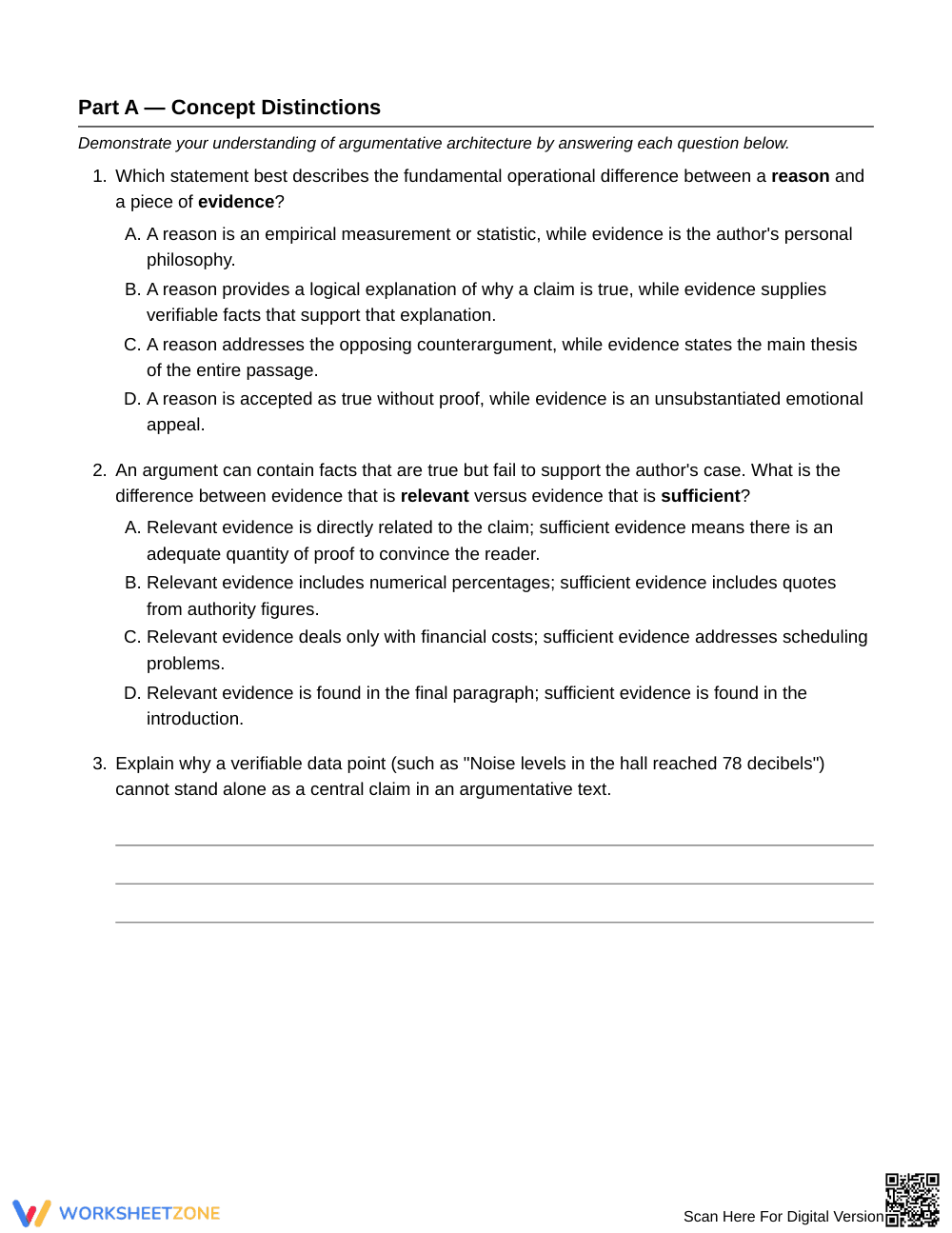
This five-page worksheet guides Grade 7 students to systematically analyze arguments by evaluating claims, reasons, and evidence in a persuasive proposal. Working through ten focused problems, learners distinguish between claims and supporting data, analyze counterarguments, and determine whether evidence is relevant and sufficient to justify the author's position.
At a Glance
- Grade: 7 · Subject: ELA
- Standard:
RI.7.8— Trace and evaluate an author's argument, assessing sound reasoning and relevant, sufficient evidence.- Skill Focus: Claim, Reason, and Evidence Roles
- Format: 5 pages · 10 problems · Answer key included · PDF
- Best For: Close reading, argument analysis, and independent practice
- Time: 40–50 minutes
The worksheet begins with a reference box defining claims, reasons, and evidence. Students read a four-paragraph civic proposal requesting a quiet study lounge at a local youth center. Across five pages, ten tasks include conceptual multiple-choice items, text-based data citations, and evaluative written responses, accompanied by a complete three-page answer key with model explanations.
Skill Progression
- Guided practice (Problems 1–3): Students review core definitions and answer three concept questions distinguishing reasons from evidence and relevance from sufficiency.
- Supported practice (Problems 4–8): Learners analyze the proposal across five text-based items, isolating the author's claim, citing numerical log data, and identifying counterarguments.
- Independent practice (Problems 9–10): Students complete two rigorous evaluations, judging whether decibel metrics and room partition solutions provide sound, sufficient proof.
This sequence implements the gradual release of responsibility model, transitioning students from foundational terminology to independent critical evaluation.
Standards Alignment
This resource aligns with RI.7.8: Trace and evaluate the argument and specific claims in a text, assessing whether the reasoning is sound and the evidence is relevant and sufficient to support the claims. It also supports RI.7.1 by requiring students to cite specific textual evidence. Both standard codes can be copied directly into lesson plans, IEP goals, or district curriculum mapping tools.
How to Use It
Deploy this worksheet after direct instruction on argumentative elements as guided independent practice or paired analysis. For formative assessment, inspect student responses to Problem 3 during circulation to verify comprehension of claims versus factual data before students evaluate extended paragraphs. The activity takes 40 to 50 minutes to complete.
Who It's For
This worksheet serves Grade 7 ELA students learning to deconstruct persuasive arguments. Concept boxes support developing readers and multilingual learners, while Part C offers analytical depth for advanced students. Pair this activity with an anchor chart on argument structures or a mini-lesson on rhetorical reasoning.
Structured informational analysis materials directly address middle school comprehension benchmarks under RI.7.8 by training students to deconstruct arguments into operational claims, supporting reasons, and empirical evidence. Educational research by Fisher & Frey (2014) highlights that intentional scaffolding through the gradual release of responsibility—moving from foundational concept definitions to text-based extraction and independent evidentiary critique—significantly improves students' ability to evaluate persuasive texts. By engaging with authentic informational proposals, Grade 7 learners learn to interrogate data points, detect unaddressed assumptions, and judge whether cited proof meets rigorous standards of relevance and sufficiency. Rather than accepting persuasive rhetoric passively, students develop critical reading habits necessary to assess reasoning soundness, parse opposing counterclaims, and articulate nuanced justifications. This five-page curriculum-aligned resource provides educators with structured tasks and complete answer keys that systematically build independent argumentative analysis skills across diverse classroom environments.


