


























Views
Downloads




Complete Circular Reasoning Worksheet | Grade 6 ELA
Paste this activity's link or code into your existing LMS (Google Classroom, Canvas, Teams, Schoology, Moodle, etc.).
Students can open and work on the activity right away, with no student login required.
You'll still be able to track student progress and results from your teacher account.
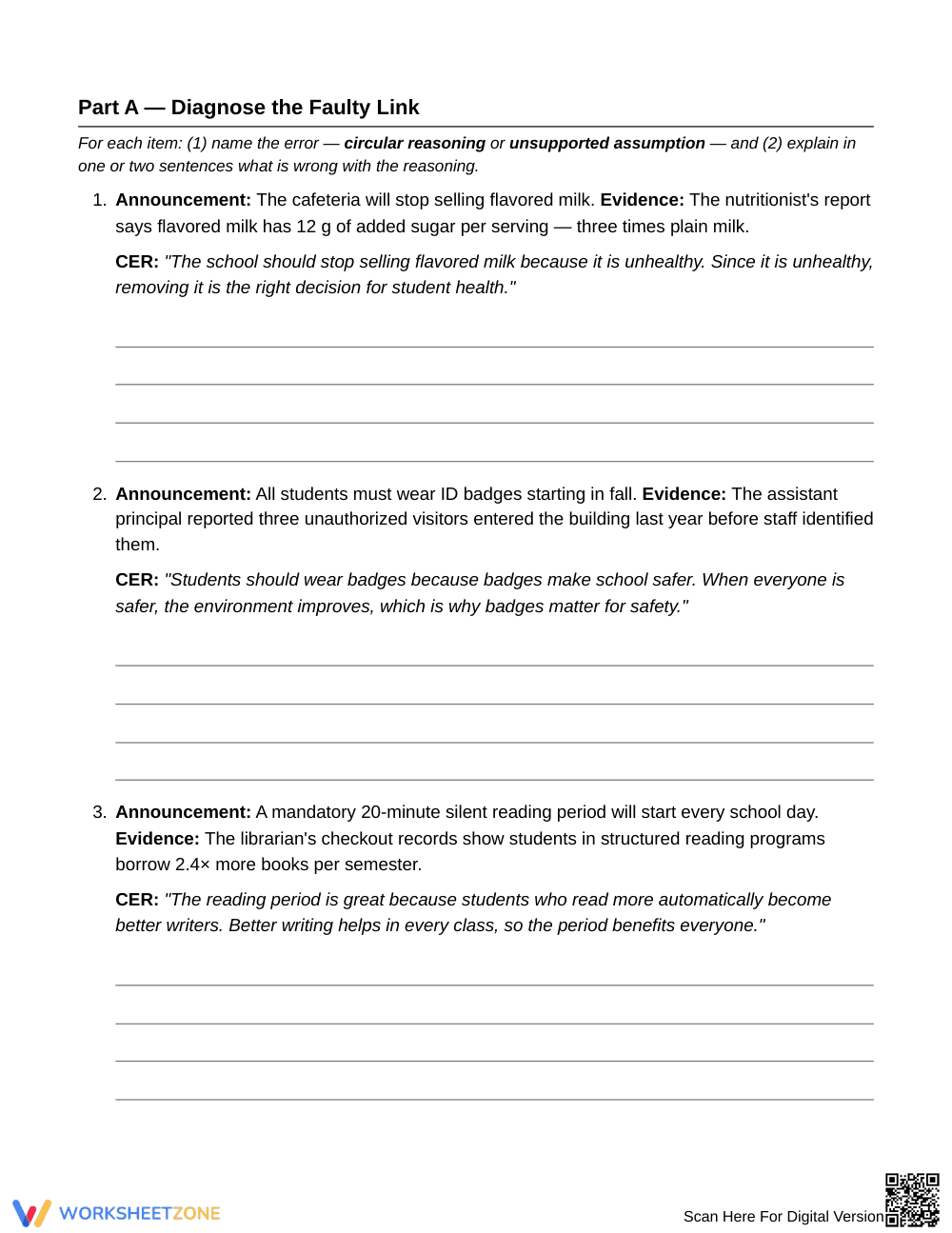
This Grade 6 ELA worksheet helps students identify and repair circular reasoning and unsupported assumptions in Claim-Evidence-Reasoning (CER) writing. Students analyze flawed rationale and rewrite logical links using concrete data, ensuring claims connect to evidence rather than repetitive restatements.
At a Glance
- Grade: 6 · Subject: ELA
- Standard:
W.6.1.b— Support claims with clear reasons and relevant evidence using credible sources.- Skill Focus: Repair Circular Reasoning
- Format: 5 pages · 10 problems · Answer key included · PDF
- Best For: Argumentative writing revision and error analysis
- Time: 35–45 minutes
This 5-page printable resource includes key definitions for circular reasoning and unsupported assumptions, plus a worked example modeling error diagnosis and revision. The worksheet contains 10 practice items divided into error-identification tasks and sentence rewrites, supported by a 2-page answer key.
Skill Progression
- Guided practice: A worked example models how to deconstruct an announcement, isolate repetitive logic, and compose an evidence-based replacement sentence.
- Supported practice (Part A, Items 1–5): Students analyze 5 school scenarios to identify logical errors, classifying each as circular reasoning or an unsupported assumption.
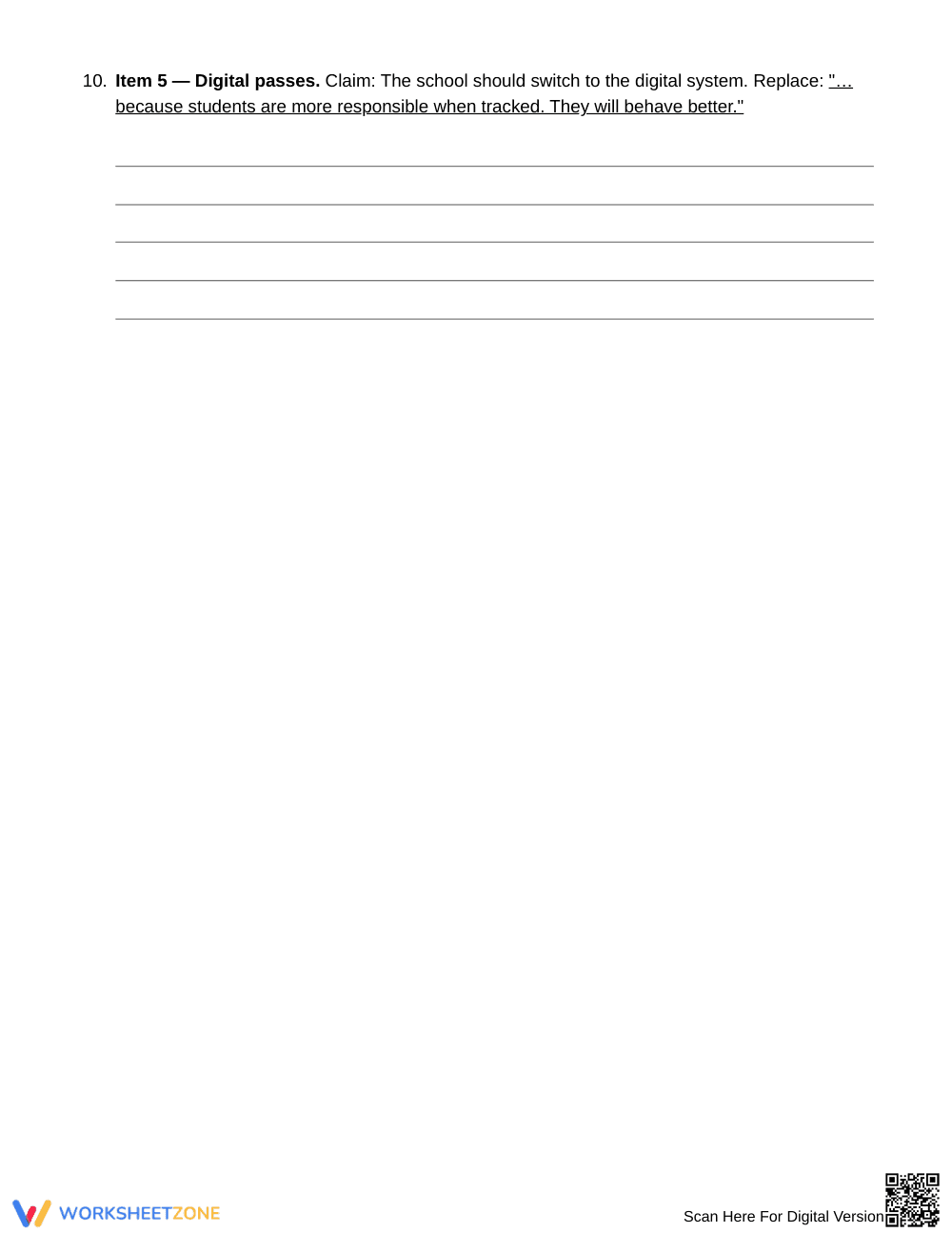
- Independent practice (Part B, Items 6–10): Students write original reasoning sentences for each scenario, connecting verified evidence directly to the claim.
This progression follows a gradual-release model, guiding writers from error diagnosis to independent revision.
Standards Alignment
This resource targets W.6.1.b: Support claim(s) with clear reasons and relevant evidence, using credible sources and demonstrating an understanding of the topic or text. It also supports CCRA.W.1 by asking students to construct valid arguments. Both standard codes can be copied directly into lesson plans, IEP goals, or district curriculum mapping tools.
How to Use It
Use this worksheet during guided writing practice after teaching logical fallacies, or assign it during peer revision workshops. As a formative assessment check, review Part A diagnoses before students attempt the Part B rewrites. Most sixth-grade students will complete the 10 tasks in 35 to 45 minutes.
Who It's For
This activity supports Grade 6 ELA classrooms, middle school intervention groups, and English language learners needing explicit practice with logical linking phrases. Pair this worksheet with a CER graphic organizer or mentor text analysis to reinforce effective argumentative writing.
Mastering argumentative reasoning under W.6.1.b requires middle school students to distinguish valid logical deductions from circular restatements. According to Fisher & Frey (2014), explicit error-analysis tasks accelerate writing competence by requiring learners to articulate why flawed reasoning fails before attempting independent drafting. When sixth graders evaluate concrete scenarios and replace faulty links with empirical evidence, they develop metacognitive control over their own argumentative syntax. Empirical research demonstrates that structured revision exercises—such as isolating claims, identifying unsupported assumptions, and integrating survey or quantitative data—significantly improve persuasive clarity. This 10-task instructional resource provides the explicit modeling and gradual release necessary to shift students from passive proofreading to active analytical reasoning. By applying targeted diagnostic frameworks to authentic school-based scenarios, students build foundational writing skills that directly support standards-aligned essay composition and critical evaluation across all content areas.


