


























Views
Downloads

Complete Changing Musical Sound Worksheet | Grade 6 Science
Paste this activity's link or code into your existing LMS (Google Classroom, Canvas, Teams, Schoology, Moodle, etc.).
Students can open and work on the activity right away, with no student login required.
You'll still be able to track student progress and results from your teacher account.
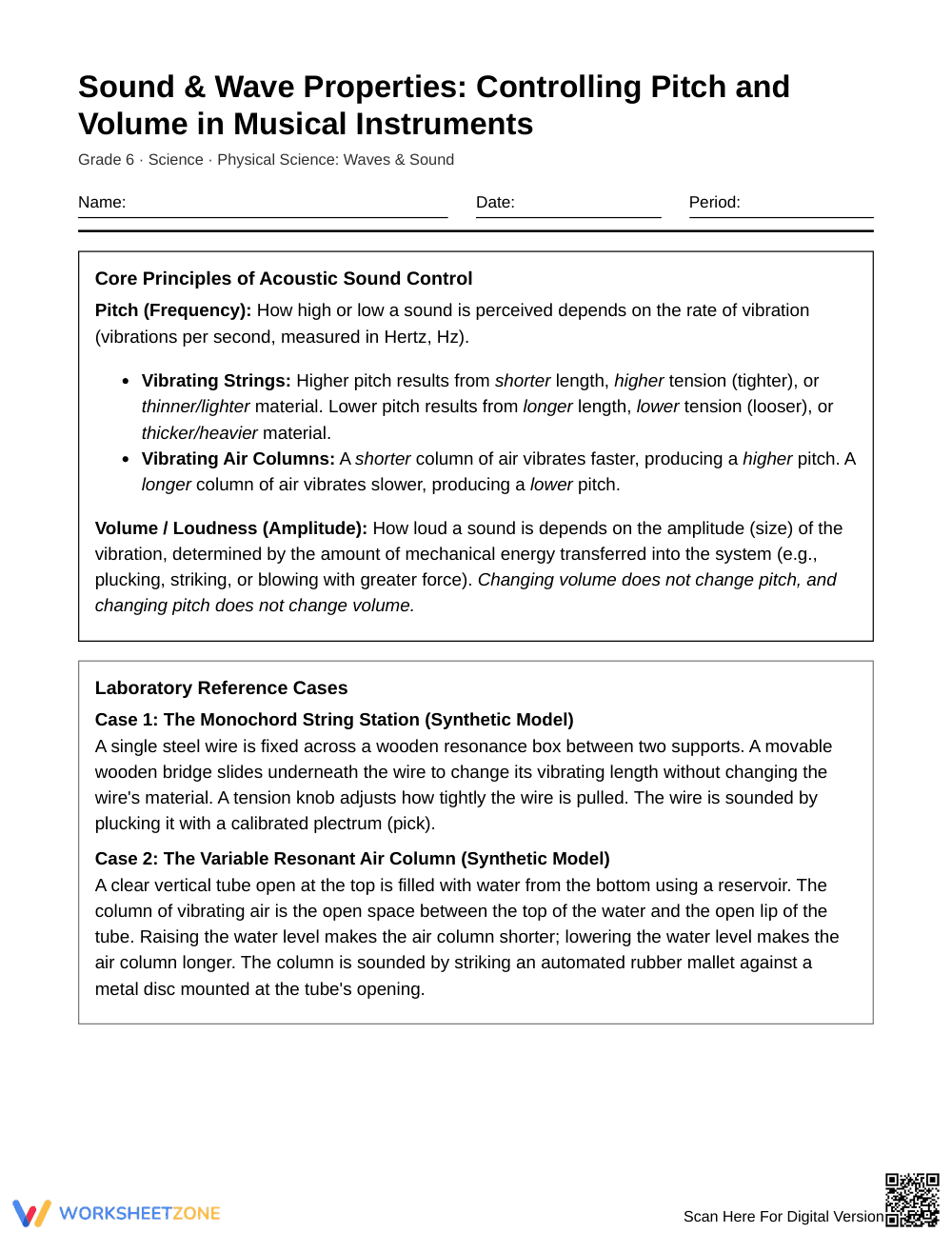
This physical science worksheet equips Grade 6 students to analyze and manipulate pitch and volume across stringed and air column instruments. Through ten targeted tasks, learners apply wave concepts—including frequency, wavelength, and amplitude—to predict acoustic behaviors, isolate independent variables, and evaluate scientific claims about vibrating systems.
At a Glance
- Grade: 6 · Subject: Science
- Standard: Physical Science — Predict how changing vibrating materials alters sound wave pitch and volume
- Skill Focus: Choose How to Change a Musical Sound
- Format: 5 pages · 10 problems · Answer key included · PDF
- Best For: Sound unit practice and lab reinforcement
- Time: 35–45 minutes
What's Inside
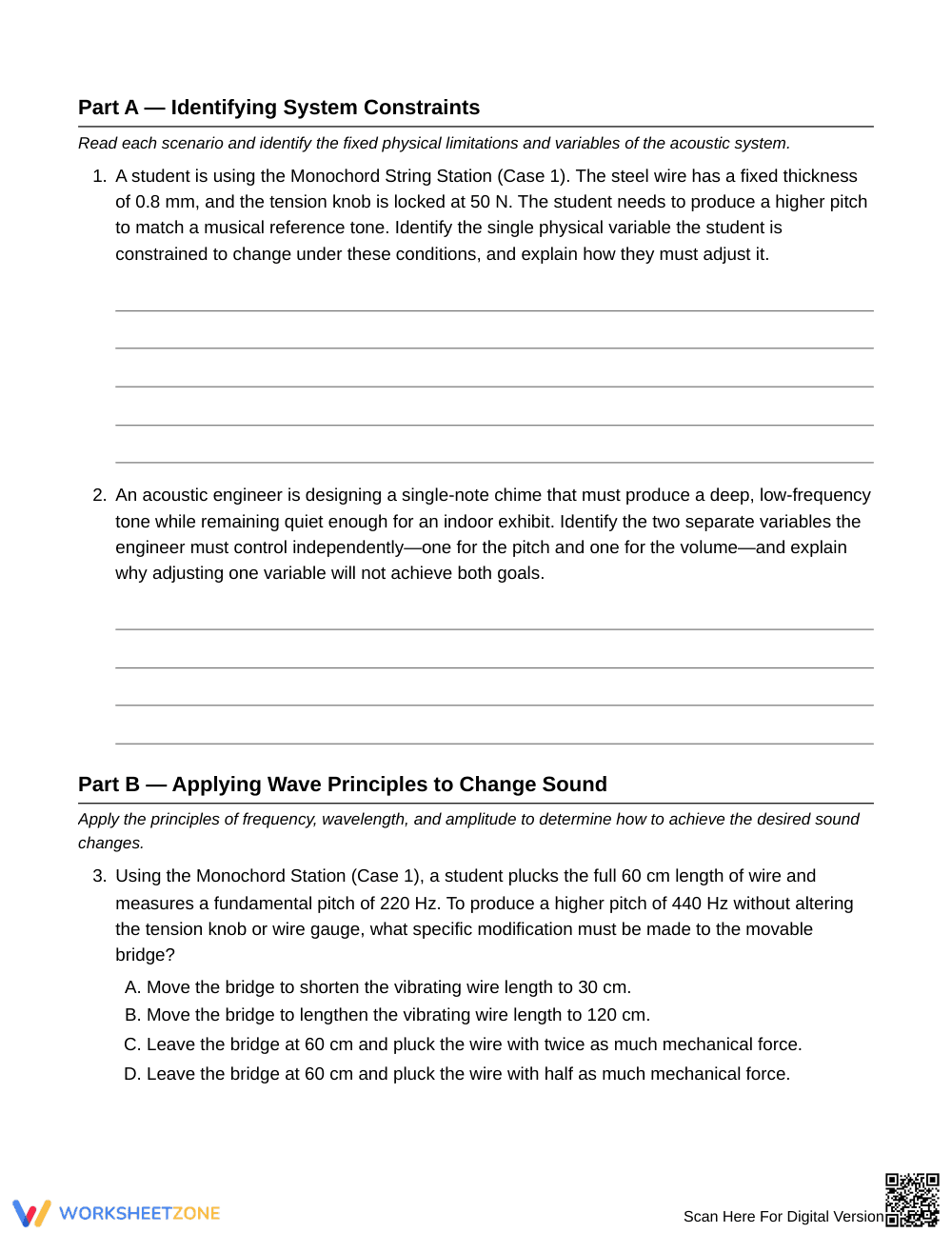
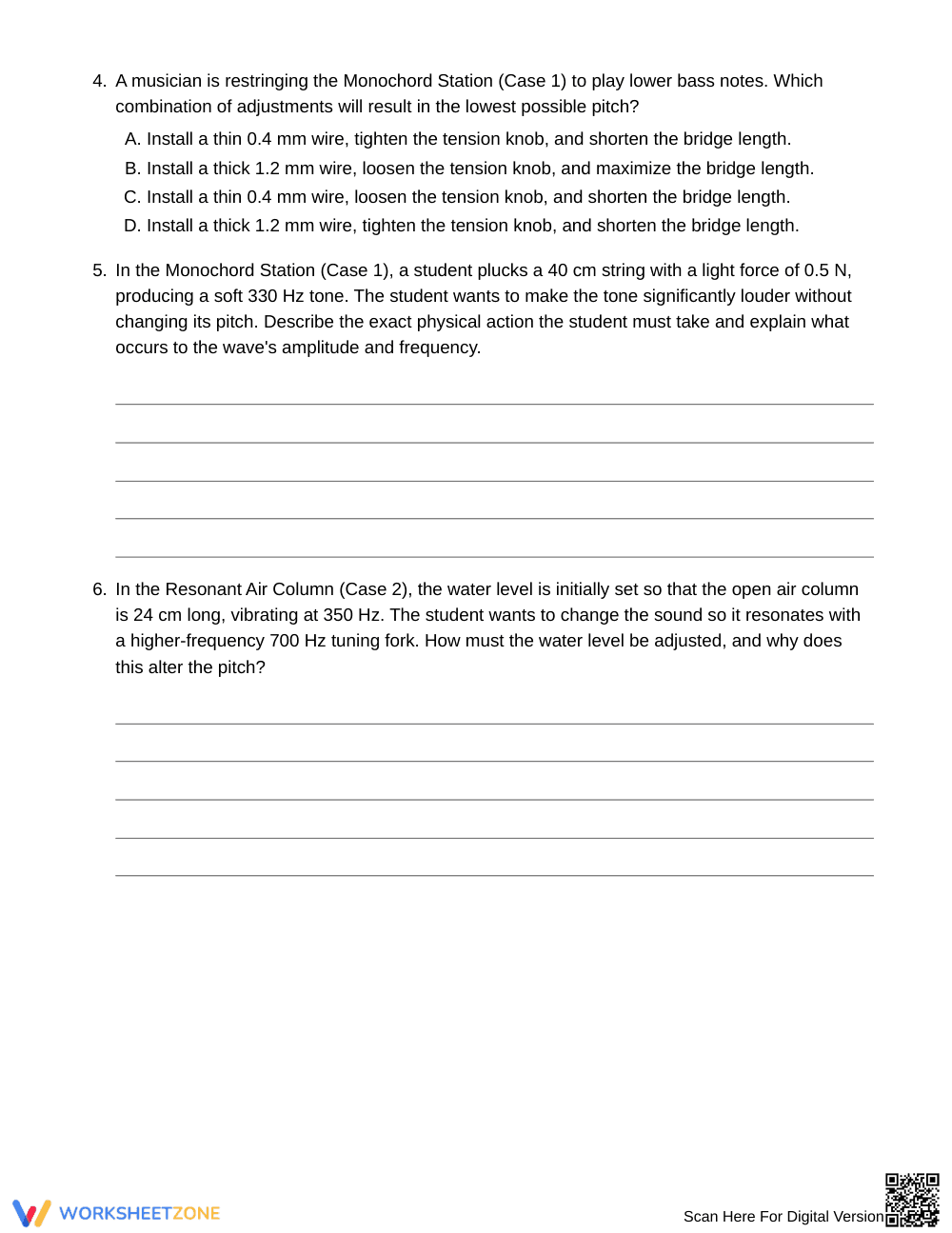
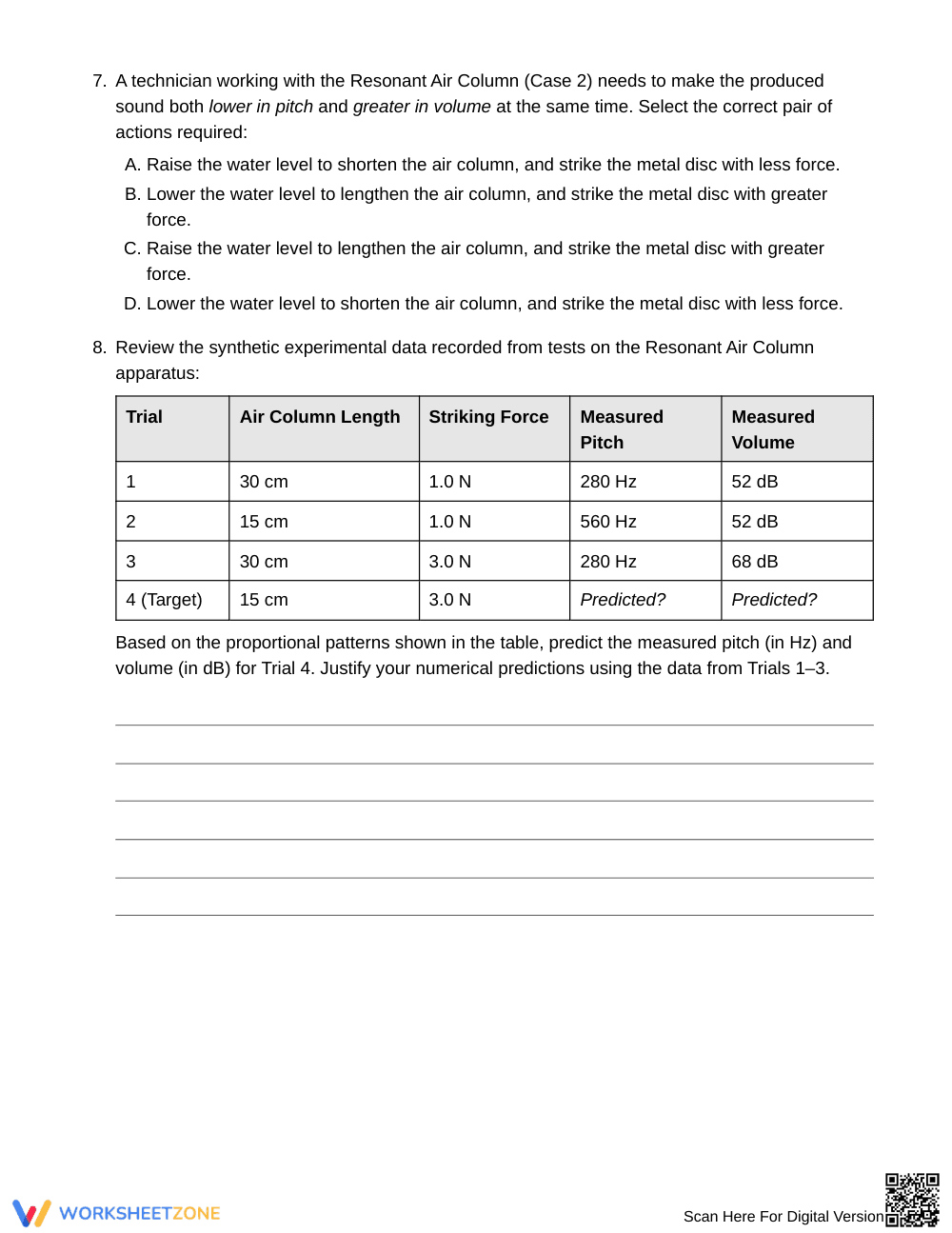
The five-page resource opens with a structured reference section defining acoustic principles and outlining two synthetic laboratory models: a monochord string station and a variable resonant air column. Students encounter two system constraint prompts, six core wave mechanics applications including multiple-choice questions and a numerical data prediction table, and two scientific claim evaluation tasks. A complete two-page answer key provides full explanations and sample justifications.
Skill Progression
- Guided Practice (Part A — 2 items): Students identify physical constraints and isolate single variables in structured string and chime apparatus scenarios using the provided reference models.
- Supported Practice (Part B — 6 items): Learners manipulate length, tension, thickness, and force across multiple-choice questions, descriptive short responses, and a quantitative experimental data table.
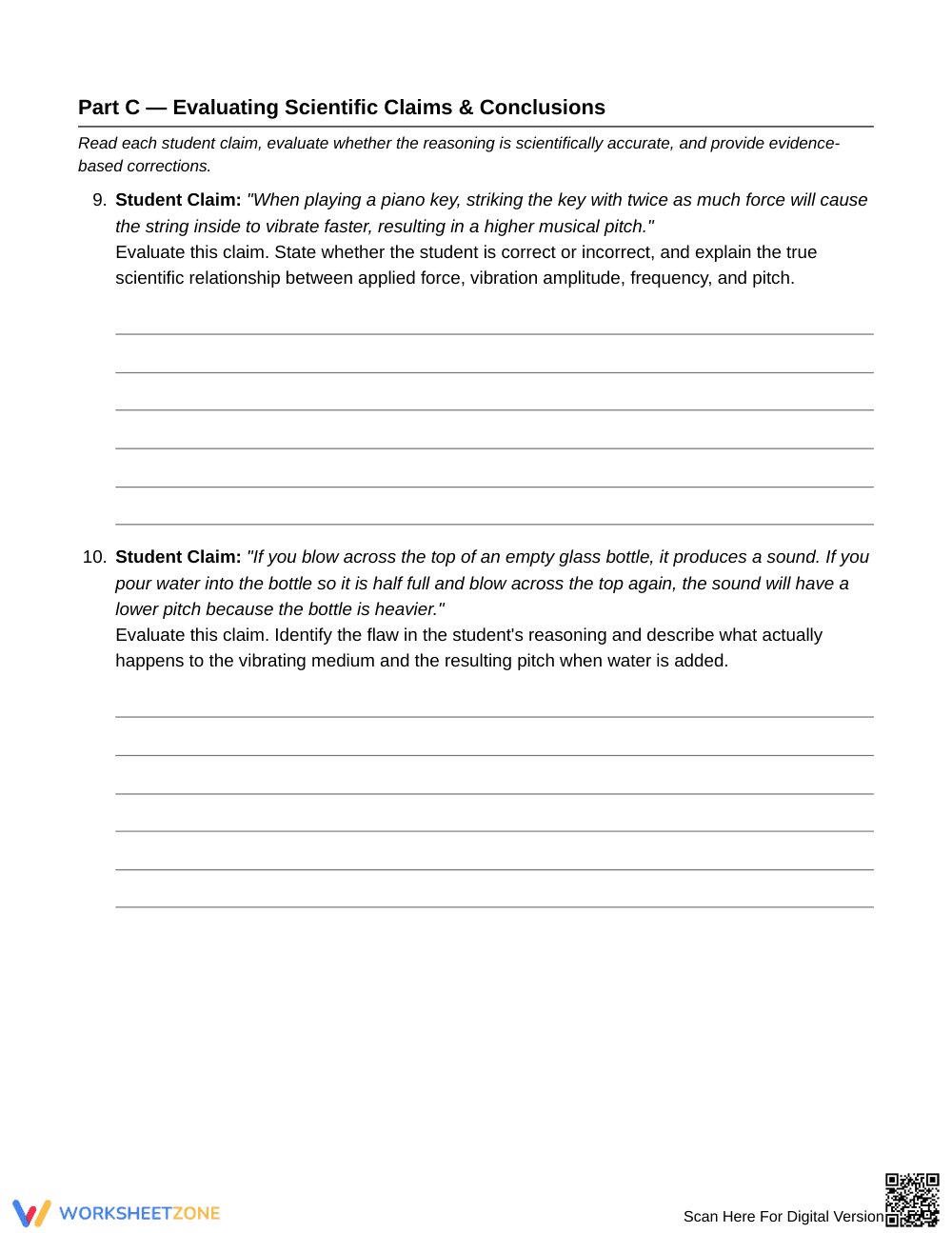
- Independent Practice (Part C — 2 items): Students critically evaluate authentic peer claims about striking force and water levels, correcting common misconceptions about amplitude and vibrating medium length.
This sequence follows a gradual-release model that builds from foundational variable identification to independent error analysis and data-driven prediction.
Standards Alignment
This activity aligns with middle school physical science standards requiring students to develop and use models to describe how waves are reflected, absorbed, or transmitted through various materials. Supporting expectations address planning and carrying out investigations to identify relationships between wave energy, amplitude, and frequency. Both standard codes can be copied directly into lesson plans, IEP goals, or district curriculum mapping tools.
How to Use It
Deploy this packet directly after introductory instruction on mechanical wave properties or as a structured post-lab synthesis following hands-on sound stations. During class, monitor how students differentiate between force adjustments (amplitude/loudness) and physical dimension changes (frequency/pitch) in Part B to catch lingering confusion early. Expect students to complete the ten items in 35 to 45 minutes.
Who It's For
This worksheet serves Grade 6 science classrooms learning physical science units on waves, sound, and energy transfer. The embedded reference box supports English language learners and students needing memory retrieval cues, while the multi-step proportional reasoning in the data table challenges advanced learners. Pair this resource with an acoustic wave anchor chart or an interactive virtual sound simulator.
Understanding acoustic sound modulation requires middle school students to distinguish clearly between energy-dependent amplitude and physical frequency determinants. According to Fisher & Frey (2014), structured practice tasks that prompt students to evaluate common misconceptions and explain physical system constraints significantly strengthen conceptual retention during guided inquiry. This physical science resource provides explicit scaffolding across ten focused items, helping Grade 6 learners connect string tension, vibrating column length, material thickness, and mechanical striking force directly to observable wave characteristics. By progressing systematically from constrained variable identification to quantitative frequency predictions and peer claim evaluations, students master how physical adjustments alter pitch and volume in musical instruments. The inclusion of two synthetic laboratory reference models ensures that learners apply foundational physics principles to realistic acoustic scenarios with scientific fidelity, accuracy, and analytical precision throughout their physical science coursework.


