




























Views
Downloads




Complete Changing Judgments Worksheet | Grade 7 ELA

Paste this activity's link or code into your existing LMS (Google Classroom, Canvas, Teams, Schoology, Moodle, etc.).
Students can open and work on the activity right away, with no student login required.
You'll still be able to track student progress and results from your teacher account.
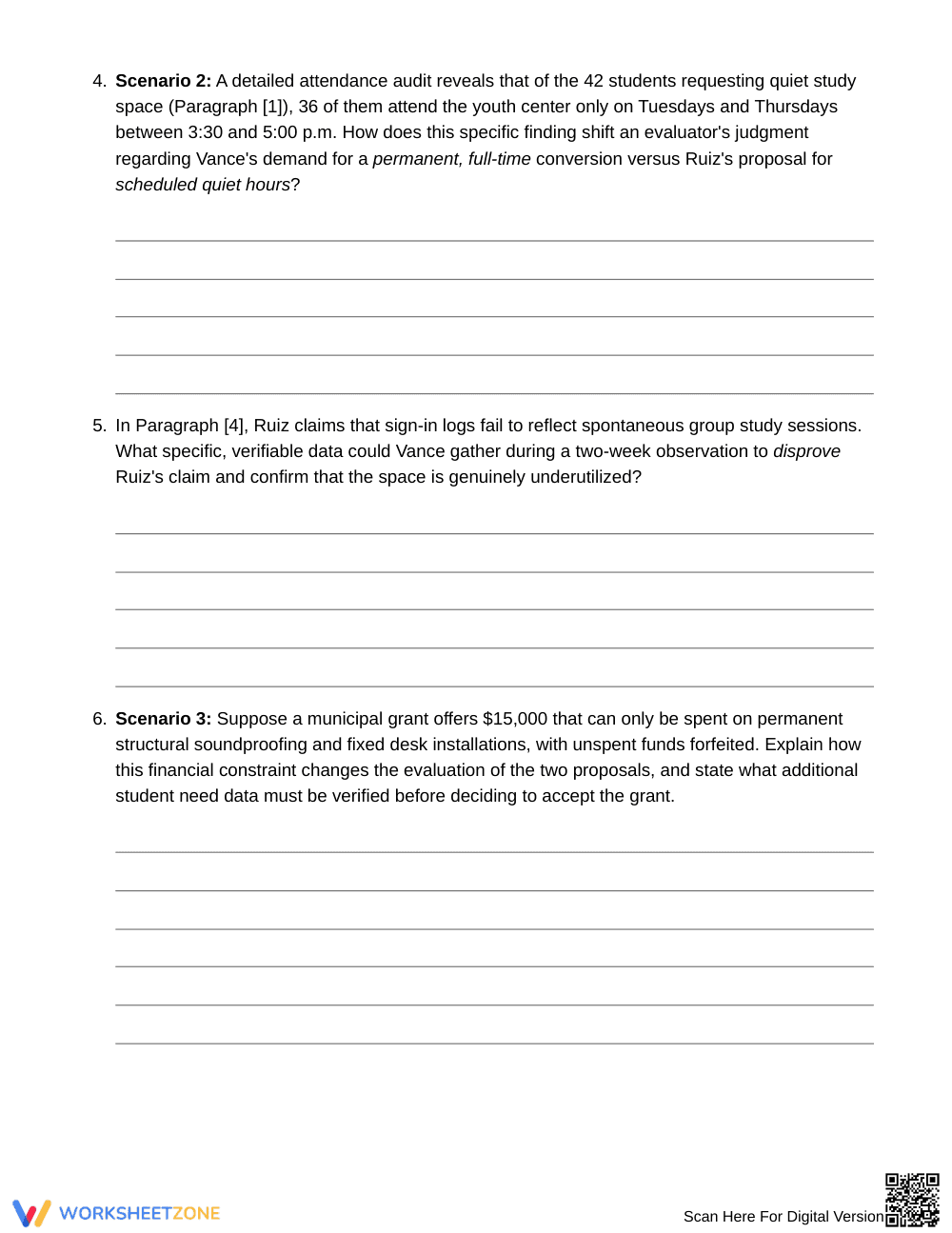
This Grade 7 informational text worksheet trains students to evaluate conflicting claims, identify evidence limitations, and explain how new data shifts judgments. Using a dual-perspective community center debate, learners evaluate baseline sufficiency, test scenario findings, and formulate qualified conclusions.
At a Glance
- Grade: 7 · Subject: ELA
- Standard:
RI.7.8— Evaluate argument claims and determine whether supporting evidence is relevant and sufficient.- Skill Focus: Explain What Evidence Would Change a Judgment
- Format: 5 pages · 8 problems · Answer key included · PDF
- Best For: Argument evaluation and evidence analysis
- Time: 40–50 minutes
What's Inside
This 5-page printable resource features a paired debate over community center space allocation. Students complete 8 text-dependent analytical tasks supported by a core concept box defining relevance, sufficiency, and constraints. A complete 3-page teacher answer key provides detailed exemplar responses and evaluation criteria.
Skill Progression
- Guided practice (Part A, 2 tasks): Students identify unstated assumptions and evaluate baseline evidence sufficiency in both proposals.
- Supported practice (Part B, 4 tasks): Students analyze acoustic data, attendance audits, and grant restrictions to explain how specific new findings shift evaluator judgments.
- Independent practice (Part C, 2 tasks): Students formulate a reasoned compromise and define two empirical metrics for a 60-day trial.
This sequence follows a gradual-release framework, advancing students from textual critique to independent evidentiary reasoning.
Standards Alignment
This resource aligns to CCSS `RI.7.8`: "Trace and evaluate the argument and specific claims in a text, assessing whether the reasoning is sound and the evidence is relevant and sufficient to support the claims." The synthesis in Part C supports `W.7.1` by requiring evidence-based qualified arguments. Both standard codes can be copied directly into lesson plans, IEP goals, or district curriculum mapping tools.
How to Use It
Use this worksheet following direct instruction on argument evaluation. Pairs can analyze the competing texts and complete Parts A and B, followed by Part C as an independent formative check. As an observation tip, verify that students explain the causal link between new data and shifted judgments rather than merely summarizing scenarios. Expected completion time is 40 to 50 minutes.
Who It's For
Designed for Grade 7 ELA classrooms, this activity also provides targeted intervention for Grade 8 readers and enrichment for Grade 6 classes. English learners benefit from structured prompt frames and authentic data points. Pair this worksheet directly with an argument evaluation anchor chart or a structured classroom debate.
According to Fisher & Frey (2014), developing rigorous argumentative literacy requires students to engage in productive struggle by evaluating how competing evidence alters judgments. This worksheet targets standard RI.7.8 by guiding Grade 7 students to evaluate whether claims are backed by sufficient evidence and explain how newly introduced empirical findings shift an objective judgment. Rather than treating claims as static facts, eight structured tasks challenge middle school readers to examine acoustic decibel levels, attendance logs, and municipal funding constraints across two competing proposals. By practicing authentic evidence-based reasoning, students learn to detect unstated assumptions, identify data limitations, and establish verifiable thresholds for future trials. The included multi-page scoring key provides comprehensive response benchmarks that support actionable feedback and objective evaluation across standards-aligned secondary English language arts classrooms while strengthening core analytical writing competencies.


