




























Views
Downloads




Complete Central Idea & Details Worksheet | Grade 7 ELA

Paste this activity's link or code into your existing LMS (Google Classroom, Canvas, Teams, Schoology, Moodle, etc.).
Students can open and work on the activity right away, with no student login required.
You'll still be able to track student progress and results from your teacher account.
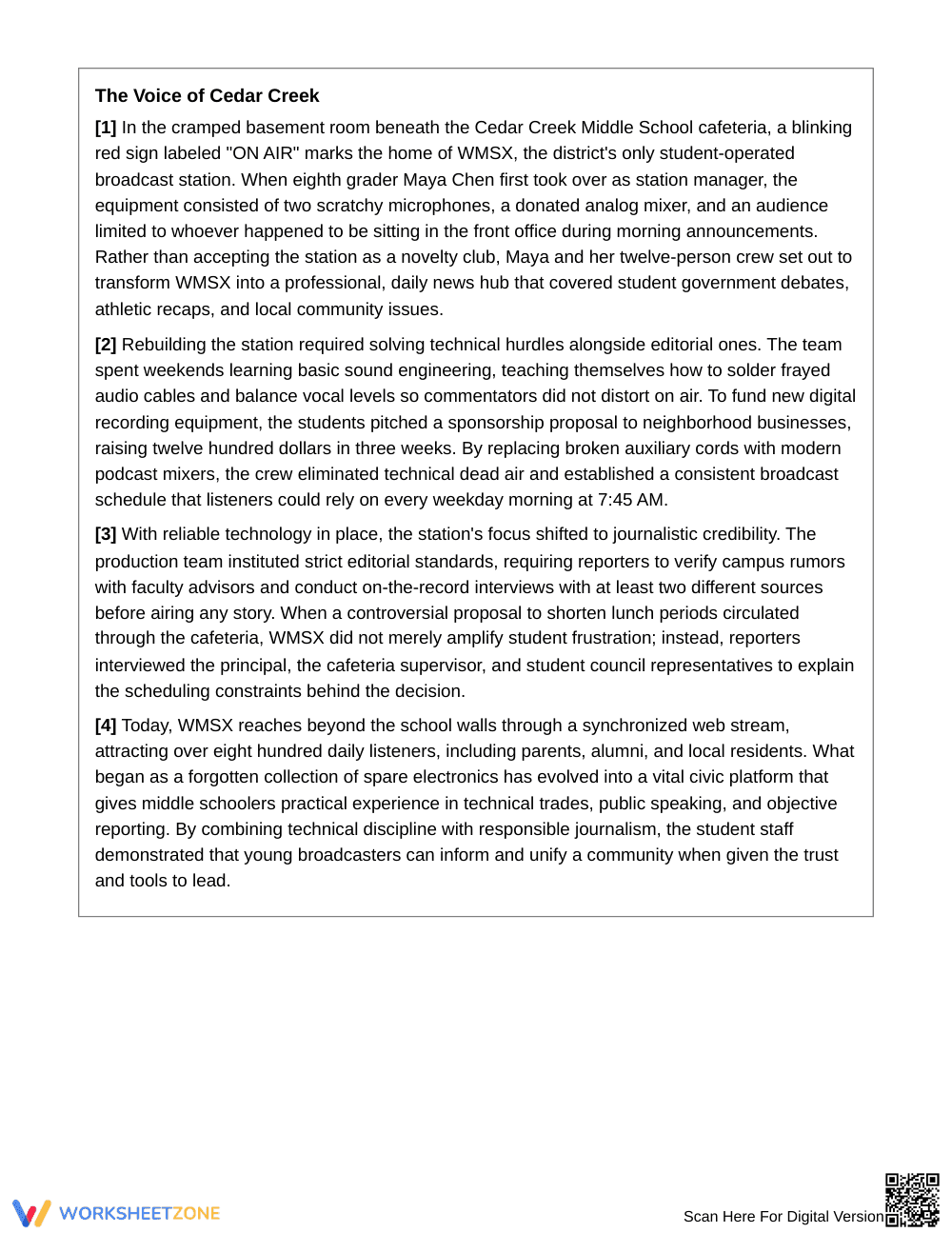
This Grade 7 informational text worksheet equips students to identify central ideas and trace how key details develop them across an entire passage. Through a structured informational article about a student-led radio station, learners analyze evidence relationships, craft objective summaries, and eliminate subjective opinions from textual analysis.
At a Glance
- Grade: 7 · Subject: ELA
- Standard:
RI.7.2— Determine central ideas in informational texts and provide an objective summary- Skill Focus: Build a Central Idea from Key Details
- Format: 5 pages · 10 problems · Answer key included · PDF
- Best For: Informational text reading comprehension practice
- Time: 40–50 minutes
What's Inside
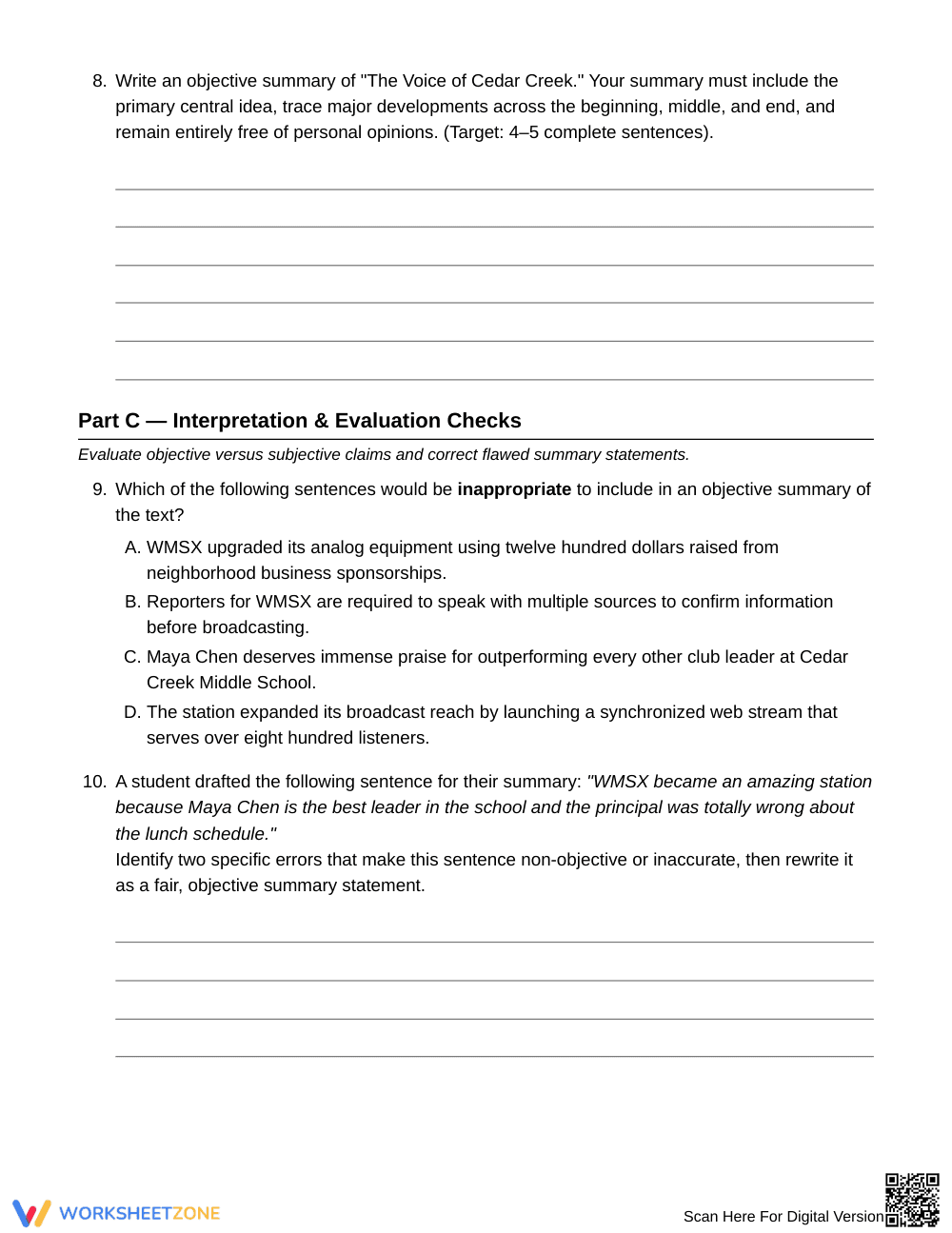
This 5-page printable resource features a complete original informational passage, "The Voice of Cedar Creek," accompanied by 10 scaffolded questions across three distinct sections. It begins with explicit concept definitions and a worked annotation model, continues with structured graphic organizers and multiple-choice items, and finishes with summary evaluation tasks alongside a thorough 3-page answer key with exemplar responses.
Skill Progression
- Guided practice (Tasks 1–3): Students complete evidence-linking graphic organizers and trace how paragraph-level problems directly generate specific solutions across the text.
- Supported practice (Tasks 4–8): Learners identify primary central ideas, analyze organizational text structure, examine secondary themes, and draft a 4- to 5-sentence objective summary.
- Independent practice (Tasks 9–10): Students evaluate summary statements to distinguish objective analysis from subjective commentary, diagnosing and revising biased sentences into neutral informational overviews.
This structured progression follows the gradual-release framework, moving learners from modeled text annotation toward independent objective writing.
Standards Alignment
This worksheet is aligned directly to RI.7.2: Determine two or more central ideas in a text and analyze their development over the course of the text; provide an objective summary of the text. Students also engage with supporting standard RI.7.1 by citing specific textual evidence when defending their analytical conclusions. Both standard codes can be copied directly into lesson plans, IEP goals, or district curriculum mapping tools.
How to Use It
Use this activity during guided reading instruction or immediately after a direct lesson on objective summarization. As students work through Part A, circulate to verify that they are citing concrete details rather than broad topic words. Allow 40 to 50 minutes for full completion, or divide the passage and Part A into one class period and assign Parts B and C for targeted follow-up practice.
Who It's For
This resource is designed for seventh-grade English language arts classrooms, reading intervention groups, and resource settings focusing on informational text complexity. It pairs naturally with an anchor chart comparing central ideas against supporting details or a mini-lesson on avoiding bias in academic writing.
According to Fisher & Frey (2014), explicit instruction in tracking key details across informational paragraphs is critical for middle school students transitioning to multi-layered textual analysis. Standard RI.7.2 requires learners to determine two or more central ideas and produce an objective summary without personal bias. This 5-page, 10-task worksheet systematically builds this skill by combining modeled annotations with structured evidence analysis. By guiding students from evidence connection charts to independent summary generation and error evaluation, the resource provides the exact developmental scaffolding recommended by literacy researchers for mastering complex informational standards.


