































Complete Cell Types Worksheet | Grades 7-12 Science

Paste this activity's link or code into your existing LMS (Google Classroom, Canvas, Teams, Schoology, Moodle, etc.).
Students can open and work on the activity right away, with no student login required.
You'll still be able to track student progress and results from your teacher account.
This comprehensive science worksheet trains students to analyze cell structures through real-world medical and ecological contexts. Learners examine bacterial biotechnology, antibiotic mechanisms, endosymbiosis, and microbial growth data, transitioning from basic structural identification to complex evidence-based scientific claims about prokaryotes and eukaryotes.
At a Glance
- Grade: Grades 7–12 · Subject: Science
- Standard: Life Science — Distinguish cellular components and evaluate prokaryotic versus eukaryotic functions
- Skill Focus: Real-World Application
- Format: 4 pages · 35 problems · Answer key included · PDF
- Best For: Biology review and independent study
- Time: 45–60 minutes
What's Inside
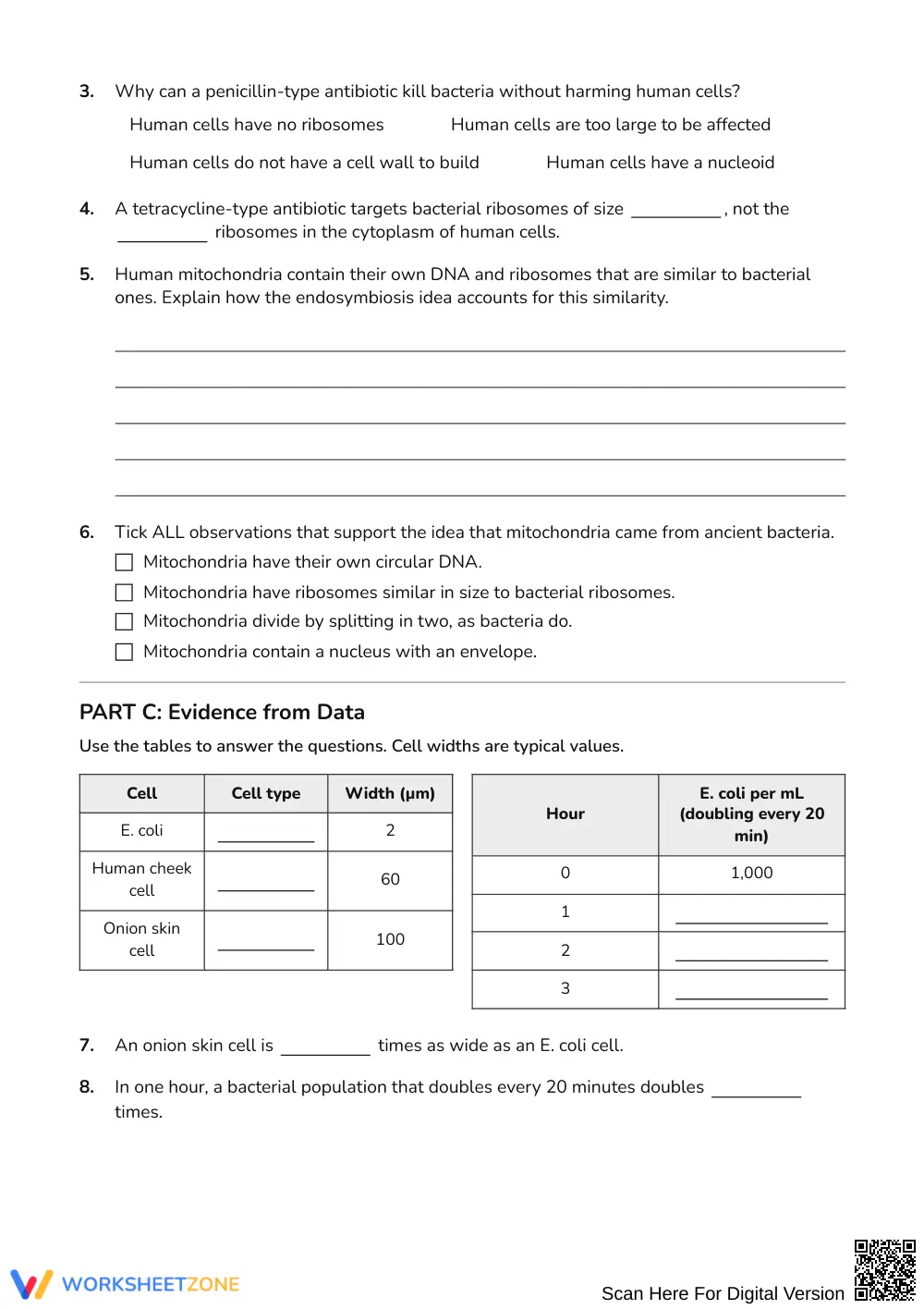
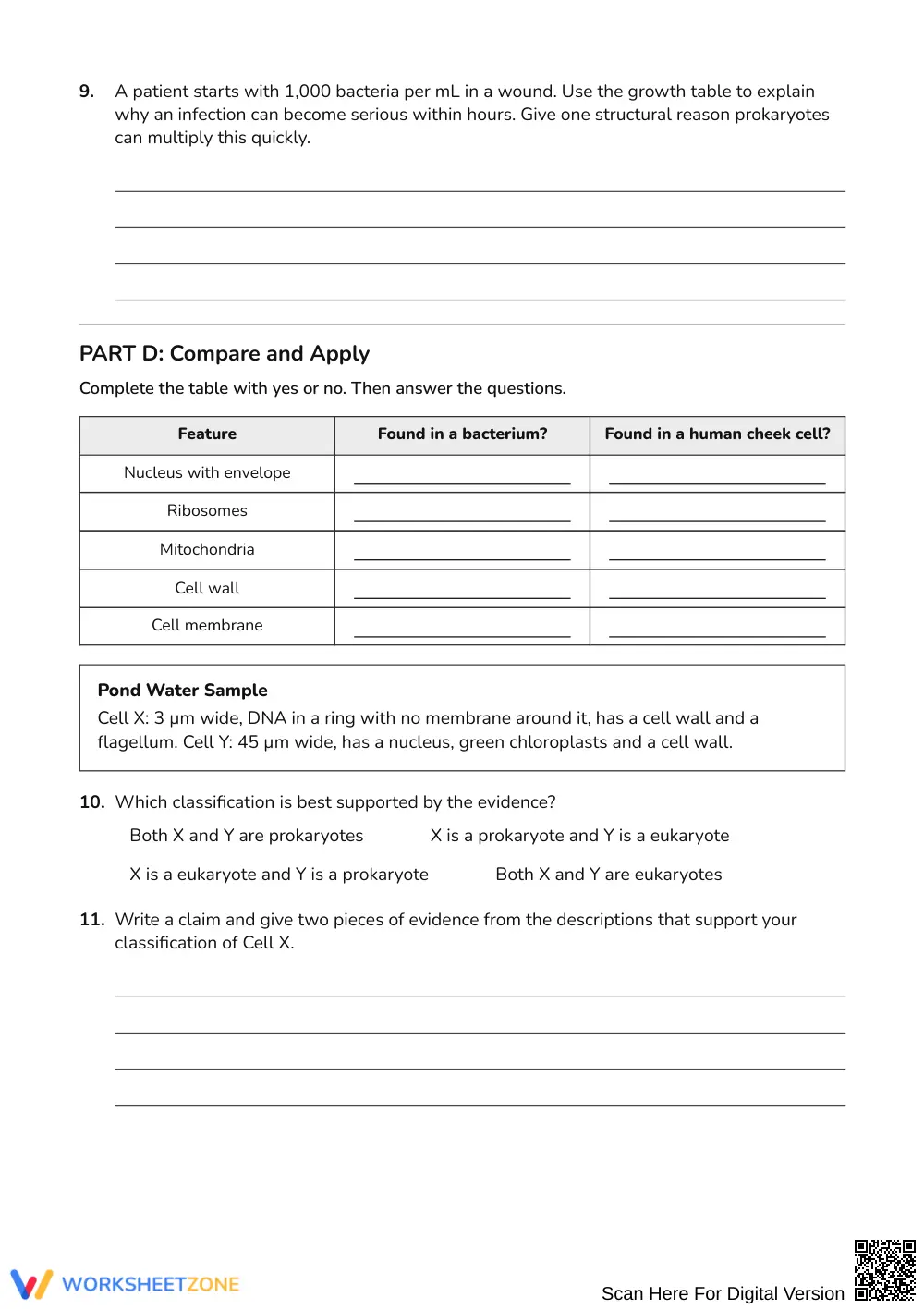
Spanning 4 student-facing pages, this resource features 35 scaffolded tasks distributed across four distinct parts. Students evaluate labeled cellular diagrams, read contextual passages regarding antibiotic targets, calculate microbial doubling rates from quantitative data tables, and complete comparative matrices. A complete 4-page teacher answer key provides full explanations and sample claim-evidence responses.
Skill Progression
- Guided Practice (Part A): Students examine an introductory structural diagram of an engineered bacterium, answering 5 foundational questions identifying plasmids and ribosomes in biotechnology.
- Supported Practice (Parts B & C): Learners analyze informational passages on antibiotic inhibition and interpret a mathematical growth chart across 15 structured analysis questions.
- Independent Practice (Part D): Working without immediate prompts, students complete a 15-item comparative matrix and formulate written claim-evidence arguments classifying mystery pond water specimens.
This deliberate sequence reflects the gradual release of responsibility model, guiding students systematically from guided model analysis toward independent scientific reasoning.
Standards Alignment
This worksheet directly targets state and national secondary life science standards requiring students to develop models illustrating the fundamental structural differences between prokaryotic and eukaryotic cells. Students evaluate how internal organelles enable specific physiological functions and explain evolutionary mechanisms such as endosymbiosis. These learning objectives align directly with standard biology curriculum frameworks and can be integrated into district lesson planning guides.
How to Use It
Deploy this activity immediately after introducing cellular organelles as a mid-unit formative assessment, or assign it during review stations prior to a major life science exam. As students work through the antibiotic passage in Part B, observe whether they correctly distinguish between eukaryotic 80S and prokaryotic 70S ribosomes, targeting any misconceptions regarding mitochondrial evolution during mid-lesson checks. Expected completion time is 45 to 60 minutes.
Who It's For
Designed for middle school life science and high school biology classrooms, this resource supports diverse learners through clear data tables and contextual medical prompts. Pair this packet with a compound microscope lab observing live cheek cells and Elodea to reinforce tangible distinctions between cell kingdoms.
Secondary science programs increasingly prioritize contextualized problem-solving over simple rote memorization of cellular diagrams. According to EdReports 2024 evaluations of standard life science curricula, students demonstrate significantly higher retention and conceptual mastery when cellular organelles are introduced through functional, authentic scenarios such as pharmaceutical development and epidemiological data tracking. This 4-page worksheet systematically engages learners in applying structural biology concepts to antibiotic resistance and bacterial division mechanics. By pairing concrete quantitative analysis with rigorous claim-evidence-reasoning prompts, the resource reinforces critical scientific literacy skills demanded across standard secondary biology assessments. Instructors can utilize the included multi-page key for rapid grading, student self-correction, or IEP progress monitoring, making it an efficient instructional asset for rigorous science classrooms.


