
































Complete Cell Theory Worksheet | Grades 7-12 Science

Paste this activity's link or code into your existing LMS (Google Classroom, Canvas, Teams, Schoology, Moodle, etc.).
Students can open and work on the activity right away, with no student login required.
You'll still be able to track student progress and results from your teacher account.
This cell theory worksheet gives students in grades 7 through 12 structured practice mastering fundamental biology concepts. Students review key tenets, analyze cell diagrams, examine historical discoveries, and classify biological specimens. By completing these visual and analytical tasks, learners build essential prior knowledge for advanced life science units.
At a Glance
- Grade: Grades 7–12 · Subject: Science
- Standard: Core Life Science — Explain cell theory principles and differentiate cell structures
- Skill Focus: Cell theory foundations and vocabulary
- Format: 4 pages · 30 problems · Answer key included · PDF
- Best For: Introductory lessons and unit review
- Time: 45–60 minutes
What's Inside
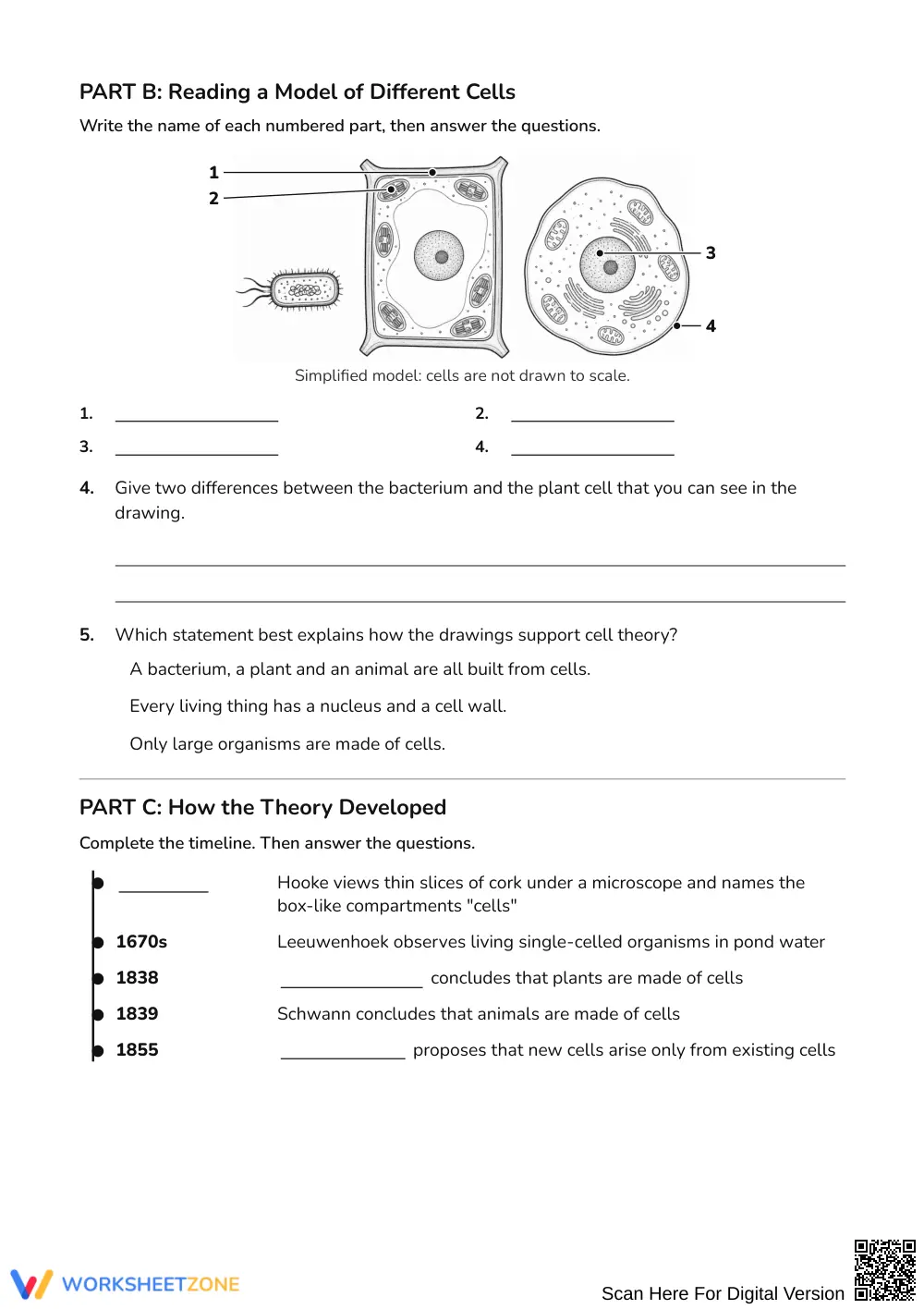
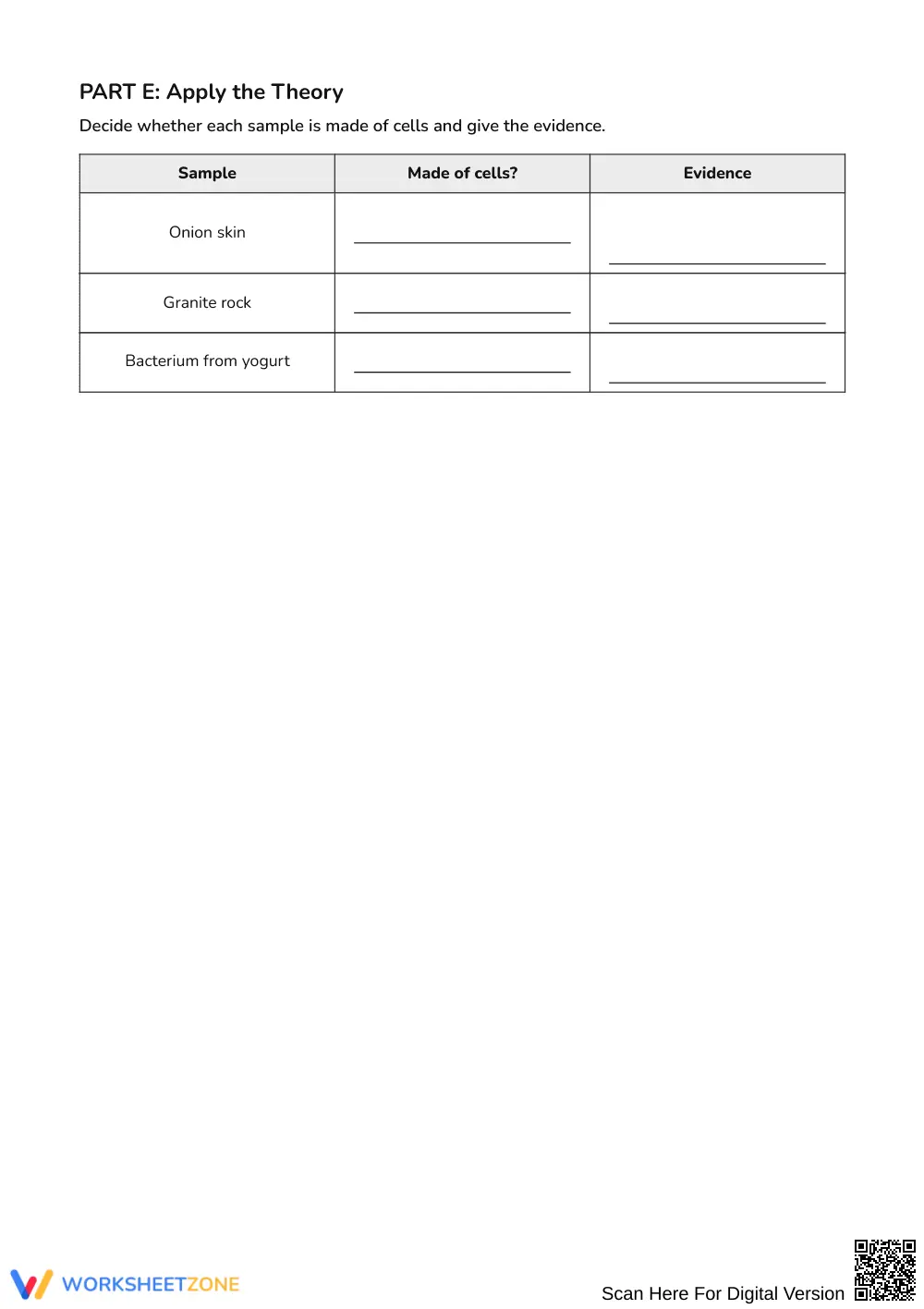
The 4-page worksheet includes 30 problems across five sections. Part A introduces cell theory tenets with vocabulary matching. Part B provides labeled diagrams comparing bacteria, plant, and animal cells. Part C features a historical timeline spanning Hooke to Virchow. Part D covers cell division, and Part E provides a specimen classification chart. A 4-page answer key is included.
Skill Progression
- Guided practice (Tasks 1–10): Students match vocabulary and recall the three tenets of cell theory with clear definitions provided.
- Supported practice (Tasks 11–22): Learners interpret cell diagrams and historical timeline milestones to explain theoretical developments.
- Independent practice (Tasks 23–30): Students analyze division models and classify mystery specimens without scaffolding.
This structure follows the gradual release of responsibility model, guiding students toward independent scientific evaluation.
Standards Alignment
This worksheet aligns with secondary life science standards requiring students to explain cell theory tenets and differentiate cellular structures. Students investigate how cells serve as the basic structural unit of all living organisms. Both standard descriptions can be copied directly into lesson plans, IEP goals, or district curriculum mapping tools.
How to Use It
Use this resource after introducing cell theory. In pairs, students can analyze the Part B diagrams to compare bacterial and eukaryotic cells. As a formative check, review Part C to ensure students understand that dead cork compartments lack living processes. The complete 30-question activity takes 45 to 60 minutes.
Who It's For
This printable is designed for middle and high school life science and biology classrooms. Visual cell models and structured data tables support diverse learners and English language learners. Pair this worksheet directly with a compound microscope lab examining cheek and plant cells.
Mastering core cell theory and biological vocabulary enables secondary students to comprehend complex cellular mechanisms and organismal physiology. According to Fisher & Frey (2014), structured instructional progressions that guide students from foundational terminology to independent analytical application significantly enhance long-term retention and conceptual mastery in science disciplines. This 4-page instructional resource operationalizes those findings through 30 scaffolded tasks. By engaging with comparative diagrams, historical chronologies, and evidence-based sample classification, students move past passive memorization into active scientific reasoning. Research shows that integrating visual models alongside analytical writing prompts reinforces knowledge transfer across diverse student demographics, ensuring that learners develop the evidentiary reasoning skills emphasized in modern science frameworks. Furthermore, examining historical milestones grounds abstract biological concepts in authentic scientific investigation. The included 4-page answer key streamlines targeted formative feedback, allowing educators to address student misconceptions promptly during initial unit instruction.


