


























Views
Downloads




Complete Cell Part Cooperation Worksheet | Grade 6 Science
Paste this activity's link or code into your existing LMS (Google Classroom, Canvas, Teams, Schoology, Moodle, etc.).
Students can open and work on the activity right away, with no student login required.
You'll still be able to track student progress and results from your teacher account.
This Grade 6 science worksheet guides students through modeling the cell as an interdependent biological system. Learners examine how organelles like the nucleus, central vacuole, cell wall, and cell membrane cooperate to maintain homeostasis, store resources, and process critical cellular signals across 14 rigorous practice items.
At a Glance
- Grade: 6 · Subject: Science
- Standard: Life Science — Model cell parts and explain how cellular structures interact as an integrated system.
- Skill Focus: Explaining cooperation among essential cell parts
- Format: 5 pages · 14 problems · Answer key included · PDF
- Best For: Mid-unit practice and system analysis
- Time: 40–50 minutes
The 5-page worksheet includes 14 structured items across three progressive sections. Students evaluate multiple-choice scenarios, analyze a synthetic leaf tissue data table tracking turgor pressure across four conditions, and resolve competing student models. A comprehensive 3-page answer key provides clear diagnostic explanations and sample student responses for open-ended synthesis questions.
Structured Skill Progression
- Guided practice (Items 1–4): Foundational multiple-choice and short-response items prompt students to identify direct interactions between specific organelle pairs, such as chloroplasts and central vacuoles.
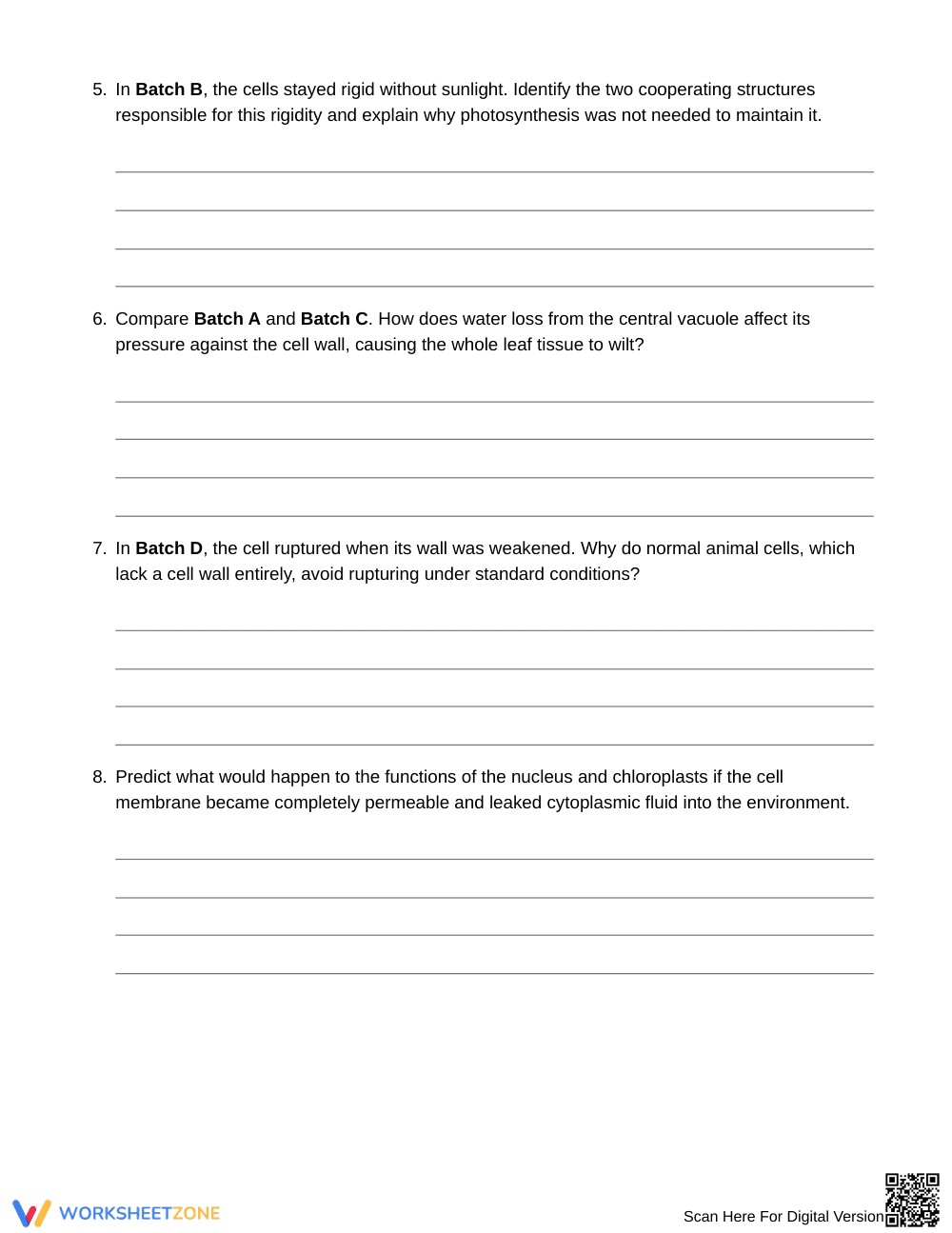
- Supported practice (Items 5–8): Data table analysis challenges students to interpret experimental batches to connect vacuole volume and cell wall integrity to overall tissue rigidity.
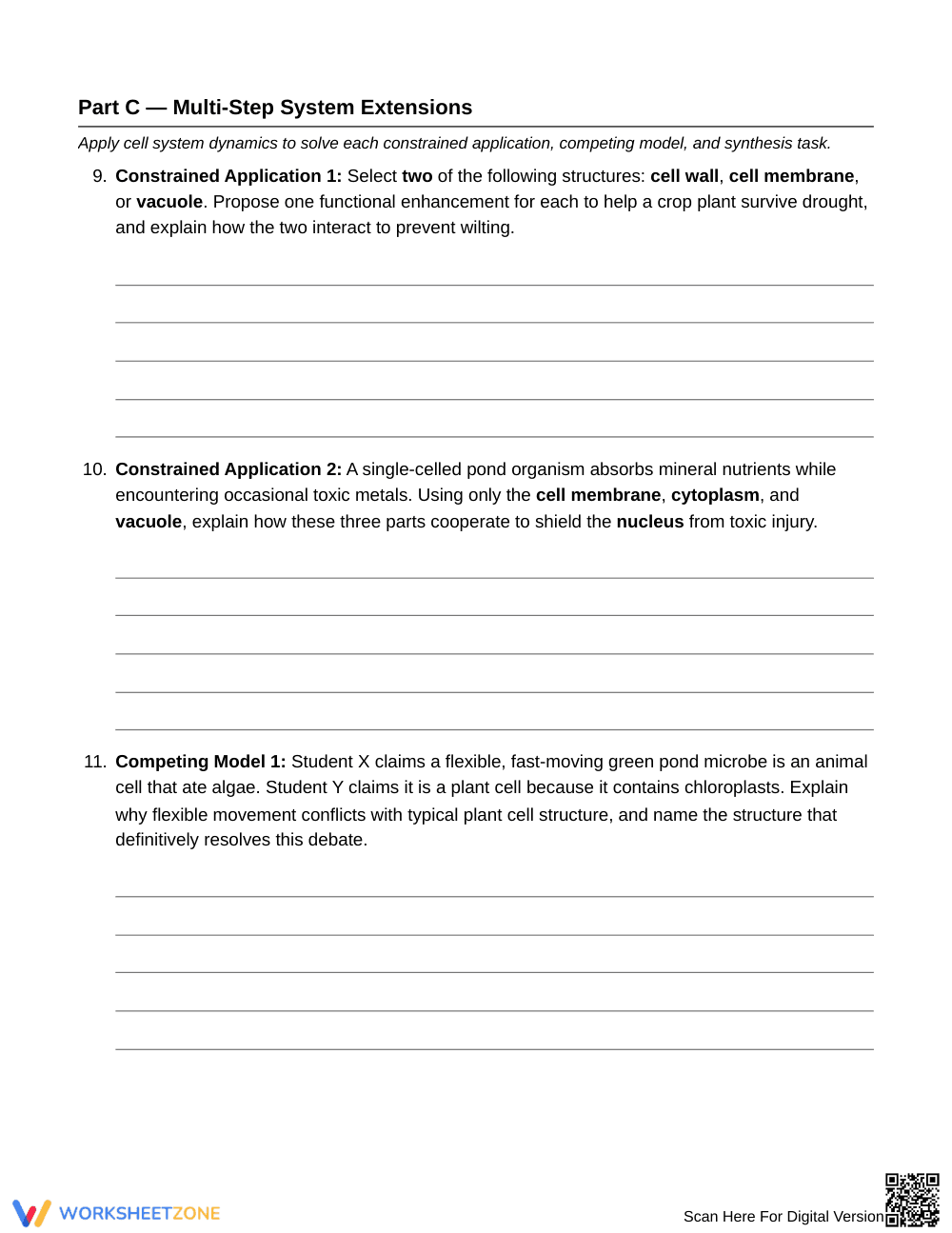
- Independent practice (Items 9–14): High-demand synthesis tasks require students to evaluate competing scientific claims and trace system-wide organelle failure pathways.
This structure follows an explicit gradual-release framework to move learners from foundational structure recall to robust systems thinking.
Standards Alignment
This resource aligns with middle school life science standards focusing on cellular structure and function. Students develop conceptual models demonstrating how specialized parts of cells work together to carry out essential life functions. The problem sets specifically emphasize system-level interactions over isolated organelle memorization. These concepts can be copied directly into lesson plans, IEP goals, or district curriculum mapping tools.
How to Use It
Deploy this worksheet after direct instruction on plant and animal organelle functions. For mid-unit formative assessment, have students complete Part B in collaborative pairs to observe how accurately they link vacuole turgor pressure to tissue structure. Alternatively, assign Part C as an independent evaluative check during review cycles. Expect full completion to take 40 to 50 minutes.
Who It's For
This resource supports Grade 6 life science students developing systems-thinking skills. It includes structured prompts within questions to assist diverse learners and striving readers. Pair this activity with a plant cell microscopy lab or an interactive cell membrane transport simulation.
Middle school science instruction requires students to move beyond rote organelle memorization toward understanding cellular organization as an interdependent system. According to Fisher & Frey (2014), gradual-release instructional designs that scaffold from guided structural identification to independent multi-variable analysis significantly strengthen conceptual retention in middle school science. This 5-page Grade 6 worksheet provides 14 rigorous, structured problems that prompt students to evaluate organelle interactions, interpret experimental tissue data, and defend biological claims about cellular homeostasis. By analyzing how the nucleus, vacuole, cytoplasm, and cell membrane cooperate, learners master the analytical reasoning needed for complex life science coursework. Educational teams can deploy this comprehensive print resource for independent practice, small-group intervention, or formative evaluation with complete instructional confidence.


