































Complete Cell Misconception Worksheet | Grade 7-12 Science

Paste this activity's link or code into your existing LMS (Google Classroom, Canvas, Teams, Schoology, Moodle, etc.).
Students can open and work on the activity right away, with no student login required.
You'll still be able to track student progress and results from your teacher account.
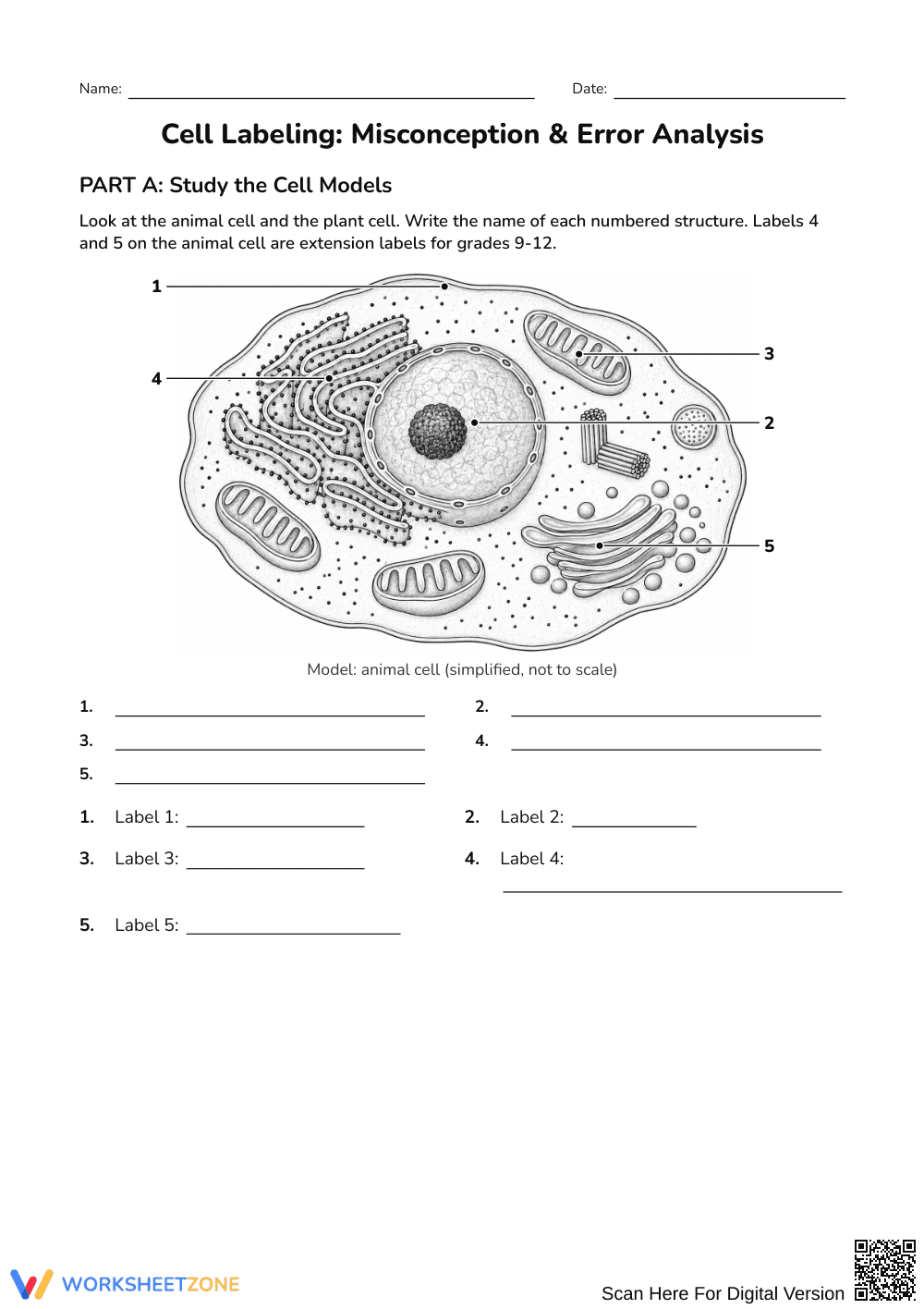
This cell labeling and error analysis worksheet strengthens students' conceptual understanding of organelle structure and function across animal and plant cells. Students identify structural components, evaluate flawed scientific arguments, and apply evidence-based reasoning to classify unknown specimens. Through active critique, learners replace persistent misconceptions with accurate biological principles.
At a Glance
- Grade: 7–12 · Subject: Science
- Standard: Cell Structure — Analyze cell models and evaluate scientific arguments using evidence
- Skill Focus: Identifying and correcting organelle misconceptions
- Format: 4 pages · 28 problems · Answer key included · PDF
- Best For: Formative assessment and misconception review
- Time: 45–60 minutes
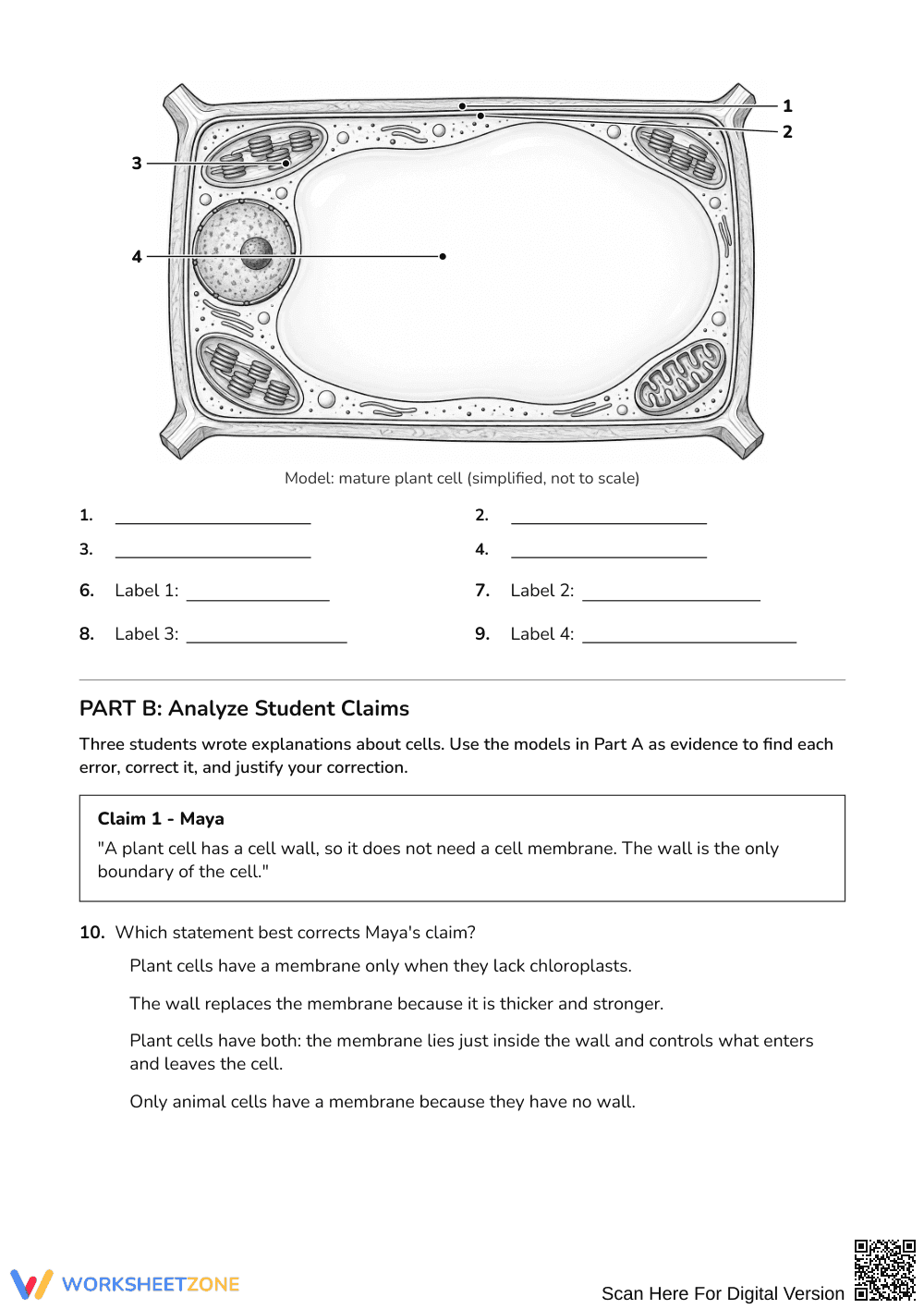
What's Inside: The 4-page student activity features detailed diagrams of animal and plant cross-sections, structured claims analysis, and an unknown-cell data matrix. Students complete diagram labeling, multiple-choice error identification, and short-answer written justifications. The included 4-page answer key provides complete model responses and thorough scientific explanations for teacher reference or self-checking.
Skill Progression
- Guided Practice (Part A): Students examine foundational animal and plant cell diagrams to label key organelles, including extension structures like the rough endoplasmic reticulum and Golgi apparatus.
- Supported Practice (Part B): Learners critique authentic student misconceptions regarding the cell membrane, chloroplasts versus mitochondria, and organelle continuity using model evidence.
- Independent Practice (Part C): Students analyze a comparative data matrix of unknown cell specimens to deduce classification and justify specialized tissue types without direct scaffolding.
This structured gradual-release sequence moves learners deliberately from visual identification to complex analytical critique and independent deduction.
Standards Alignment
This resource aligns with secondary life science standards emphasizing that cells possess specialized structures responsible for distinct functional capabilities. Students model cell anatomy and construct scientific explanations showing how organelles work together to maintain living systems. Curricular alignment details can be copied directly into lesson plans, IEP goals, or district curriculum mapping tools.
How to Use It
Deploy this worksheet after direct instruction on cell organelles as a mid-unit formative check. Have students work in pairs on Part B to debate student claims before writing individual justifications. During work time, monitor whether students recognize that plant cells contain both chloroplasts and mitochondria, as this is a frequent stumbling block. Expect 45 to 60 minutes for full completion.
Who It's For
Designed for middle and high school life science and biology classrooms, this resource supports diverse academic needs. Labels 4 and 5 offer built-in extension for advanced high school learners, while the structured table in Part C scaffolds data interpretation for struggling readers. Pair this activity with an interactive microscope lab or organelle graphic organizer for optimal concept reinforcement.
Secondary science students frequently hold persistent misconceptions about plant cell respiration and boundary functions, often assuming plants lack membranes or mitochondria. Research from Fisher & Frey (2014) demonstrates that structured error analysis and evidence-based argumentation significantly outperform passive diagram memorization in promoting durable conceptual change. When students must identify, critique, and correct peer misconceptions using visual models, they activate higher-order metacognitive processing and build precise domain vocabulary. This 4-page resource targets 28 focused tasks designed to dismantle common organelle misconceptions through structured claim evaluation. By requiring students to justify their scientific reasoning with diagrammatic evidence, the activity transforms routine cell labeling into an analytical inquiry task. The structured progression ensures students not only recall organelle names but understand how distinct cell components cooperate to support cellular life across diverse living organisms.


